
In industrial engineering, the component that appears to have failed is not always the component that actually caused the failure.
A broken thread.
A cracked housing.
A damaged seal.
A bent rod.
These are often the most visible consequences of a problem, but not necessarily its origin.
One of the most important tasks of an engineering department is therefore not simply to identify what broke, but to reconstruct the sequence of events that led to the failure.
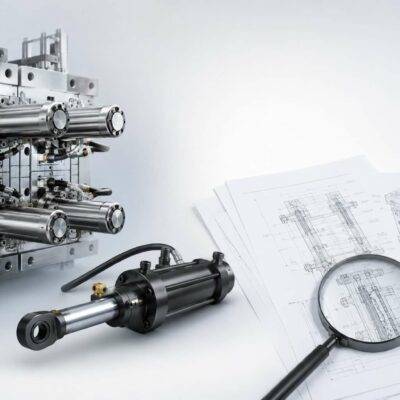
Recently, Vega Technical Dep. was asked to investigate a hydraulic cylinder problem occurring during the first trial of an injection mold manufactured for a European customer.
At first sight, the diagnosis appeared straightforward.
The rear threaded cartridge of a compact hydraulic cylinder had been severely damaged.
The thread was completely stripped.
The cylinder body could no longer be repaired and required replacement.
However, as often happens in engineering, the visible damage turned out to be only the final chapter of a much longer story.
The Initial Problem
The customer reported an oil leakage occurring during the first mold trial.
The leakage appeared to originate from the rear closure area of a compact hydraulic cylinder integrated into the mold.
Since the mold trial was already underway and production timing was critical, the maintenance personnel attempted to eliminate the leak by further tightening the threaded component responsible for sealing the cylinder assembly.
The intervention initially appeared reasonable.
After all, tightening a threaded hydraulic connection is often the first reaction when a leak occurs.
Unfortunately, the applied torque exceeded the mechanical limits of the threaded connection.
The result was catastrophic damage to the thread of the cylinder body.
At this point, the obvious conclusion would have been simple:
The thread failed.
But engineering investigations should never stop at the obvious.
Looking Beyond the Visible Damage
The first question investigated by Vega Technical Dep. was not:
“Who damaged the thread?”
The real question was:
“Why was additional tightening applied in the first place?”
Reconstructing the sequence of events revealed an important detail.
Due to temporary unavailability of magnetic sensors, the cylinders had been supplied in a partially assembled condition.
As a consequence, the standard final hydraulic validation procedure had not been completed before shipment.
This detail fundamentally changed the investigation.
The damaged thread could no longer be considered automatically as the primary failure.
Instead, the entire event sequence had to be reconstructed.
Root Cause Analysis Versus Failure Observation
One of the most common mistakes in industrial troubleshooting is to confuse the final visible failure with the original cause.
Engineering failure analysis distinguishes between:
- Primary Failure
- Secondary Failure
- Failure Propagation
- Visible Consequences
In this case, the most probable sequence was reconstructed as follows:
- A minor hydraulic leakage occurred during the first mold trial.
- The leakage generated concern during mold commissioning.
- Additional tightening torque was applied.
- The applied torque exceeded the allowable thread load.
- Plastic deformation of the thread occurred.
- The thread completely failed.
The damaged thread was therefore not necessarily the original problem.
It was the consequence of an attempt to solve the original problem.
Why Small Hydraulic Leaks Should Never Be Underestimated
Hydraulic systems behave differently from what many operators intuitively expect.
According to fundamental hydraulic principles, pressure acts uniformly in all directions, while even apparently incompressible hydraulic oil exhibits measurable elastic behavior due to both fluid compressibility and dissolved air content.
In mold applications, several factors may contribute to minor oil leakage:
- microscopic contamination particles;
- incomplete venting of the hydraulic circuit;
- trapped air inside the cylinder;
- pressure spikes generated by machine operation;
- thermal expansion;
- elastic deformation of seals and metal components.
The presence of dissolved air is particularly important.
Hydraulic oil can compress approximately 1% every 160 bar due to fluid elasticity and dissolved gases.
Consequently, a small leakage observed during initial operation does not necessarily indicate a catastrophic sealing failure.
However, if an operator attempts to eliminate the leakage through excessive tightening, a secondary mechanical failure may develop.
Thread Failure Mechanics
Threaded connections operate within precise mechanical limits.
Initially, the thread works in the elastic deformation range.
Within this region, the connection returns to its original condition after the applied load is removed.
Once the yield point of the material is exceeded, plastic deformation begins.
At this stage:
- thread flanks deform permanently;
- load distribution becomes uneven;
- local stresses increase dramatically;
- failure propagation accelerates rapidly.
The operator often experiences this process as a sudden failure.
In reality, the damage develops progressively until the remaining load-bearing capacity collapses.
This explains why thread failures often appear abrupt while actually resulting from a sequence of cumulative events.
Why Sequence Reconstruction Matters
Modern injection mold engineering requires multidisciplinary analysis.
Successful troubleshooting involves not only hydraulics, but also:
- mechanics;
- material science;
- assembly procedures;
- operator interaction;
- mold validation processes;
- reliability engineering.
Injection mold standards and validation procedures emphasize the importance of complete functional testing before production approval because early-stage failures frequently reveal interactions that are impossible to predict through calculations alone.
For this reason, engineering investigations should always answer four questions:
- What happened first?
- What happened next?
- Which event triggered the others?
- Which failure was the consequence rather than the cause?
Only after reconstructing the complete sequence can the actual root cause be identified.
The Engineering Decision
After reviewing all available evidence, Vega Technical Dep. concluded that assigning complete responsibility to either party would not accurately reflect the technical reality.
The damaged thread was clearly caused by excessive tightening torque.
However, the excessive tightening would never have occurred without the original hydraulic leakage.
Instead of focusing on contractual responsibility, Vega adopted an engineering-based approach aimed at preserving long-term reliability and customer confidence.
A replacement cylinder body was therefore supplied, while the technical investigation focused on understanding the complete failure sequence rather than simply identifying who made the final mistake.
Engineering Is About Understanding, Not Blaming
One of the most valuable lessons from this case is that technical support should never focus exclusively on assigning responsibility.
Its primary objective should be understanding.
In industrial systems:
- visible failures are often secondary failures;
- small problems can create large consequences;
- human intervention can amplify minor defects;
- root cause analysis requires reconstruction rather than assumption.
This approach not only solves technical problems.
It builds trust.
Lessons Learned
1. The visible failure is not always the original failure
The most dramatic damage often represents the final consequence of an earlier event.
2. Hydraulic systems can generate misleading symptoms
Small leaks do not always indicate severe failures.
3. Human intervention is part of the engineering system
Operators’ actions must always be considered during failure analysis.
4. Root cause analysis requires reconstructing events
Engineering investigations should focus on sequence rather than appearance.
5. Technical support creates value through understanding
The objective is not to identify who was wrong.
The objective is to understand what really happened.
Conclusion
At first glance, this appeared to be a simple case of thread damage.
A deeper engineering investigation revealed something far more interesting.
The damaged thread was not the beginning of the problem.
It was the end of a chain of events that started with a minor hydraulic leakage and evolved through a sequence of perfectly understandable decisions.
By separating the visible failure from the root cause, Vega Technical Dep. was able to provide not only a technical solution, but also a valuable engineering lesson.
Because in engineering, the most important question is rarely:
“What broke?”
The most important question is:
“What happened before it broke?”