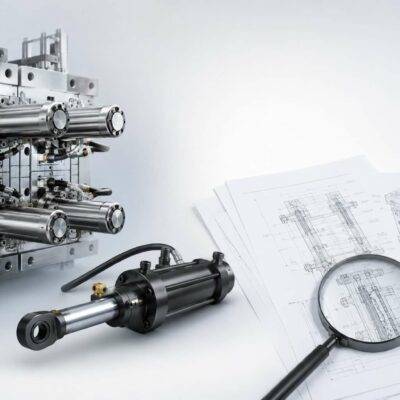

Why Increasing Hydraulic Pressure Does Not Always Solve Hydraulic Cylinder Problems
In hydraulic systems for injection molds, increasing the operating pressure is often seen as the quickest way to solve a performance problem.
If a hydraulic cylinder appears unable to generate sufficient force, the first reaction is frequently:
“Let’s increase the pressure.”
From a purely theoretical perspective, this seems reasonable.
Higher pressure generates higher force.
However, experienced mold engineers know that this approach can easily create new problems that are far more serious than the original one.
A real engineering case handled by the Vega Technical Department demonstrates why increasing hydraulic pressure should never be considered the first solution.
Instead, every application must be evaluated as a complete mechanical system before modifying the cylinder’s operating conditions.
The Customer’s Request
The customer contacted Vega after experiencing problems with a hydraulic cylinder equipped with an integrated oil supply.
The initial request appeared straightforward.
The customer wanted to operate the cylinder at a significantly higher pressure than the standard version.
The assumption was simple:
if the cylinder could withstand a higher pressure, the application would become more reliable.
Rather than immediately approving the modification, the Vega Technical Department started a complete engineering analysis of the application.
This is an important difference between troubleshooting and engineering.
Troubleshooting often focuses on the visible symptom.
Engineering investigates the entire system before proposing a solution.
Is Higher Pressure Really Necessary?
The first question raised by the Vega Technical Department was not:
“Can the cylinder withstand higher pressure?”
Instead, the engineers asked:
- Is the hydraulic cylinder correctly sized?
- Is the application compatible with this cylinder series?
- Is the load distributed correctly?
- Is the cylinder completing its full stroke?
- Are there external forces acting on the cylinder?
- Is the sealing system operating within its design limits?
Only after answering these questions can pressure be considered as part of the solution.
Increasing pressure without understanding the mechanical conditions may simply transfer the problem to another component.
Every Hydraulic Cylinder Has Design Limits
Hydraulic cylinders are not limited only by their piston diameter or generated force.
Every component has its own design limitations:
- piston;
- rod;
- seals;
- guide bushings;
- threaded joints;
- oil ports;
- integrated O-ring manifolds.
One of the most critical aspects is the hydraulic oil supply system.
In cylinders using integrated manifold connections with O-rings, sealing performance depends on both pressure and groove geometry.
The V250CE technical catalogue clearly specifies that integrated O-ring oil supply connections have lower maximum pressure ratings than threaded oil ports. Exceeding these limits may cause oil leakage from the manifold O-rings.
This warning is extremely important.
Many engineers assume that because the cylinder body can withstand high pressure, every sealing interface can do the same.
This is not always true.
Selecting the Correct Cylinder Is More Important Than Increasing Pressure
Another important observation emerged during the analysis.
The application involved a V250CE hydraulic cylinder.
The technical catalogue explicitly states that this cylinder series is not recommended for ejector plate movements or heavy-duty applications.
This statement is often overlooked.
When a hydraulic cylinder operates outside its intended application, increasing pressure rarely improves reliability.
Instead, it increases the mechanical loads acting on seals, fastening screws, guide surfaces and oil supply interfaces.
For this reason, selecting the correct cylinder series is generally far more important than increasing the operating pressure.
Pressure Is Only One Part of the Engineering Equation
Hydraulic force is proportional to pressure, but pressure is only one variable in the overall design.
Engineers must also consider:
- contact stresses;
- seal extrusion risk;
- structural rigidity;
- support conditions;
- alignment;
- fatigue resistance;
- long-term reliability.
Ignoring these factors often results in recurring failures despite using stronger hydraulic components.
The Vega Technical Department therefore evaluated not only the pressure requirements but also the complete mechanical behaviour of the hydraulic cylinder within the mold.
Engineering Before Modification
One of the most valuable lessons from this case is the engineering methodology itself.
Instead of immediately redesigning the cylinder for higher pressure, the Vega Technical Department first verified whether the existing design was being used within its intended operating conditions.
Only after analysing:
- cylinder application;
- sealing configuration;
- pressure limits;
- mechanical loading;
- oil supply design;
did the engineering team begin evaluating a possible redesign.
This systematic approach prevents unnecessary modifications and ensures that any special solution addresses the actual root cause rather than simply increasing the pressure rating.
Engineering a Hydraulic Cylinder for Higher Pressure
In Part 1, we saw that increasing hydraulic pressure should never be the starting point when solving a hydraulic cylinder problem.
The Vega Technical Department first analysed the complete application, verifying whether the cylinder was operating within its intended design limits.
Only after completing this engineering evaluation did the team consider whether the hydraulic cylinder itself should be modified.
This approach is essential because pressure alone is rarely the real cause of a failure.
The Weak Point Was Not the Cylinder Body
One of the most important conclusions reached during the investigation was that the cylinder body itself was not the limiting factor.
Instead, attention focused on the integrated hydraulic oil supply sealing system.
The customer had experienced damage to the O-ring responsible for sealing the integrated oil passage.
Rather than simply recommending stronger O-rings, the Vega Technical Department investigated whether the sealing geometry itself could be improved.
This distinction is extremely important.
Seal performance depends not only on the elastomer material but also on the geometry surrounding the seal.
O-Ring Groove Geometry Determines Pressure Capability
Many engineers assume that increasing pressure simply requires a stronger O-ring.
In reality, the groove supporting the O-ring often determines the maximum pressure the sealing system can safely withstand.
If the groove is not properly designed:
- the O-ring may deform excessively;
- elastomer extrusion may occur;
- sealing pressure becomes uneven;
- the seal can be permanently damaged.
For this reason, the Vega Technical Department evaluated the possibility of redesigning the sealing groove rather than merely changing the sealing material.
A Special High-Pressure Design
Following its analysis, the Vega Technical Department proposed developing a special version of the integrated oil supply connection.
The objective was to redesign the O-ring housing so that the sealing system could safely operate at approximately 220–230 bar, significantly above the standard pressure capability.
The proposal did not rely on exotic sealing materials.
Instead, the improvement was achieved primarily through engineering the sealing geometry.
This perfectly illustrates an important engineering principle:
Better design is often more effective than simply using stronger components.
Higher Pressure Requires a Complete Engineering Review
Whenever operating pressure increases, engineers should evaluate the entire hydraulic system.
Among the aspects requiring verification are:
- seal groove geometry;
- O-ring support conditions;
- oil supply interfaces;
- cylinder fastening;
- body stiffness;
- pressure distribution;
- long-term fatigue behaviour.
Ignoring any of these factors may simply transfer the failure from one component to another.
This is why increasing pressure should always be considered an engineering project rather than a simple specification change.
Respecting the Intended Application
The investigation also reinforced another important recommendation found in the V250CE Technical Catalogue.
The catalogue clearly specifies that V250CE cylinders are not intended for ejector plate movement or other heavy-duty applications.
Likewise, it specifies that the maximum allowable pressure for integrated O-ring oil supply connections is lower than that of conventional threaded hydraulic ports, and exceeding those limits may cause oil leakage through the manifold seals.
These recommendations are not conservative limitations.
They are engineering design criteria established to ensure long-term reliability.
Whenever an application requires operating conditions beyond the catalogue specifications, the correct approach is not simply to increase pressure but to evaluate whether a dedicated cylinder design is required.
Engineering Solutions Instead of Temporary Fixes
One of the most valuable lessons from this case is the engineering philosophy adopted by the Vega Technical Department.
Rather than modifying only the pressure rating, the engineers analysed:
- the hydraulic application;
- the sealing system;
- the oil supply configuration;
- the cylinder series;
- the operating conditions.
Only after understanding all these factors did they propose developing a special high-pressure version.
This systematic methodology minimizes technical risks while providing a solution specifically designed for the customer’s application.
Conclusion
This engineering case demonstrates that increasing hydraulic pressure is not always the correct solution when hydraulic cylinder problems occur.
The investigation carried out by the Vega Technical Department showed that the real limitation was not the cylinder body itself, but the design of the integrated oil supply sealing system. By redesigning the O-ring groove geometry, the engineering team proposed a special solution capable of operating at approximately 220–230 bar, while addressing the actual cause of the sealing problem rather than simply increasing pressure.
At the same time, the case reinforces another essential engineering principle: every hydraulic cylinder has been designed for a specific application. Using a cylinder outside its intended operating conditions—or exceeding the pressure limits specified for its sealing interfaces—can significantly reduce reliability.
Ultimately, this case demonstrates that successful hydraulic engineering is achieved by optimising the entire system—not simply by increasing operating pressure.
Related Articles (Verified on icvega.com)
These official Vega articles complement the engineering concepts discussed in this case:
- How to Find the Right Vega Cylinder or Accessory – Explains how to select the correct cylinder series according to the application, helping engineers avoid using a cylinder outside its intended operating conditions.
- Shopping for Cylinders – Presents the V250CE, V450CM and V500CZ product families and highlights the importance of configuring cylinders according to the application rather than selecting them only by size or pressure.
- Block Cylinders Compatibility – Discusses different block cylinder designs and explains how application requirements influence cylinder selection and interchangeability.
- Alternative Classic – Describes engineering improvements developed for demanding applications, including cooling systems and special sealing solutions for severe operating conditions.