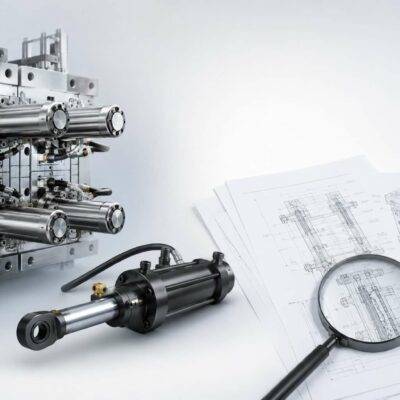

Hydraulic cylinder maintenance is often considered a routine operation.
Technicians inspect seals, replace worn components and tighten tie rods or cylinder head screws before returning the cylinder to service.
Because tightening bolts is a common mechanical operation, many maintenance teams rely on generic torque tables based solely on screw diameter and strength class.
Although this approach may appear reasonable, it can cause serious damage when applied to hydraulic cylinders.
A real engineering case handled by the Vega Technical Department demonstrates why tightening torque values for hydraulic cylinders should never be taken from generic bolt tables.
Instead, every hydraulic cylinder should always be assembled according to the manufacturer’s dedicated technical specifications.
The Customer’s Maintenance Problem
After performing maintenance on a Vega hydraulic cylinder, the customer reported damage to one of the tie rods.
At first glance, the failure appeared unexpected.
The maintenance procedure itself had been performed correctly.
The mistake was hidden elsewhere.
During assembly, the customer had tightened the tie rods using a generic tightening torque table normally applied to standard screws.
Only later did the customer realise that the values used were incorrect for that hydraulic cylinder.
After reviewing the documentation provided by the Vega Technical Department, the customer acknowledged that the wrong torque table had been used during maintenance.
Hydraulic Cylinder Tie Rods Are Not Standard Bolts
One of the most common misconceptions in industrial maintenance is assuming that every threaded fastener can be tightened according to standard engineering tables.
This assumption is incorrect for hydraulic cylinders.
Although tie rods may appear similar to conventional bolts, they are designed as structural components of the hydraulic cylinder.
Their function extends far beyond simply clamping two mechanical parts together.
Tie rods must:
- maintain the correct preload between cylinder components;
- withstand alternating hydraulic loads;
- preserve sealing integrity;
- ensure precise alignment between the cylinder body and end caps.
For these reasons, the tightening torque is determined by the complete hydraulic cylinder design rather than by thread diameter alone.
Every Hydraulic Cylinder Has Its Own Torque Specification
The technical procedure issued by Vega clearly defines dedicated tightening torque values for the V215R cylinder series.
Instead of referring to generic engineering tables, the document specifies individual tightening torques according to cylinder diameter.
The procedure also explains that the tie rods must always be tightened following a cross-pattern sequence (1–3–2–4) to ensure uniform preload across the cylinder assembly.
This requirement is not simply a recommendation.
It is part of the cylinder’s engineering design.
Why Cross Tightening Matters
Many maintenance technicians focus primarily on achieving the correct final torque.
Equally important, however, is the tightening sequence.
If one tie rod is fully tightened before the others, uneven stresses may develop inside the hydraulic cylinder.
These stresses can result in:
- uneven gasket compression;
- distortion of the end cap;
- incorrect alignment of internal components;
- non-uniform preload between tie rods.
For this reason, the Vega Technical Department specifies a cross-tightening sequence to distribute the clamping force progressively and uniformly throughout the assembly.
More Torque Does Not Mean Better Reliability
Another common misconception is that tightening beyond the specified value provides additional safety.
In reality, excessive tightening can be just as harmful as insufficient tightening.
Applying excessive torque may produce:
- permanent deformation of threaded components;
- excessive preload;
- damage to tie rods;
- reduced fatigue life;
- premature mechanical failure.
Conversely, insufficient tightening may allow:
- movement between components;
- preload loss;
- oil leakage;
- progressive loosening during operation.
The correct tightening torque therefore represents an engineering balance established during the hydraulic cylinder design process.
Large Hydraulic Cylinders Require Special Procedures
The Vega technical procedure also highlights another important practical aspect.
For tightening torques above 330 Nm, a conventional torque wrench is no longer sufficient.
The document recommends applying higher torques using the lever-and-weight method, providing an example that illustrates how the required force changes according to the operator’s weight and lever length.
This demonstrates that proper hydraulic cylinder maintenance is not simply a matter of selecting a larger tool.
It requires following precise engineering procedures developed specifically for that cylinder family.
Maintenance Procedures Are Part of the Product Design
One of the most valuable lessons from this case is that maintenance instructions should never be considered secondary documentation.
They are an integral part of the hydraulic cylinder design.
The Vega Technical Department did not simply provide tightening values.
It supplied:
- dedicated torque specifications;
- tightening sequence;
- assembly recommendations;
- procedures for high tightening torques.
Each instruction contributes directly to the long-term reliability of the hydraulic cylinder.
Ignoring even one of these recommendations may significantly reduce service life.
Engineering Before Assumptions
This case perfectly illustrates the engineering philosophy adopted by the Vega Technical Department.
Instead of assuming that standard maintenance practices were sufficient, the engineers identified the real cause of the failure.
The damaged tie rod was not the result of defective manufacturing.
It was the consequence of applying tightening values intended for standard screws rather than for a hydraulic cylinder specifically engineered with its own tightening specifications.
This distinction is fundamental.
Good maintenance is not based on general rules.
It is based on following the engineering specifications defined for each individual product.
Conclusion
This real engineering case demonstrates why generic tightening torque tables should never be used for hydraulic cylinders.
The investigation carried out by the Vega Technical Department showed that using torque values intended for standard screws led to damage during maintenance because the hydraulic cylinder required dedicated tightening specifications. After reviewing the correct documentation, the customer recognised that the wrong torque table had been used.
The Vega technical procedure further reinforces that reliable assembly depends not only on the correct tightening torque, but also on the specified cross-tightening sequence and, for higher torque values, the appropriate tightening method.
Ultimately, this case reinforces one of the most important principles of hydraulic engineering:
Hydraulic cylinders are engineered systems. Their maintenance procedures—including tightening torque values—are part of the design itself and should always follow the manufacturer’s technical specifications rather than generic engineering tables.
Related Articles (Verified on icvega.com)
- Hydraulic Cylinder Maintenance
https://www.icvega.com/maintenance/hydraulic-cylinder-maintenance - How to Find the Right Vega Cylinder or Accessory
https://www.icvega.com/choosing/find-right-vega-cylinder-accessory