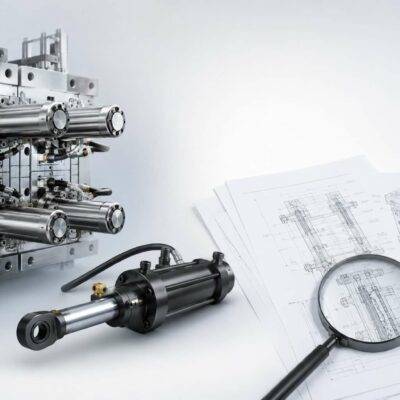

Why Changing the Stroke Is More Than a Simple Machining Operation
Hydraulic cylinders used in injection molds are often designed with highly specific stroke lengths.
Even a difference of 1 mm can determine whether a slide reaches its correct position, whether a locking mechanism operates safely or whether the mold functions as intended.
For this reason, mold designers occasionally face an important question.
Can an existing hydraulic cylinder simply be modified to achieve a different stroke, or should it be returned to the manufacturer?
At first glance, shortening or extending the stroke by only one millimeter may appear to be a straightforward machining operation.
However, a real engineering case handled by the Vega Technical Department demonstrates that changing the stroke of a hydraulic cylinder involves much more than removing material from a mechanical component.
It requires careful consideration of tolerances, sealing systems, assembly procedures and product reliability.
The Customer’s Request
The case began when Norm Galbraith from ALBA Enterprises contacted the Vega Technical Department regarding a customer using a CM036MB030 locking hydraulic cylinder.
The cylinder had originally been manufactured with a stroke reducer, reducing the standard stroke from 35 mm to 30 mm.
During installation, however, the customer realized that the application actually required a 31 mm stroke instead of 30 mm.
Norm therefore asked two practical engineering questions.
Would it be possible for the customer to open the cylinder and machine 1 mm from the existing stroke reducer?
Alternatively, could Vega supply a new rod and piston assembly configured for a 31 mm stroke, allowing the customer to replace the existing internal components?
Although the requested modification appeared minimal, the engineering implications were far from insignificant.
Why a One-Millimeter Difference Matters
To someone unfamiliar with hydraulic cylinder design, a one-millimeter stroke variation may appear almost negligible.
Inside a mold, however, that single millimeter can determine:
- whether a slide reaches its mechanical stop;
- whether a locking wedge engages correctly;
- whether sensors detect the correct position;
- whether moving components interfere with each other;
- whether the molded part is released safely.
Modern injection molds frequently operate with tolerances measured in tenths or even hundredths of a millimeter.
Consequently, apparently minor dimensional changes can have a significant influence on mold performance.
The First Engineering Concern: Product Reliability
Stefano Rogora did not immediately answer the machining question.
Instead, he first considered the consequences of modifying the hydraulic cylinder outside Vega’s manufacturing facility.
His recommendation was clear.
He preferred that the customer should not open or modify the cylinder, because any problems arising after the modification would no longer be covered by Vega’s product warranty.
This response highlights an important engineering principle.
Hydraulic cylinders are precision assemblies.
Changing a single component may influence the behaviour of the complete system.
Why Hydraulic Cylinders Should Not Be Considered Simple Mechanical Parts
A hydraulic cylinder contains much more than a piston moving inside a bore.
Its performance depends on the interaction between:
- piston geometry;
- rod dimensions;
- sealing system;
- guide components;
- internal clearances;
- assembly tolerances.
Any modification affecting one of these elements may influence:
- sealing performance;
- operating friction;
- stroke accuracy;
- service life;
- overall reliability.
For this reason, professional manufacturers generally discourage field modifications unless they can be carefully controlled.
Vega Offered an Engineering Solution
Rather than simply refusing the customer’s request, Stefano proposed two alternative solutions.
Depending on the customer’s preference, Vega could supply:
- a complete rod-piston assembly with seals, already configured for a 31 mm stroke;
- or only the 31 mm stroke reducer piston, allowing the customer to replace the necessary internal components.
This approach allowed the customer to obtain the required stroke while maintaining components manufactured according to Vega’s engineering specifications.
Instead of modifying existing parts, the customer could install components specifically designed for the application.
Engineering Is Also About Supporting Production
The most interesting part of Stefano Rogora’s response comes at the end of the email.
Although Vega preferred not to recommend customer modifications, Stefano also understood the realities of industrial production.
If the customer could not wait for replacement parts, he acknowledged that the existing piston could be modified, provided that the customer exercised extreme care during reassembly, because improper assembly could prevent the cylinder from operating correctly.
This demonstrates an engineering philosophy based on practicality rather than rigid rules.
Whenever possible, the manufacturer should protect product quality.
At the same time, production requirements sometimes require carefully managed compromises.
Balancing Warranty and Flexibility
This case illustrates an issue faced by many maintenance departments.
Returning a hydraulic cylinder to the manufacturer guarantees that the modification will be performed according to original specifications.
However, production schedules do not always allow sufficient time.
Field modifications may reduce downtime, but they also transfer responsibility for assembly quality and long-term reliability to the customer.
Finding the right balance between these two priorities is often one of the most challenging aspects of industrial service engineering.
Looking Beyond the Machining Operation
At first sight, this case appears to concern nothing more than machining 1 mm from a stroke reducer.
In reality, it highlights a much broader engineering question.
When should a hydraulic cylinder be modified?
Who should perform the modification?
How should product reliability be protected?
The answers involve engineering, manufacturing, quality assurance and customer support—not simply machining.
Why Proper Assembly Is Just as Important as the New Components
In Part 1, we examined a real engineering case involving a CM036MB030 locking hydraulic cylinder that required a stroke modification from 30 mm to 31 mm.
At first glance, removing 1 mm from the stroke reducer appeared to be a simple machining operation.
However, the response from the Vega Technical Department revealed that the real engineering challenge was not machining the component—it was ensuring that the hydraulic cylinder would continue to operate correctly after reassembly.
A Hydraulic Cylinder Is a Precision Assembly
One of the most common misconceptions is that a hydraulic cylinder is simply a piston moving inside a steel body.
In reality, every cylinder is a precision assembly composed of carefully matched components.
These include:
- the piston;
- the piston rod;
- guide elements;
- sealing systems;
- retaining components;
- internal mechanical stops.
Each part is designed to work within precise dimensional tolerances.
Changing a single component without considering the complete assembly may affect the overall performance of the cylinder.
This is why professional manufacturers generally prefer to perform modifications under controlled factory conditions.
Vega’s Preferred Solution
Rather than recommending that the customer modify the existing cylinder, Stefano Rogora proposed a safer engineering approach.
Vega could supply either:
- a complete rod and piston assembly with seals, already manufactured for a 31 mm stroke;
- or a 31 mm stroke reducer piston, allowing only the necessary internal component to be replaced.
This solution minimizes the risk associated with machining existing components while ensuring that the replacement parts conform to the original engineering specifications.
Instead of adapting the product, the customer receives components already designed for the required stroke.
Why Warranty Matters
One of the key points emphasized in Stefano Rogora’s reply concerns product warranty.
He clearly explains that Vega prefers the customer not to open or modify the cylinder, because any problems occurring after an unauthorized modification would no longer be covered by the manufacturer’s warranty.
This is not simply a legal consideration.
It reflects an engineering reality.
Once a hydraulic cylinder has been disassembled outside the manufacturer’s controlled environment, it is no longer possible to verify:
- assembly quality;
- seal positioning;
- tightening procedures;
- cleanliness during assembly;
- dimensional accuracy.
Even a perfectly machined component may fail if reassembled incorrectly.
Production Cannot Always Wait
Stefano Rogora also demonstrated a practical understanding of the customer’s production constraints.
He acknowledged that shipping the cylinder back to Vega and waiting for the modification could be expensive or incompatible with production deadlines.
For this reason, he introduced an important degree of flexibility.
If the customer did not have time to wait for the replacement parts, the existing piston could be modified, provided that the customer paid particular attention during the assembly process, because incorrect assembly could prevent the cylinder from operating correctly.
This balanced approach reflects real industrial engineering.
The objective is always to preserve product quality while helping customers minimize production downtime.
Assembly Is More Critical Than Machining
Interestingly, Stefano’s greatest concern was not the machining operation itself.
His warning focused on the assembly phase.
This is a valuable lesson for maintenance engineers.
A modification performed with excellent machining accuracy may still fail if:
- seals are installed incorrectly;
- components are assembled in the wrong sequence;
- contamination enters the cylinder;
- tightening procedures are not respected;
- internal parts become damaged during assembly.
For precision hydraulic cylinders, assembly quality often determines long-term reliability more than the machining operation itself.
Engineering Means Evaluating Risk
This case illustrates another important engineering principle.
Every modification should be evaluated by balancing:
- technical feasibility;
- production urgency;
- cost;
- product reliability;
- long-term maintenance.
Sometimes returning the cylinder to the manufacturer is the safest solution.
In other situations, carefully managed field modifications may represent the most practical alternative.
Engineering consists of selecting the option that offers the best overall balance rather than simply choosing the fastest solution.
Service Engineering Is More Than Selling Spare Parts
One of the most interesting aspects of this case is the role played by the Vega Technical Department.
Instead of merely supplying replacement components, Stefano Rogora evaluated:
- the customer’s technical request;
- warranty implications;
- production timing;
- available spare parts;
- practical alternatives.
This demonstrates that technical support is not limited to selling components.
It involves helping customers make informed engineering decisions based on their operational priorities.
Conclusion
This real engineering case demonstrates that changing the stroke of a hydraulic cylinder is far more complex than machining a single component.
Although the requested modification involved only 1 mm, the Vega Technical Department evaluated the request from multiple perspectives, including reliability, warranty, assembly quality and production requirements.
By proposing factory-manufactured replacement components while also acknowledging the customer’s production constraints, Vega provided a balanced engineering solution that protected both product quality and operational continuity.
Ultimately, this case highlights an important lesson for every mold designer and maintenance engineer:
The success of a hydraulic cylinder modification depends not only on the new component, but also on the quality of the engineering decisions made before the modification begins.
Related Articles
- https://www.icvega.com/support/can-you-repair-a-hydraulic-cylinder-yourself
- https://www.icvega.com/support/how-to-change-the-stroke-of-a-hydraulic-cylinder
- https://www.icvega.com/support/hydraulic-cylinder-spare-parts-complete-guide
- https://www.icvega.com/support/how-to-disassemble-a-hydraulic-cylinder-safely
- https://www.icvega.com/support/locking-hydraulic-cylinder-maintenance
- https://www.icvega.com/support/why-hydraulic-cylinder-warranty-matters
- https://www.icvega.com/support/common-hydraulic-cylinder-repair-mistakes
- https://www.icvega.com/support/how-to-replace-a-piston-and-rod-assembly
- https://www.icvega.com/products/v260cf-self-locking-hydraulic-cylinder
- https://www.icvega.com/products/v270cg-self-locking-hydraulic-cylinder
These articles naturally reinforce the SEO cluster around:
- hydraulic cylinder repair;
- stroke modification;
- locking cylinders;
- maintenance;
- spare parts;
- warranty;
- field service;
- mold maintenance.