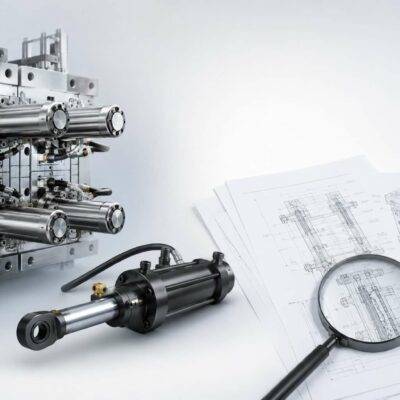

Engineering Challenges of Hydraulic Cylinders for Rubber Injection Molds
Hydraulic cylinders are widely used in plastic injection molds to actuate slides, cores, lifters and other moving components.
Most of these applications operate under relatively moderate thermal conditions, where the mold temperature is carefully controlled to optimize cycle time and part quality.
Rubber injection molding, however, is a completely different environment.
Instead of processing thermoplastics that solidify during cooling, rubber compounds require high mold temperatures to vulcanize correctly.
As a result, hydraulic cylinders installed on these molds are exposed to thermal conditions that are far more demanding than those encountered in conventional plastic injection molding.
This immediately raises an important engineering question:
Can a standard hydraulic cylinder operate reliably inside a mold running at 200°C?
The answer depends on much more than pressure ratings.
Seal materials, hydraulic fluid, thermal expansion, lubrication, installation layout and heat transfer all become critical design parameters.
A real engineering case handled by the Vega Technical Department illustrates how these factors must be evaluated before selecting or modifying a hydraulic cylinder.
The Customer’s Application
The case began with a request from ILPEA Poland, a manufacturer producing rubber components.
The customer was using hydraulic cylinders inside a rubber injection mold operating at approximately 200°C.
The moving mold plate weighed approximately 150–200 kg, while the hydraulic system operated at a pressure between 100 and 120 bar.
Rather than requesting a standard replacement cylinder, the customer specifically asked whether Vega could supply two improved pistons similar to those used in die-casting applications, believing they would better withstand the severe operating conditions.
This request immediately indicated that the problem was not simply one of hydraulic force.
The real challenge was ensuring long-term reliability in an extremely hot operating environment.
High Temperature Changes Everything
Many engineers focus primarily on operating pressure when selecting a hydraulic cylinder.
In reality, temperature often becomes the limiting factor.
As temperature increases, several important changes occur simultaneously:
- seals lose mechanical strength;
- elastomer aging accelerates;
- hydraulic oil viscosity decreases;
- thermal expansion alters internal clearances;
- lubricating films become thinner;
- electronic sensors may operate outside their recommended limits.
For this reason, cylinder selection for high-temperature applications requires a completely different engineering approach.
The Vega Technical Manual specifically highlights the importance of considering the consequences of high temperatures on seals and electronic components during cylinder selection.
Rubber Injection Molding Is Different from Plastic Injection Molding
One reason these applications are particularly demanding is that rubber processing differs fundamentally from thermoplastic injection molding.
Thermoplastics are injected into relatively cool molds where the polymer solidifies during cooling.
Rubber compounds, by contrast, require heated molds to initiate the vulcanization process.
This means that the hydraulic cylinder remains close to elevated temperatures throughout production instead of experiencing only brief thermal peaks.
Continuous exposure to heat significantly accelerates seal wear and increases the importance of selecting suitable materials.
Heat Does Not Affect Only the Seals
When engineers think about high-temperature cylinders, they often focus exclusively on seal materials.
In reality, heat influences nearly every component inside the cylinder.
Temperature affects:
- piston-to-body clearance;
- rod expansion;
- guide wear;
- lubricant performance;
- hydraulic fluid properties;
- sensor reliability.
Even the hydraulic oil itself changes behaviour as temperature increases.
According to the Vega Technical Manual, the compatibility between hydraulic fluids and sealing materials must always be evaluated because certain fluids may accelerate seal ageing under elevated temperatures.
This explains why selecting suitable seals alone is not sufficient.
The complete hydraulic system must be evaluated.
Vega Did Not Recommend a Product Immediately
One of the most interesting aspects of this engineering case is Stefano Rogora’s response.
Rather than immediately recommending a specific cylinder or supplying the requested pistons, he first requested:
- additional photographs;
- the complete mold drawing produced by Rabbi Stampi.
Only after reviewing the complete application would Vega determine whether the existing V450 hydraulic cylinders could be adapted or whether an alternative engineering solution would be required.
This reflects a fundamental engineering principle.
Cylinder selection should never begin with the product catalogue.
It should begin with understanding the application.
Why Application Engineering Comes Before Product Selection
Modern hydraulic cylinders are capable of producing very high forces within compact dimensions.
Choosing the correct model, however, always requires balancing multiple factors.
As explained in the Vega Technical Manual, selecting a hydraulic cylinder is “more often than not, a work of compromises,” requiring engineers to evaluate every aspect of the application before making a decision.
Temperature is only one of those factors.
Engineers must also consider:
- pressure;
- stroke;
- available installation space;
- moving mass;
- duty cycle;
- maintenance requirements;
- environmental conditions.
Only after analysing the complete operating environment can an appropriate hydraulic cylinder be selected.
Engineering Begins with Understanding the Environment
This case demonstrates that severe operating environments require more than stronger components.
They require a complete engineering evaluation.
Before recommending any product, the Vega Technical Department wanted to understand:
- how heat reached the cylinder;
- where the cylinder was installed;
- how the mold was designed;
- whether existing components could be improved.
Only after analysing these details could a reliable solution be proposed.
Selecting Hydraulic Cylinders for High-Temperature Rubber Injection Molds
In Part 1, we examined a real engineering case involving a customer operating hydraulic cylinders inside a rubber injection mold at approximately 200°C.
Rather than immediately recommending a product, the Vega Technical Department first requested additional photographs and the complete mold drawings to understand the actual operating conditions before proposing a solution.
This engineering approach is particularly important for high-temperature applications, where operating pressure is only one of many parameters influencing cylinder reliability.
High Temperature Affects the Entire Hydraulic System
When hydraulic cylinders operate close to heated molds, temperature influences every component of the hydraulic system.
Engineers usually focus on seals, but elevated temperatures also affect:
- hydraulic oil viscosity;
- rod expansion;
- internal clearances;
- guide wear;
- lubrication;
- sensor reliability;
- maintenance intervals.
For this reason, selecting a hydraulic cylinder for a rubber injection mold requires analysing the complete operating environment rather than simply checking the maximum pressure rating.
Why Die-Casting Cylinders Can Be an Interesting Alternative
One of the customer’s requests was particularly revealing.
Rather than asking for a standard replacement, the customer wanted two improved pistons similar to those used in Vega die-casting cylinders, expecting that these components would better withstand the severe thermal conditions.
This request is technically well founded.
Die-casting cylinders are specifically developed for environments where high temperatures are present continuously.
According to Vega’s engineering documentation, these cylinders incorporate features such as:
- special sealing materials;
- cooling solutions;
- compatibility with water-glycol fluids;
- improved durability under severe thermal conditions.
Although rubber injection molding and die casting are different manufacturing processes, they share one important characteristic: prolonged exposure to elevated temperatures.
Cooling Can Extend Cylinder Life
One of Vega’s most significant developments for high-temperature applications is the introduction of integrated cooling solutions for the V450 series.
The cooling system is designed to reduce the amount of heat transferred from the mold to the cylinder, protecting seals and extending maintenance intervals.
Depending on the configuration, Vega offers cooling through:
- an internal cooling cartridge;
- a cooled double-rod system.
These solutions were originally developed for die-casting applications but have also proven valuable wherever cylinders operate close to intense heat sources.
Reducing seal temperature by even a few tens of degrees can significantly increase service life.
Seal Material Is Only Part of the Solution
When discussing high-temperature cylinders, engineers often ask:
“Should I simply install higher-temperature seals?”
In many cases, the answer is no.
Although selecting the appropriate sealing material is essential, seal life also depends on:
- rod temperature;
- cylinder alignment;
- contamination;
- lubrication;
- hydraulic fluid compatibility;
- thermal cycling.
Even the best sealing material cannot compensate for poor application design.
This is why Vega first evaluates the application before recommending a specific technical solution.
Application Engineering Always Comes Before Product Selection
One of the most valuable lessons from this case is the engineering methodology itself.
Stefano Rogora did not start by identifying a cylinder model.
Instead, he wanted to understand:
- where the cylinder was mounted;
- how heat reached the cylinder;
- how the mold was designed;
- whether cooling was already available;
- whether existing components could be upgraded.
Only after gathering this information would Vega determine whether the existing V450 cylinder could be adapted or whether another solution would be preferable.
This reflects Vega’s long-standing engineering philosophy of providing application-oriented solutions rather than simply supplying products.
Engineering Means Understanding the Complete Environment
A hydraulic cylinder operating at 100 bar in a room-temperature environment behaves very differently from the same cylinder operating at 100 bar inside a mold maintained at 200°C.
Pressure alone does not determine reliability.
Engineers must evaluate the combined effects of:
- temperature;
- pressure;
- operating cycles;
- cooling efficiency;
- hydraulic fluid;
- maintenance intervals;
- mold construction.
Only by considering all these variables can the most appropriate hydraulic cylinder be selected.
Conclusion
This real engineering case demonstrates that selecting hydraulic cylinders for rubber injection molds requires much more than checking pressure and stroke.
Although the customer initially requested improved pistons derived from Vega’s die-casting cylinders, the Vega Technical Department first analysed the complete application before recommending any modification.
This approach minimizes technical risk while ensuring that every solution is tailored to the actual operating conditions.
Ultimately, high-temperature applications remind every mold designer of one essential engineering principle:
The correct hydraulic cylinder is selected by understanding the application—not simply by comparing catalogue specifications.
Related Articles
These articles are available on icvega.com and are highly relevant to this topic: