
A Customer case on customizing cylinder rod length
In injection mold design, the standard configuration of a hydraulic cylinder does not always fit the available space or the geometry of the mold.
In some applications, the distance between the hydraulic cylinder and the mold slide requires a longer rod than the standard configuration.
A longer rod can be a practical and effective solution, but it also introduces an important mechanical consideration: alignment between the hydraulic cylinder and the slide.
A real application analysed by the Vega Team provides a clear example.
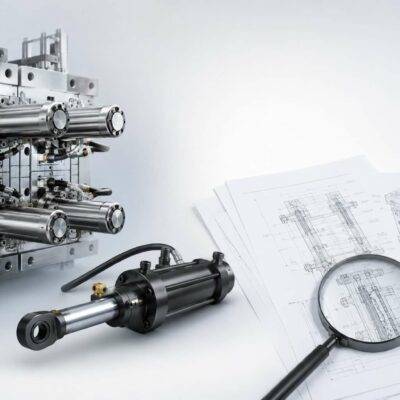
The Customer submitted drawings showing a hydraulic cylinder with an extended rod and requested that Vega manufacture the cylinders according to the dimensions shown in the drawings.
The Vega Team confirmed that the cylinders could be manufactured with the requested longer rods. However, the technical team also highlighted a potential risk: the longer rod could increase the risk of misalignment between the cylinder and the slide.
This apparently simple request therefore became an important example of why custom hydraulic-cylinder design must consider not only manufacturing feasibility, but also the mechanical conditions of the complete mold assembly.
1. The Customer’s Requirement
The Customer had sent Vega drawings showing the hydraulic-cylinder rods extended beyond the standard configuration.
The required rod dimensions were specified directly in the drawings.
The request was straightforward:
Could Vega manufacture the cylinders with the longer rods shown in the drawings?
The Vega Team confirmed that this was technically possible.
However, the response also included an important engineering warning.
The Customer needed to ensure perfect alignment between the hydraulic cylinder and the slide.
This distinction between manufacturing feasibility and application suitability is the central point of the case.
2. Why a Longer Rod Changes the Mechanical Situation
At first sight, increasing rod length may appear to be a simple dimensional modification.
The cylinder remains the same.
The bore remains the same.
The stroke can remain the same.
Only the rod extends farther.
However, mechanically, increasing the distance between the cylinder body and the point where the force is applied can make the system more sensitive to misalignment.
A simplified way to visualize the principle is:
Short rod → shorter lever distance
Longer rod → greater sensitivity to angular deviation
The longer the rod, the more important it becomes to ensure that the cylinder axis and the slide movement remain properly aligned.
This does not mean that long rods are unsuitable.
It means that their installation requires greater attention to mechanical geometry.
3. The Main Risk Identified by the Vega Team
The most important technical observation in the Customer case was not that the longer rod could not be manufactured.
It was the opposite.
The Vega Team confirmed:
the cylinders could be manufactured with the longer rods shown in the drawings.
But immediately afterwards, the Vega Team identified the potential problem:
the risk of misalignment could be high.
The Customer was therefore advised to guarantee perfect alignment between the cylinder and the slide.
This is an excellent example of application engineering.
The question is not simply:
Can Vega manufacture this cylinder?
The more important question is:
Can this customized cylinder operate correctly within the mechanical system of the mold?
4. Why Alignment Matters
A hydraulic cylinder is primarily designed to generate force along its axis.
Ideally, the force path should therefore be:
Cylinder
↓
Rod
↓
Connection
↓
Slide
with all components properly aligned.
If the slide and cylinder are not correctly aligned, the rod may be exposed to forces that are not purely axial.
This can potentially increase:
- side loading;
- friction;
- wear;
- seal loading;
- rod deflection;
- resistance to slide movement.
For this reason, the Vega Team specifically emphasized alignment in the Customer application.
5. A Longer Rod Does Not Mean a Longer Stroke
An important distinction must be made between rod length and cylinder stroke.
The Customer’s request concerned the extension of the rod itself, with the required dimension indicated on the drawing.
The rod length determines the physical distance between the cylinder body and the connection point.
The stroke determines how far the piston and rod move during operation.
These are two different parameters.
Therefore, a cylinder can have:
- a relatively short stroke;
- but a customized longer rod.
This distinction is particularly important when designing hydraulic cylinders for injection molds, where available installation space can be highly constrained.
6. Why Mold Geometry Can Require a Longer Rod
Injection molds often contain complex mechanical layouts.
The cylinder may need to be positioned:
- behind a mold plate;
- beside a slide;
- inside a restricted cavity;
- away from hot areas;
- in a location dictated by the mold structure.
In such situations, the standard rod length may not be sufficient to reach the required connection point.
A longer rod can eliminate the need for an additional mechanical extension.
However, the resulting geometry must still ensure that the cylinder remains properly aligned with the slide throughout its movement.
7. The Slide Is Part of the Hydraulic System
It is tempting to consider the hydraulic cylinder as an independent component.
In reality, the cylinder and slide form a mechanical system.
The complete force path is:
Hydraulic pressure
↓
Cylinder piston
↓
Cylinder rod
↓
Mechanical connection
↓
Slide
↓
Slide guides
The cylinder therefore cannot be designed independently of the slide.
If the slide is not correctly guided, the hydraulic cylinder may be forced to absorb loads that it was not intended to handle.
8. The Importance of the Slide Guides
The slide guides have a fundamental role in maintaining the correct movement.
Their purpose is to control the slide trajectory and absorb the mechanical forces associated with the mold movement.
The hydraulic cylinder should provide the required driving force.
It should not be used as a substitute for proper mechanical guidance.
This becomes particularly important when a longer rod is used.
A well-guided slide helps ensure that the rod remains aligned with the cylinder axis during the complete movement.
9. Alignment Must Be Maintained During the Entire Stroke
Another important consideration is that alignment should not be checked only when the mold is stationary.
The system must remain correctly aligned throughout the movement.
Possible sources of variation include:
- mechanical tolerances;
- assembly errors;
- guide clearance;
- deformation;
- movement of connected components.
A system that appears perfectly aligned at one position may experience a small angular deviation at another point in the stroke.
With a longer rod, even a relatively small angular deviation can become more significant at the connection point.
10. Why the Vega Team Included a Warning
The Vega Team’s response is particularly useful because it did not simply approve the customization.
The response effectively contained two separate conclusions:
Manufacturing conclusion
The requested longer rod can be manufactured.
Application conclusion
The Customer must guarantee perfect alignment between cylinder and slide because the longer rod increases the risk of misalignment.
This distinction is valuable for mold designers.
A custom component can be completely feasible from a manufacturing perspective while still requiring specific conditions during installation.
11. The Drawing Is Essential
The Customer had included the required rod dimensions directly in the drawings.
This allowed Vega to understand the required configuration.
For custom hydraulic cylinders, the drawing should clearly define the relevant interfaces and dimensions.
Depending on the application, these can include:
- rod length;
- rod-end geometry;
- mounting dimensions;
- bore;
- stroke;
- oil connections;
- switch positions;
- fixing details.
The more accurately the application is described, the easier it becomes to evaluate whether the requested customization is suitable.
12. A Longer Rod Can Increase Sensitivity to Misalignment
The key mechanical concept can be simplified as follows.
Imagine that the rod has a very small angular deviation from the cylinder axis.
With a short rod, the displacement at the connection point may remain relatively small.
With a longer rod, the same angular deviation can result in a larger positional difference at the end of the rod.
Therefore:
longer rod + angular deviation = greater positional displacement at the connection
This is why rod length must be considered together with the mounting geometry.
13. Possible Consequences of Poor Alignment
The Customer case does not document a failure or a specific damage event, so such outcomes should not be attributed to this application.
However, from an engineering perspective, poor alignment is a condition that should be avoided because it can introduce unwanted mechanical loading.
Potential concerns can include:
- increased friction;
- uneven wear;
- higher loads on the rod;
- increased seal stress;
- irregular slide movement;
- reduced component life.
The important point for this case is therefore not that these problems occurred, but that Vega identified misalignment as a risk that the Customer needed to control.
14. Customization Versus Standard Configuration
The Customer’s requirement illustrates why customized hydraulic cylinders can be useful in mold design.
A standard cylinder is designed around a predefined set of dimensions.
But molds are rarely identical.
A particular mold may require:
- a special rod length;
- a different mounting arrangement;
- customized oil connections;
- different sensors;
- a special rod end.
Vega officially states that it can customize hydraulic cylinders according to customer-specific requirements and describes custom V450CM applications among its special-cylinder projects.
The Customer case is therefore consistent with Vega’s broader approach to customized hydraulic-cylinder solutions.
15. The V450CM Family
The V450CM is a heavy-duty short-stroke compact hydraulic-cylinder family developed for injection-mold applications.
Vega’s official product information states that the standard V450CM range includes piston bores from 16 to 100 mm and strokes from 10 to 200 mm. The series is intended primarily for moving components such as carts, pins and plugs that can create undercuts in injection molds, and it can also be used for ejection-plate movement.
The V450CM is designed around a compact steel body and single-ended rod configuration.
Its maximum working pressure is approximately 450 bar, while maximum delivery varies between 7 and 45 l/min, depending on the configuration.
16. V450CM and Custom Applications
The official Vega website also provides individual V450CM configurations with different mounting arrangements.
For example, the V450CM EOE configuration is available with bore options including 50 and 63 mm, together with different stroke selections.
The CGH configuration also provides bore options including 50 and 63 mm.
This modular approach makes the V450CM suitable for a wide range of mold configurations.
When the standard configuration is not sufficient, Vega also offers customized hydraulic-cylinder solutions.
17. When Should a Long Rod Be Considered?
A customized longer rod can be considered when the mold geometry requires a greater distance between the cylinder body and the moving component.
Typical design situations may include:
- limited installation space;
- recessed cylinder mounting;
- unusual slide geometry;
- restricted access to the mold;
- special connection positions.
However, before specifying a longer rod, the designer should verify:
1. Cylinder position
Where is the cylinder mounted?
2. Slide position
Where is the connection point?
3. Movement direction
Does the slide move parallel to the cylinder axis?
4. Guide system
Can the slide maintain its trajectory throughout the stroke?
5. Rod length
Does the customized rod introduce additional sensitivity to misalignment?
18. An Engineering Checklist
For a customized long-rod hydraulic cylinder, a practical design review should include:
Geometry
Check the relative position of the cylinder and slide.
Alignment
Verify the axes of the cylinder and slide.
Rod length
Check the requested extended length.
Stroke
Verify that the stroke is sufficient for the required movement.
Connection
Ensure that the rod-end connection does not introduce unnecessary lateral loads.
Guides
Verify that the slide guides control the movement correctly.
Tolerances
Consider the cumulative effect of manufacturing and assembly tolerances.
Operating conditions
Check the actual mold cycle and movement conditions.
This checklist goes beyond the cylinder itself and addresses the complete mechanical application.
19. What the Customer Case Teaches Mold Designers
Several useful lessons emerge from this application.
A longer rod can be manufactured
The Vega Team confirmed that the requested configuration was technically feasible.
Customization does not eliminate mechanical constraints
The longer rod introduced a higher potential risk of misalignment.
Perfect alignment is essential
The Customer was specifically asked to guarantee alignment between the cylinder and slide.
Rod length and stroke are different parameters
A longer rod does not automatically mean a longer cylinder stroke.
The cylinder must be considered as part of the mold
The slide, guides, connection and cylinder must work together as one mechanical system.
20. The Value of Application Engineering
This case is a good example of the difference between simply supplying a hydraulic cylinder and providing application engineering support.
The Customer asked for a specific modification.
Vega could manufacture it.
But the Vega Team also identified a condition that needed to be controlled during installation:
perfect alignment between the cylinder and the slide.
That additional technical observation is important because it helps the mold designer understand not only what can be manufactured, but also how the customized component must be integrated into the mold.
Conclusion
A request for a longer hydraulic-cylinder rod may appear to be a simple dimensional modification.
The Customer case analysed by the Vega Team shows why it should instead be considered as part of the complete mechanical design of the mold.
The Customer provided drawings showing the required extended rod dimensions.
Vega confirmed that the cylinders could be manufactured with the requested longer rods.
At the same time, the Vega Team identified an important risk: the longer rod could increase the risk of misalignment between the cylinder and the slide. The Customer was therefore required to guarantee perfect alignment between the two components.
The main lesson is:
A customized hydraulic cylinder must be evaluated not only for manufacturing feasibility, but also for its mechanical integration into the mold.
When a longer rod is required, particular attention should be paid to:
rod length → cylinder position → slide geometry → guide system → alignment → connection.
A well-designed hydraulic system is not simply a cylinder that produces the required force. It is a complete mechanical and hydraulic solution in which the cylinder, rod, slide and guides work together correctly throughout the entire mold cycle.
Useful and Verified URLs
1. V450CM – Heavy-Duty Short-Stroke Compact Hydraulic Cylinders
Official Vega product page for the V450CM family, including its standard bore and stroke range, applications, working pressure and hydraulic delivery.
V450CM – Heavy-Duty Short-Stroke Compact Hydraulic Cylinders
2. Custom Hydraulic Cylinders
Official Vega page dedicated to customized hydraulic cylinders. It explains Vega’s ability to manufacture cylinders according to specific customer requirements and includes examples of customized V450CM cylinders.
Custom Hydraulic Cylinders – Vega Cylinders
3. Hydraulic Cylinders for Molds
Official Vega catalogue page showing the different cylinder families available for mold applications, including the V450CM for cart, plug and ejection-plate movement.
Hydraulic Cylinders for Molds – Vega Cylinders
4. V450CM – EOE Configuration
Official V450CM product page showing available bore and stroke configurations, including Ø50 and Ø63 versions.
V450CM EOE – Product Configuration
5. V450CM – CGH Configuration
Official V450CM product page for the CGH mounting configuration, also showing bore options including Ø50 and Ø63.
V450CM CGH – Product Configuration
6. Cart and Plug Movement
Official Vega application category for hydraulic cylinders used to move carts, pins and plugs that create undercuts in injection molds.