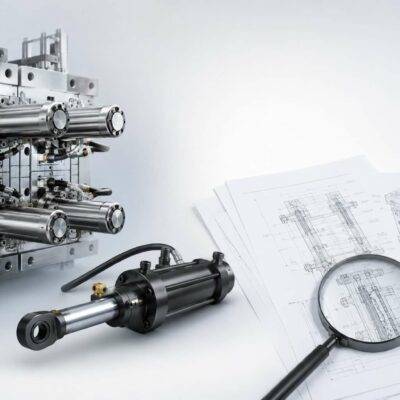

Hydraulic cylinders used in injection molds are designed to withstand extremely demanding operating conditions.
They move heavy mold components thousands of times every day, absorb dynamic loads, resist hydraulic pressure peaks, and continue operating reliably over hundreds of thousands—or even millions—of production cycles.
For this reason, when a hydraulic cylinder suddenly breaks, the first reaction is usually straightforward.
“The cylinder failed.”
However, experienced engineers know that a broken cylinder is not necessarily the root cause of the failure.
In many industrial applications, the cylinder is simply the component that reveals a much larger problem occurring somewhere else within the hydraulic system or the molding machine.
Unexpected overloads, incorrect machine sequences, blocked hydraulic valves, or abnormal impact loads can all generate forces far greater than those considered during normal operation.
In these situations, replacing the damaged cylinder without understanding why it failed often leads to the same problem occurring again.
This is why every failure investigation should begin with a simple question:
Did the cylinder really fail because of its own design, or was it the victim of external operating conditions?
A real engineering case handled by the Vega Technical Department provides an excellent example of this approach.
A customer reported the fracture of a V215CR hydraulic cylinder installed inside an injection mold.
The cylinder was operating in tension, moving a mass of approximately 270 kg, with a hydraulic pressure ranging between 70 and 90 bar.
At the time of the failure, the cylinder had already completed approximately 268,000 operating cycles, making the fracture even more unusual.
Rather than immediately concluding that the cylinder was defective, the Vega Technical Department requested the damaged component for a complete technical investigation.
Their objective was not simply to repair the cylinder.
Their objective was to determine why it had broken.
That distinction is the foundation of every professional Root Cause Analysis.
A Broken Cylinder Does Not Automatically Mean a Manufacturing Defect
Whenever a mechanical component fractures, there is a natural tendency to associate the damage with poor manufacturing quality.
In reality, fractures may originate from many completely different causes.
For example, engineers must evaluate whether the failure resulted from:
- excessive hydraulic pressure;
- unexpected mechanical overload;
- fatigue after millions of operating cycles;
- impact loading;
- improper installation;
- incorrect machine sequencing;
- material defects;
- stress concentrations;
- external interference inside the mold.
Each of these mechanisms leaves different evidence on the failed component.
Understanding the origin of the fracture requires engineering analysis rather than assumptions.
Replacing the cylinder without identifying the true cause simply hides the symptom while leaving the real problem unresolved.
The Investigation Started Before Any Conclusions Were Drawn
Immediately after receiving the damaged cylinder, the Vega Technical Department informed the customer that the component was under detailed examination.
No assumptions were made regarding the origin of the failure.
Instead, the engineering team began analysing the fracture to determine the real cause before issuing any technical conclusions.
This approach reflects a fundamental engineering principle.
Good engineers do not begin with answers.
They begin with evidence.
Only after collecting measurements, inspecting the damaged surfaces, reviewing the operating conditions, and performing structural calculations can a reliable conclusion be reached.
The Customer’s Operating Conditions Appeared Perfectly Acceptable
The information supplied by the customer did not initially suggest any abnormal operating conditions.
According to the application data:
- the cylinder operated in tension;
- it moved approximately 270 kg;
- the hydraulic circuit operated between 70 and 90 bar;
- the cylinder had already completed approximately 268,000 cycles before the failure occurred.
From these values alone, there was no obvious indication that the cylinder had been overloaded.
In fact, everything appeared to fall within the expected operating range for this model.
This made the fracture particularly interesting.
If the operating conditions were apparently normal, why had the cylinder broken?
That question led the Vega Technical Department to perform a detailed structural analysis, the results of which completely changed the direction of the investigation.
The Structural Calculations Completely Changed the Investigation
After completing the first inspection of the damaged cylinder, the Vega Technical Department carried out a complete structural analysis of the failed area.
The objective was simple:
Could the cylinder really have broken under its normal operating conditions?
The engineering team analysed the minimum resistant cross-section in the centering area of the cylinder while also considering one of the most demanding operating conditions that could realistically occur during cushioning.
Rather than using only the customer’s nominal working pressure of 70–90 bar, the calculations also considered a maximum back pressure of 200 bar, which could develop during the cushioning phase while operating at a nominal pressure of 90 bar, a rod speed of 0.8 m/s, and a moving mass of 270 kg.
The result was unexpected.
The calculated stress was only 10 kg/mm².
From an engineering standpoint, this value was far below the strength required to fracture the component.
The conclusion was clear.
Under the declared operating conditions, the cylinder should not have broken.
This completely changed the direction of the investigation.
No Manufacturing Defects Were Found
Once the structural calculations excluded normal operating loads as the cause of failure, the next step was to inspect the damaged component itself.
The Vega Technical Department carefully examined the fractured cylinder, looking for possible manufacturing defects, machining errors, sharp notches or stress raisers that could have initiated the crack.
Nothing abnormal was found.
The inspection did not reveal machining defects, material discontinuities or geometric imperfections capable of explaining the fracture.
This is an important aspect of failure analysis.
Many people assume that if a component breaks, a manufacturing defect must be responsible.
In reality, genuine manufacturing defects are only one of many possible causes.
A complete engineering investigation must first eliminate every other possibility before attributing responsibility to the component itself.
The Real Suspect Was an External Overload
Once both the structural calculations and the physical inspection excluded an internal defect, the investigation focused on the machine.
The Vega Technical Department concluded that the most likely explanation was an unexpected overload acting on the cylinder.
According to the engineering assessment, two scenarios appeared particularly plausible:
- an incorrect mold opening or closing sequence;
- a hydraulic valve becoming stuck during machine operation.
Both situations can generate forces that are dramatically different from the loads considered during normal design calculations.
Hydraulic cylinders are designed to withstand very high operating forces.
However, they are not intended to absorb uncontrolled impact loads, mechanical interference or abnormal pressure spikes generated by unexpected machine behaviour.
This distinction is fundamental.
A cylinder may fail even though its design is perfectly correct if the surrounding hydraulic or mechanical system subjects it to loads that were never intended to occur.
Why Dynamic Loads Are More Dangerous Than Static Loads
One of the most common misunderstandings in hydraulic engineering is assuming that hydraulic pressure alone determines the load acting on a cylinder.
In reality, moving systems generate additional dynamic forces.
Sudden deceleration, mechanical impacts, trapped hydraulic oil, valve malfunctions and synchronization errors may all create extremely short load peaks that are significantly higher than the nominal operating pressure.
Although these overloads may last only a fraction of a second, they can exceed the structural limits of surrounding components.
This explains why some hydraulic cylinders operate reliably for hundreds of thousands of cycles before suddenly failing after a single abnormal event.
The cylinder is not wearing out gradually.
It is experiencing one exceptional load that exceeds its design envelope.
Engineering Means Eliminating the Impossible
The most valuable lesson from this case is not simply that the cylinder was repairable.
It is the engineering method used to reach that conclusion.
Rather than assuming a manufacturing defect, the Vega Technical Department followed a structured investigation:
- analysed the operating conditions;
- performed structural calculations;
- inspected the fractured component;
- excluded manufacturing defects;
- evaluated possible machine-related causes;
- identified external overload as the most probable explanation.
Only after eliminating every alternative could the engineering team identify the most likely root cause.
This systematic approach is the foundation of professional Root Cause Analysis and prevents expensive misdiagnoses.
Conclusions
This real engineering case demonstrates that a broken hydraulic cylinder is not always the component responsible for the failure.
Despite operating after approximately 268,000 production cycles, the structural calculations showed that the declared operating conditions were insufficient to produce the observed fracture, while the physical inspection revealed no manufacturing defects.
The investigation therefore pointed towards an external overload, most likely generated by an abnormal machine event such as an incorrect mold movement or a hydraulic valve malfunction.
For mold designers and maintenance engineers, the lesson is clear:
Before replacing a broken hydraulic cylinder, identify why it broke.
Very often, the damaged cylinder is only the visible consequence of a much larger problem elsewhere in the hydraulic or mechanical system.
Further Technical Reading
To better understand the engineering principles discussed in this case, we recommend these technical articles from the Vega Technical Blog: