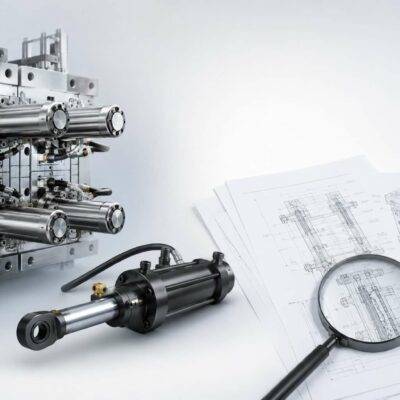

Magnetic position sensors have become standard equipment on modern hydraulic cylinders used in injection molds. They allow the molding machine to monitor piston position without mechanical contact, improving automation, repeatability, and process safety.
Although selecting a magnetic sensor may appear straightforward, the wrong choice can lead to installation difficulties, unreliable feedback, unnecessary maintenance, or higher operating costs.
A real case handled by the Vega Technical Department highlights how understanding the application is often more important than simply selecting the most common sensor.
A customer purchasing V215CR hydraulic cylinders reported that the recommended MSU1 Hall-effect sensors could not be securely mounted because the cylinder rods were too small for the installation method being used. The customer therefore asked whether another sensor could be recommended.
After reviewing the application, the Vega Technical Department explained that MSU1 sensors are suitable for all V215 cylinders and expressed surprise that this installation problem had occurred. As an alternative solution, Vega proposed using MSRC reed sensors, providing the corresponding technical documentation.
How Magnetic Sensors Work
Unlike mechanical limit switches, magnetic sensors detect the magnetic field generated by a piston magnet located inside the hydraulic cylinder.
As the piston moves, the magnetic field travels along the cylinder body. When it reaches the sensor, the sensor changes its electrical output, allowing the PLC to determine the piston position accurately without physical contact.
Because there is no mechanical wear between the piston and the sensor, magnetic sensing provides excellent reliability and a long service life.
Hall Sensors vs Reed Switches
Both technologies perform the same basic function but operate differently.
Hall-effect sensors are electronic devices powered by the machine’s electrical supply. They provide fast switching, excellent vibration resistance and a long operating life, making them ideal for high-speed automated injection molding systems.
Reed switches, on the other hand, contain two sealed ferromagnetic contacts that close when exposed to a magnetic field. They require no electronic circuitry and are appreciated for their simplicity, low cost and compatibility with many control systems.
Neither technology is universally better.
The correct choice depends on the operating environment, switching frequency, electrical requirements and installation constraints.
Why Installation Is Just as Important as Sensor Technology
Many sensor problems are not caused by the sensor itself.
Instead, they result from incorrect installation, unsuitable mounting accessories, excessive vibration or mechanical interference.
In this case, the customer believed the sensor could not be installed because of the small rod diameter.
However, according to the Vega Technical Department, the MSU1 sensor was already compatible with all V215 cylinders. Since the application presented unusual installation constraints, Vega suggested the MSRC reed sensor as an alternative rather than assuming the cylinder design was incorrect.
This demonstrates an important engineering principle:
When a component appears incompatible, the installation method should be verified before replacing the component itself.
When Should a Reed Sensor Be Selected?
Reed sensors remain an excellent solution in many industrial applications.
They are particularly suitable when:
- simple ON/OFF position feedback is required;
- switching frequencies are moderate;
- compatibility with existing electrical systems is important;
- a cost-effective solution is preferred.
The technical documentation supplied by Vega shows that the MSRC reed sensor is designed specifically for hydraulic cylinder applications and supports industrial operating conditions, making it a reliable alternative where appropriate.
Engineering Means Choosing the Right Solution
One of the most valuable lessons from this case is that engineering is not about insisting on a single product.
It is about understanding the customer’s application and selecting the most suitable solution.
Rather than simply confirming the original recommendation, the Vega Technical Department evaluated the reported installation difficulty and immediately proposed a practical alternative.
This customer-focused approach helps reduce installation time, avoid unnecessary modifications and improve the reliability of the entire injection molding system.
Conclusions
Selecting the correct magnetic sensor involves more than choosing between a Hall sensor and a reed switch.
The operating environment, cylinder design, mounting method, electrical interface and machine requirements must all be considered before making the final decision.
This real engineering case demonstrates how a small installation issue can often be solved by selecting the most appropriate sensor rather than modifying the hydraulic cylinder itself.
By analysing the application carefully and considering alternative technologies when necessary, engineers can improve system reliability while reducing installation problems and maintenance costs.
Further Reading
To learn more about hydraulic cylinders and their applications in injection molds, you may also find these technical articles useful:
- https://www.icvega.com/promoting/hydraulic-core-pulling-guide
- https://www.icvega.com/choosing/choosing-the-right-cylinder-for-mold-core-pushing-force
- https://www.icvega.com/support/how-to-calculate-the-correct-hydraulic-cylinder-size-for-injection-molds
- https://www.icvega.com/support/the-2-millimeters-that-could-have-stopped-an-entire-mold