Servo Drive Technologies at Interpack 2026: High-Performance Motion Control for Next-Generation Packaging Machines
As packaging production becomes faster, smarter and more flexible, servo drive technology has become one of the key enabling innovations behind modern packaging machinery.
Today’s manufacturers require motion systems capable of delivering exceptional positioning accuracy, synchronized movement and high-speed operation while reducing energy consumption and maintenance costs.
At Interpack 2026, servo drive technologies are expected to be among the most important automation solutions showcased by machine builders, automation suppliers and motion control specialists.
From high-speed filling machines to robotic palletizers, servo systems are redefining packaging performance.
What Is a Servo Drive?
A servo drive is an electronic controller that regulates the movement of a servo motor using continuous feedback from sensors and encoders.
Unlike conventional motors, servo systems continuously adjust position, speed and torque to achieve extremely precise motion.
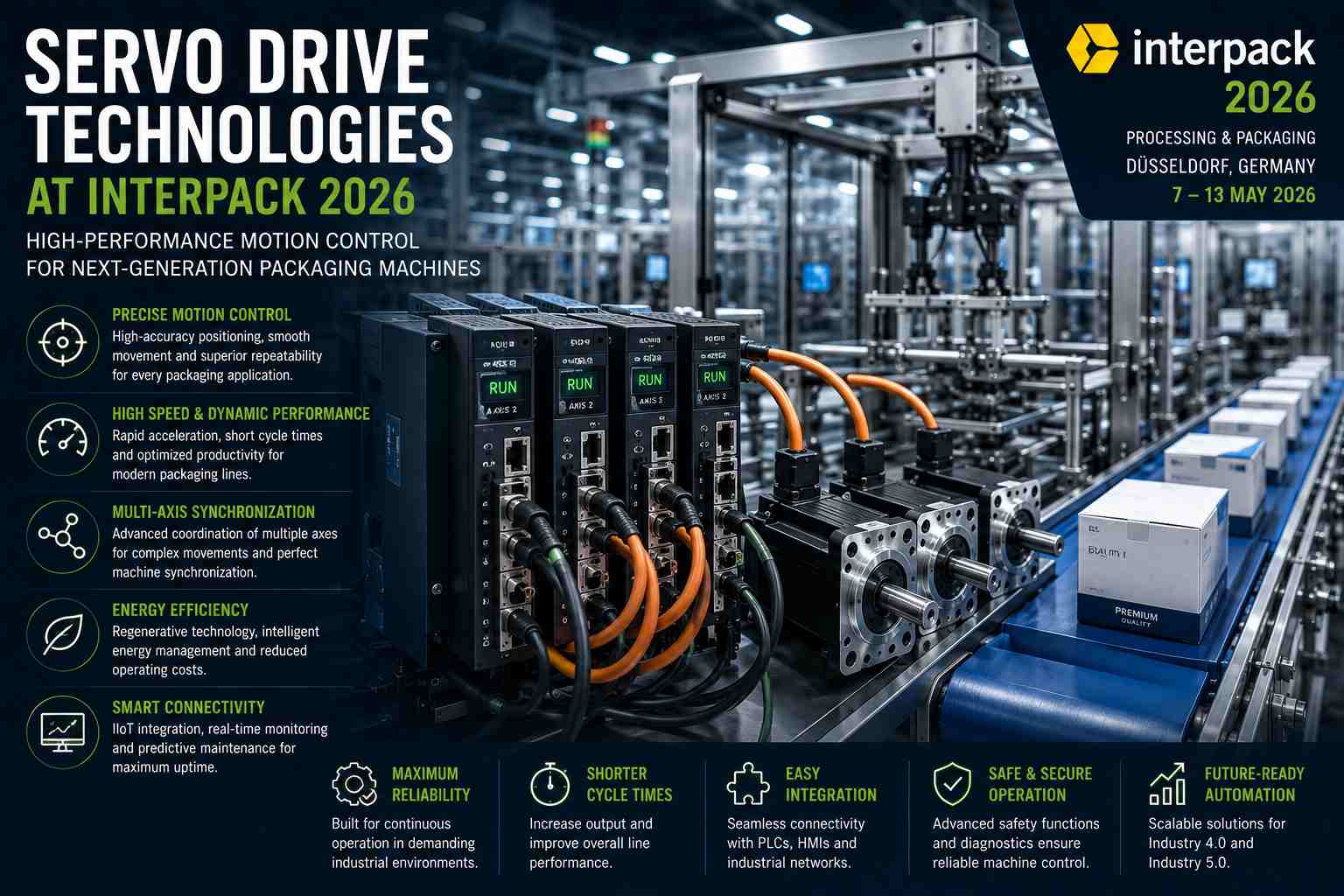
A complete servo system typically includes:
- Servo drive
- Servo motor
- Encoder
- Motion controller
- Communication network
- Feedback sensors
These components work together to deliver smooth, repeatable and highly accurate movement.
Why Servo Drives Are Essential in Packaging
Packaging machines require:
- rapid acceleration
- precise positioning
- synchronized multi-axis control
- flexible production
- reliable repeatability
Servo technology enables manufacturers to achieve all these objectives while maintaining excellent production efficiency.
Applications Across Packaging Machinery
Servo systems are used in virtually every type of packaging equipment.
Typical applications include:
Filling Machines
Servo-controlled filling systems improve:
- dosing accuracy
- filling speed
- product consistency
- changeover flexibility
Cartoning Machines
Servo technology allows:
- synchronized carton handling
- precise folding
- accurate positioning
- faster production cycles
Labeling Systems
Modern labeling equipment uses servo drives for:
- label positioning
- web tension control
- synchronization
- print registration
Robotic Packaging Cells
Robots depend on servo systems for:
- pick-and-place
- palletizing
- sorting
- assembly
- product orientation
Multi-Axis Synchronization
One of the greatest advantages of servo technology is synchronized movement.
Packaging machines often coordinate:
- conveyors
- robots
- feeders
- sealing stations
- inspection systems
Electronic synchronization replaces complex mechanical cam systems while increasing flexibility.
Precision Positioning
Servo systems provide exceptional positioning accuracy.
Benefits include:
- reduced waste
- consistent product quality
- improved repeatability
- smoother motion
- shorter cycle times
High precision is especially important in pharmaceutical and food packaging.
Servo Drives and Artificial Intelligence
Artificial Intelligence is improving servo performance.
AI algorithms optimize:
- acceleration profiles
- energy consumption
- vibration reduction
- predictive maintenance
- automatic tuning
Self-optimizing servo systems are becoming increasingly common.
Industrial IoT Integration
Servo drives are now fully connected.
Manufacturers can monitor:
- torque
- speed
- motor temperature
- cycle counts
- energy consumption
- operating efficiency
Real-time monitoring supports predictive maintenance and continuous improvement.
Energy Efficiency
Servo systems contribute significantly to lower energy consumption.
Modern solutions include:
- regenerative braking
- intelligent power management
- optimized motion profiles
- automatic standby modes
Reduced energy consumption lowers both operating costs and environmental impact.
Servo Drives and Industry 5.0
Industry 5.0 emphasizes intelligent collaboration between people and machines.
Servo technologies support this vision through:
- safer motion
- adaptive automation
- flexible manufacturing
- intelligent diagnostics
- easy programming
Modern servo systems help manufacturers respond quickly to changing production requirements.
Frequently Asked Questions
What is a servo drive?
A servo drive is an electronic controller that precisely regulates servo motor movement using continuous feedback.
Why are servo drives important?
They improve positioning accuracy, synchronization, energy efficiency and production flexibility.
Will servo technology be showcased at Interpack 2026?
Yes. Servo drives are expected to be one of the most important technologies presented across modern packaging machinery.
Are servo drives energy efficient?
Yes. Modern servo systems reduce energy consumption through regenerative braking and optimized motion control.
Which packaging machines use servo drives?
Filling machines, cartoners, labelers, palletizers, robots, inspection systems and many other automated machines.
Looking Ahead
Servo technology continues to redefine packaging automation.
By combining precise motion control, Artificial Intelligence, Industrial IoT and intelligent diagnostics, servo drives provide manufacturers with the flexibility and performance required for future packaging production.
Interpack 2026 will showcase the next generation of servo technologies that are making packaging machinery faster, smarter and more sustainable.