Smart Sensors for Packaging Machinery at Interpack 2026: The Foundation of Intelligent Automation
Modern packaging machinery is becoming increasingly intelligent thanks to the widespread adoption of smart sensors. These compact but highly sophisticated devices continuously monitor machine conditions, product quality and production performance, providing the real-time data required by today’s smart factories.
At Interpack 2026, smart sensor technology is expected to be one of the key enablers of Industry 4.0 and Industry 5.0. Combined with Artificial Intelligence, Industrial IoT and predictive maintenance, sensors allow packaging manufacturers to improve efficiency, reduce downtime and optimize every stage of production.
From pressure monitoring to machine vision and vibration analysis, smart sensors are transforming packaging automation.
What Are Smart Sensors?
A smart sensor combines a sensing element with integrated electronics capable of processing, communicating and sometimes analyzing data before sending it to higher-level control systems.
Unlike traditional sensors that simply provide an electrical signal, smart sensors can:
- process information locally
- communicate digitally
- perform self-diagnostics
- detect anomalies
- support predictive maintenance
This intelligence significantly improves machine reliability and operational efficiency.
Why Smart Sensors Matter in Packaging
Packaging lines operate at extremely high speeds.
Even a small deviation can result in:
- product waste
- machine downtime
- rejected products
- incorrect labeling
- sealing defects
- production delays
Continuous monitoring enables problems to be detected before they affect production.
Types of Smart Sensors
Modern packaging machines use many different sensing technologies.
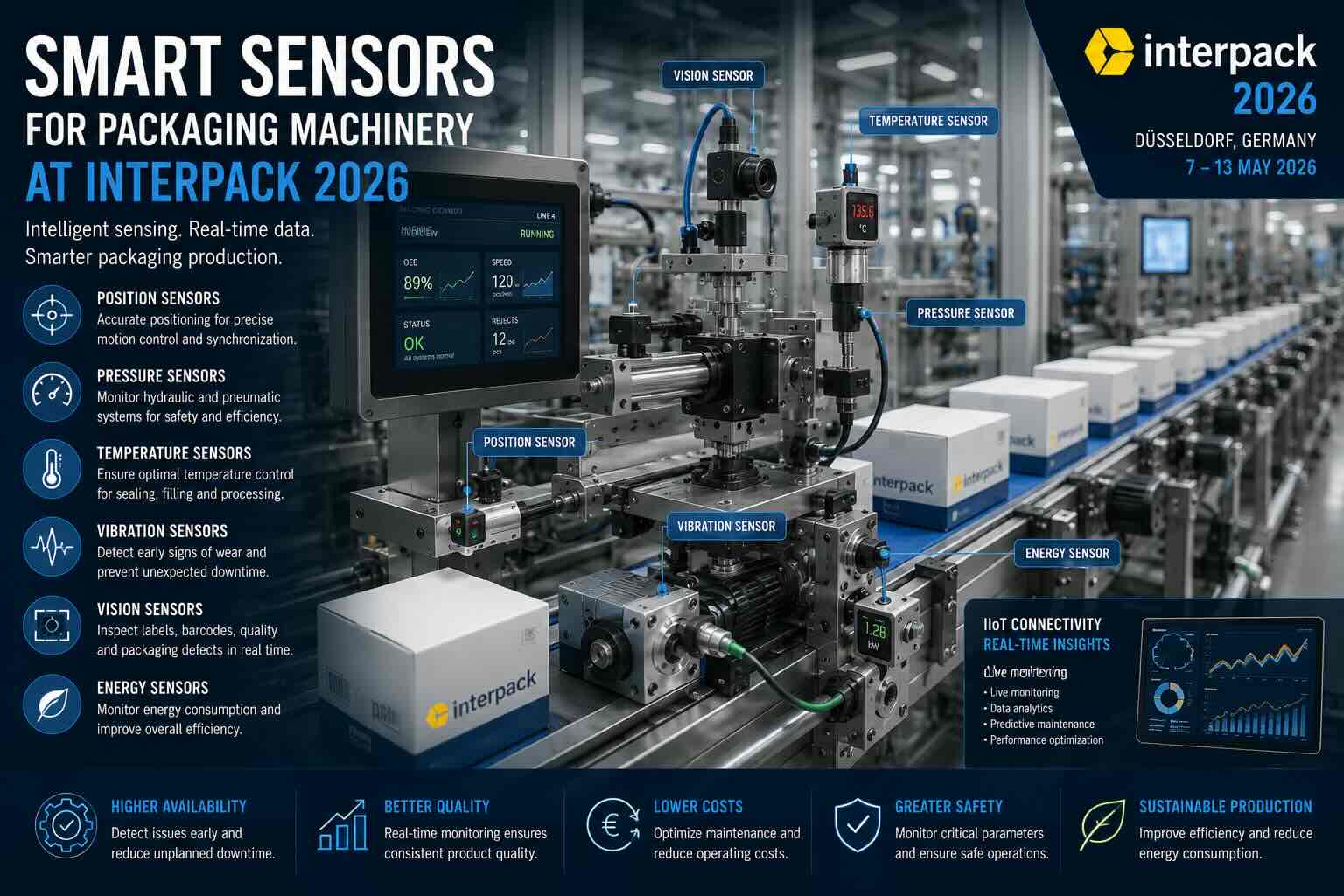
Position Sensors
Used to verify:
- actuator position
- cylinder stroke
- product location
- conveyor alignment
High positioning accuracy is essential for synchronized packaging operations.
Pressure Sensors
Pressure monitoring is widely used in:
- hydraulic systems
- pneumatic circuits
- filling equipment
- sealing machines
Real-time pressure data improves both quality and equipment protection.
Temperature Sensors
Temperature control is critical for:
- heat sealing
- food packaging
- pharmaceutical production
- plastic film processing
Accurate temperature regulation improves product consistency.
Vibration Sensors
Vibration monitoring detects:
- bearing wear
- motor imbalance
- gearbox problems
- misalignment
- mechanical looseness
These sensors form the basis of predictive maintenance.
Vision Sensors
Machine vision systems inspect:
- labels
- barcodes
- QR codes
- print quality
- product orientation
- packaging defects
Vision sensors increasingly rely on Artificial Intelligence for improved defect recognition.
Smart Sensors and Industrial IoT
Smart sensors continuously transmit production data through Industrial IoT networks.
Manufacturers monitor:
- machine health
- production speed
- energy consumption
- hydraulic pressure
- cycle counts
- quality indicators
Real-time information enables immediate corrective actions.
Artificial Intelligence and Sensor Data
AI transforms raw sensor information into valuable operational insights.
Artificial Intelligence can:
- predict failures
- optimize machine settings
- reduce false alarms
- detect production trends
- improve quality control
As sensor networks expand, AI becomes increasingly important.
Smart Sensors in Motion Control
Motion systems rely heavily on sensor feedback.
Typical monitored parameters include:
- linear position
- rotary position
- velocity
- acceleration
- force
- torque
Accurate feedback enables high-speed synchronized motion.
Energy Monitoring
Smart sensors also improve energy efficiency.
They measure:
- electrical consumption
- compressed air usage
- hydraulic efficiency
- motor performance
- production output
Energy monitoring helps reduce operating costs while supporting sustainability initiatives.
Benefits for Packaging Manufacturers
Smart sensor technology provides:
- higher machine availability
- improved product quality
- lower maintenance costs
- reduced downtime
- greater production efficiency
- improved traceability
- enhanced safety
These benefits support both productivity and long-term competitiveness.
Frequently Asked Questions
What is a smart sensor?
A smart sensor combines sensing, processing and digital communication to provide intelligent monitoring of industrial equipment.
Why are smart sensors important?
They enable predictive maintenance, quality monitoring, machine optimization and real-time production visibility.
Will smart sensors be important at Interpack 2026?
Yes. Smart sensing technology is expected to be one of the most important building blocks of intelligent packaging automation.
Which sensors are used in packaging machinery?
Position, pressure, temperature, vibration, vision and energy monitoring sensors are among the most common.
How do smart sensors support AI?
Sensors provide the real-time data that Artificial Intelligence uses to optimize production and predict equipment failures.
Looking Ahead
Smart sensors are becoming the digital nervous system of modern packaging factories.
By combining intelligent sensing, Artificial Intelligence, Industrial IoT and predictive analytics, manufacturers can create packaging lines that are more efficient, more reliable and more sustainable than ever before.
Interpack 2026 will demonstrate how sensor technology continues to drive the next generation of intelligent packaging automation.