Predictive Maintenance at Interpack 2026: How AI and Smart Sensors Are Eliminating Unplanned Downtime
Unplanned machine downtime remains one of the most expensive challenges facing modern packaging manufacturers. Every unexpected stoppage reduces productivity, increases operating costs and disrupts production schedules.
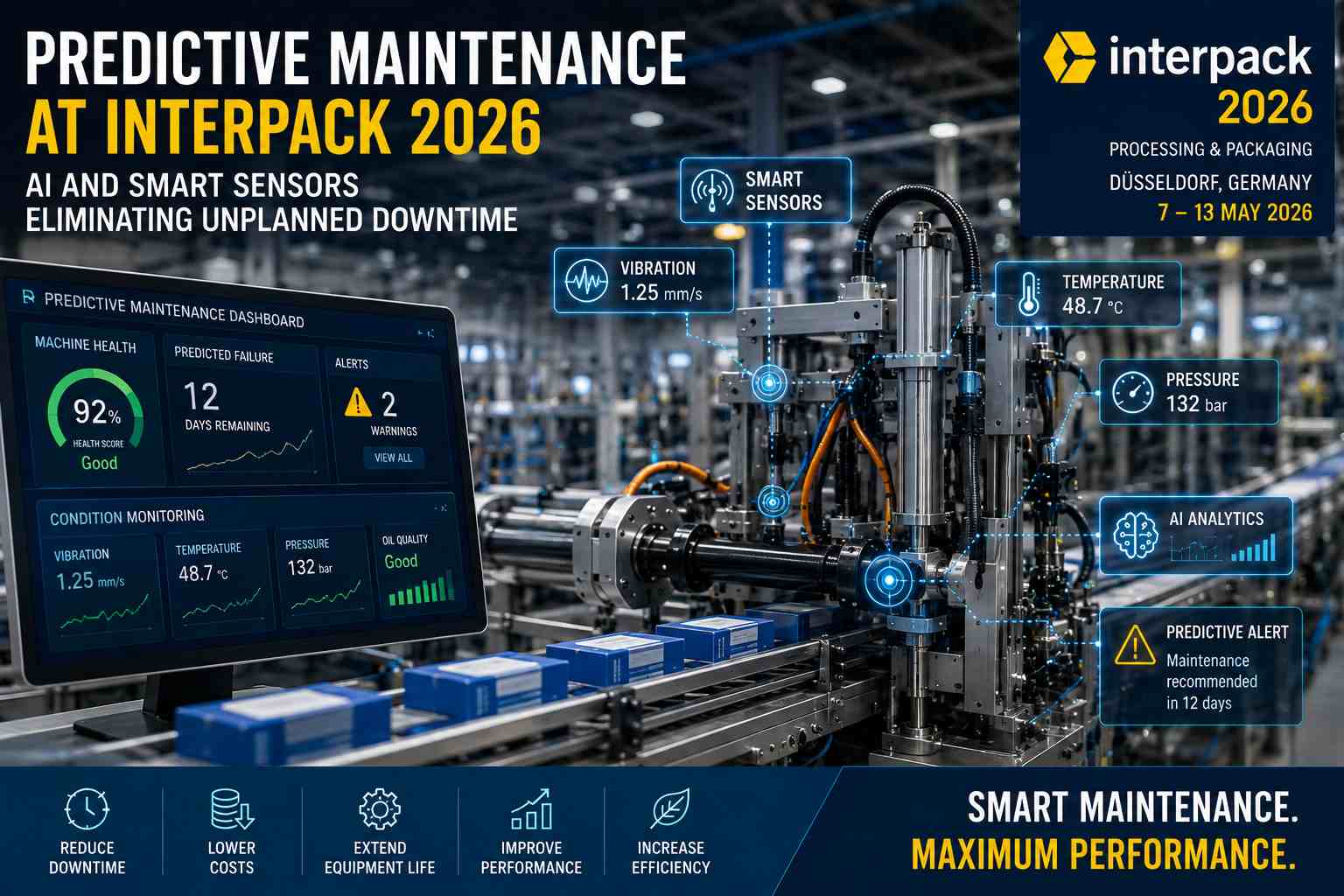
To address this challenge, manufacturers are increasingly adopting predictive maintenance, combining Artificial Intelligence, Industrial IoT, smart sensors and real-time analytics to identify equipment issues before failures occur.
At Interpack 2026, predictive maintenance is expected to be one of the most important technologies showcased by machine builders, automation suppliers and software developers.
Rather than repairing machines after a breakdown, predictive maintenance enables companies to anticipate problems and schedule maintenance at the optimal time.
What Is Predictive Maintenance?
Predictive maintenance is a maintenance strategy based on continuous monitoring of machine condition.
Instead of replacing components according to fixed schedules, predictive systems analyze equipment performance and predict when maintenance will actually be required.
Typical monitored parameters include:
- vibration
- hydraulic pressure
- oil temperature
- bearing condition
- motor current
- machine speed
- cycle counts
- energy consumption
This approach improves machine reliability while reducing unnecessary maintenance activities.
Why Packaging Manufacturers Are Adopting Predictive Maintenance
Packaging production often operates continuously.
Unexpected failures may result in:
- production delays
- missed deliveries
- increased scrap
- emergency repair costs
- customer dissatisfaction
- higher operating expenses
Predictive maintenance significantly reduces these risks by providing early warnings before failures occur.
Artificial Intelligence Makes Maintenance Smarter
Artificial Intelligence has transformed predictive maintenance.
AI continuously analyzes production data to identify patterns that indicate potential equipment problems.
Applications include:
- anomaly detection
- equipment health scoring
- automatic diagnostics
- maintenance recommendations
- failure prediction
- production optimization
Machine learning models improve continuously as more operational data becomes available.
Smart Sensors Monitor Machine Health
Modern packaging machinery includes numerous intelligent sensors.
These sensors monitor:
- hydraulic systems
- servo motors
- pneumatic actuators
- conveyors
- robotic arms
- pumps
- valves
- gearboxes
Continuous monitoring allows manufacturers to detect abnormal behavior immediately.
Industrial IoT Connects Every Machine
Industrial IoT enables predictive maintenance by collecting data from every connected machine.
Information is transmitted to central monitoring platforms where engineers can analyze:
- production performance
- equipment utilization
- maintenance history
- energy efficiency
- machine availability
Connected factories provide unprecedented visibility into equipment condition.
Predictive Maintenance for Hydraulic Systems
Hydraulic motion systems remain essential in many packaging applications.
Predictive monitoring can identify:
- pressure loss
- seal wear
- internal leakage
- abnormal temperatures
- contamination
- actuator performance degradation
Early detection helps extend equipment life while avoiding costly failures.
Digital Twins Improve Maintenance Planning
Digital Twin technology complements predictive maintenance by simulating equipment behavior.
Engineers can evaluate:
- maintenance schedules
- component replacement
- production impact
- machine performance
Simulation improves planning while minimizing production interruptions.
Benefits of Predictive Maintenance
Companies adopting predictive maintenance typically experience:
- lower maintenance costs
- reduced downtime
- improved machine availability
- longer equipment life
- higher productivity
- better product quality
- improved energy efficiency
These benefits directly improve overall manufacturing competitiveness.
Industries Benefiting from Predictive Maintenance
Predictive maintenance supports:
- food processing
- beverage production
- pharmaceutical manufacturing
- cosmetics
- consumer goods
- logistics automation
- industrial packaging
Every production environment benefits from greater equipment reliability.
Frequently Asked Questions
What is predictive maintenance?
Predictive maintenance uses real-time equipment monitoring, sensors and AI to predict failures before they occur.
Why is predictive maintenance important?
It reduces downtime, lowers maintenance costs, improves machine reliability and increases production efficiency.
Will predictive maintenance be featured at Interpack 2026?
Yes. Predictive maintenance is expected to be one of the major themes alongside Artificial Intelligence, Industrial IoT and Smart Manufacturing.
Which technologies enable predictive maintenance?
Artificial Intelligence, Industrial IoT, Digital Twins, smart sensors and cloud analytics all contribute to predictive maintenance.
Can hydraulic systems be monitored predictively?
Yes. Hydraulic pressure, temperature, contamination and actuator performance can all be monitored continuously.
Looking Ahead
Maintenance is evolving from reactive repairs to intelligent prediction.
By combining Artificial Intelligence, connected sensors and advanced analytics, predictive maintenance allows packaging manufacturers to maximize machine availability while reducing operating costs.
Interpack 2026 is expected to demonstrate how predictive maintenance will become a standard feature of next-generation packaging production systems.