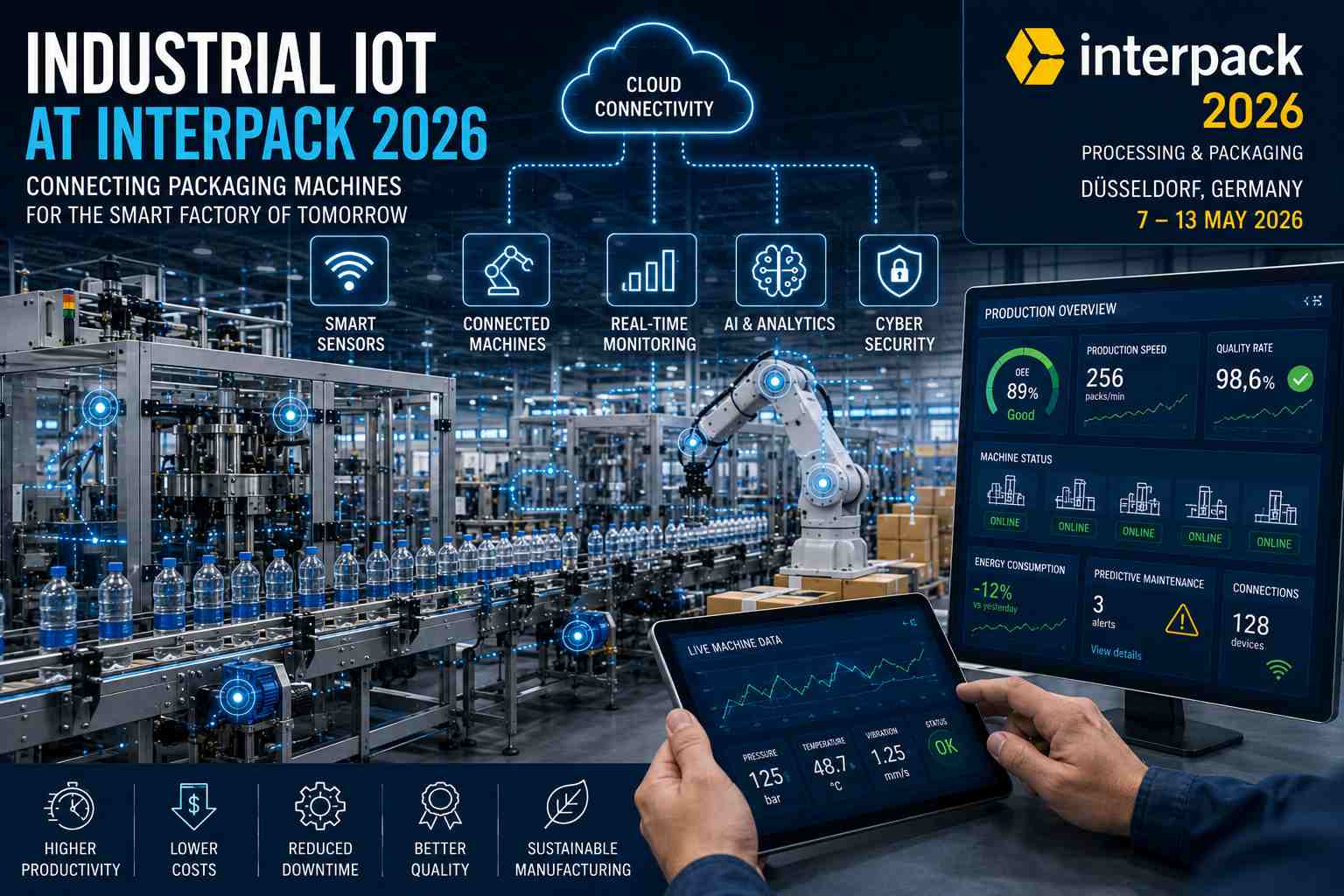
Industrial IoT at Interpack 2026: Connecting Packaging Machines for the Smart Factory of Tomorrow
The packaging industry is becoming increasingly connected. Machines, sensors, robots and software are no longer isolated systems but part of an intelligent manufacturing ecosystem where every device continuously exchanges information.
At Interpack 2026, Industrial Internet of Things (Industrial IoT or IIoT) is expected to be one of the key technologies driving the next generation of packaging production.
By connecting equipment across the factory, Industrial IoT enables manufacturers to monitor performance in real time, optimize production, reduce downtime and improve decision-making.
As packaging lines become faster and more automated, connected manufacturing is no longer optional—it is becoming a competitive necessity.
What Is Industrial IoT?
Industrial Internet of Things refers to the network of connected industrial devices that collect, exchange and analyze operational data.
Unlike traditional automation, Industrial IoT creates communication between:
- packaging machines
- robots
- PLCs
- servo drives
- hydraulic systems
- sensors
- conveyors
- production software
- cloud platforms
Every connected component contributes valuable production information.
Why Industrial IoT Matters
Packaging manufacturers face constant pressure to:
- increase productivity
- improve quality
- reduce downtime
- lower operating costs
- improve sustainability
- increase production flexibility
Industrial IoT provides real-time visibility across the entire production process.
Managers no longer rely only on historical reports—they can monitor operations live.
Smart Sensors Collect Valuable Data
Modern packaging machines include hundreds of intelligent sensors.
These devices monitor:
- temperature
- pressure
- vibration
- humidity
- flow
- motor current
- hydraulic pressure
- actuator position
- machine speed
Continuous monitoring allows operators to detect small deviations before they become larger problems.
Connected Packaging Machines
Industrial IoT transforms individual machines into connected production systems.
Typical connected equipment includes:
- filling machines
- labeling systems
- cartoners
- palletizers
- robots
- conveyors
- inspection systems
Each machine continuously exchanges operational data with other equipment.
Real-Time Production Monitoring
One of the greatest advantages of Industrial IoT is live production visibility.
Operators can monitor:
- machine status
- Overall Equipment Effectiveness (OEE)
- production speed
- downtime
- quality rate
- reject rate
- energy consumption
Real-time dashboards allow immediate corrective actions.
Artificial Intelligence and IIoT
Artificial Intelligence greatly increases the value of Industrial IoT.
AI algorithms analyze production data to:
- optimize machine parameters
- predict equipment failures
- improve energy efficiency
- reduce waste
- automate quality control
The combination of AI and IIoT creates self-improving production systems.
Cloud Connectivity
Industrial IoT increasingly relies on secure cloud platforms.
Cloud connectivity enables:
- remote monitoring
- global factory management
- centralized reporting
- software updates
- predictive analytics
- cross-site benchmarking
Manufacturers operating multiple plants can compare production performance worldwide.
Industrial IoT and Motion Control
Motion systems generate valuable operational data.
Connected motion components include:
- servo drives
- linear actuators
- hydraulic cylinders
- positioning systems
- robotic axes
- electric actuators
Monitoring motion performance improves precision while reducing wear.
Predictive Maintenance
Industrial IoT forms the foundation of predictive maintenance.
Connected sensors continuously analyze:
- vibration
- pressure
- oil temperature
- cycle counts
- actuator performance
- motor efficiency
Maintenance becomes data-driven instead of schedule-driven.
Cybersecurity in Connected Factories
As connectivity increases, cybersecurity becomes essential.
Manufacturers are investing in:
- encrypted communications
- secure industrial networks
- user authentication
- firewall protection
- secure cloud infrastructure
- network segmentation
Protecting production data is as important as protecting physical equipment.
Sustainability Through Connectivity
Industrial IoT supports sustainability by helping companies:
- reduce energy consumption
- minimize waste
- improve resource utilization
- optimize production planning
- lower carbon emissions
Connected factories operate more efficiently while reducing environmental impact.
Frequently Asked Questions
What is Industrial IoT?
Industrial IoT connects industrial machines, sensors and software to exchange real-time production data.
Why is IIoT important for packaging?
It improves machine monitoring, predictive maintenance, production efficiency and quality control.
Will Industrial IoT be featured at Interpack 2026?
Yes. Industrial IoT is expected to be one of the exhibition’s most important technology themes.
How does IIoT support predictive maintenance?
Connected sensors continuously monitor equipment condition and identify problems before failures occur.
Can hydraulic systems be connected?
Yes. Hydraulic pressure, temperature, actuator position and performance can all be monitored through Industrial IoT solutions.
Looking Ahead
Industrial IoT is transforming packaging manufacturing by connecting machines, people and data into a single intelligent ecosystem.
Combined with Artificial Intelligence, Digital Twins and predictive maintenance, Industrial IoT enables manufacturers to build smarter, more efficient and more sustainable factories.
Interpack 2026 is expected to demonstrate how connected manufacturing will shape the future of packaging automation.