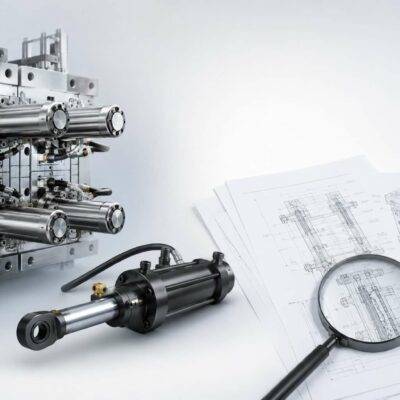

Replacing a hydraulic unscrewing device in an injection mold is not always a matter of finding a component with exactly the same dimensions as the existing product.
When a Customer approached Vega looking for an alternative to an existing hydraulic unscrewing device, the initial requirement was based on a 25 mm bore. The technical evaluation immediately identified an important limitation: Vega’s unscrewing-cylinder range started from 32 mm bore.
Rather than simply rejecting the request, the Vega Team evaluated whether a 32 mm solution could represent a technically suitable alternative.
This case illustrates an important principle in hydraulic cylinder selection: a replacement should be evaluated as part of the complete application, not only by comparing one dimensional parameter.
Understanding the application before selecting the cylinder
The original request concerned a hydraulic unscrewing device intended for an injection-molding application. The Customer was already using a solution from another manufacturer and was interested in switching to Vega. The existing manufacturer’s catalogue was provided as a reference for the required dimensions.
This is a common situation in industrial applications.
When replacing an existing hydraulic component, the engineering team needs to establish which characteristics are essential and which can potentially be modified.
For an unscrewing application, the evaluation may include:
- cylinder bore;
- stroke;
- available installation space;
- rack and pinion arrangement;
- required force;
- hydraulic pressure;
- required movement;
- fixing configuration;
- position sensing;
- compatibility with the existing mold.
The goal is therefore not necessarily to reproduce the original component exactly, but to identify a solution capable of performing the required function within the available space and operating conditions.
When the requested bore is not available
In this particular application, the requested bore was 25 mm.
The Vega Team explained that the Vega unscrewing-cylinder range started from 32 mm bore, meaning that a 25 mm version could not be supplied.
The technical evaluation did not stop there.
The Customer was offered the possibility of considering a 32 mm bore solution instead, with two alternative configurations proposed:
- CS0321.0650AGMN300
- CS0321.0650CGHN300
This is an important distinction when selecting hydraulic equipment.
A dimensional difference does not automatically mean that an application is impossible. It means that the complete system needs to be recalculated and checked.
Why a larger bore can be a viable alternative
The bore of a hydraulic cylinder directly influences the force available at a given hydraulic pressure.
Consequently, moving from a 25 mm bore to a 32 mm bore is not a simple one-to-one replacement. The resulting force, dimensions and integration requirements must be evaluated.
For this reason, the correct engineering approach is to ask:
Can the larger cylinder perform the required movement and force while remaining compatible with the mold?
The answer depends on the application.
Vega’s current V210CS range is specifically designed for unscrewing movements in plastic injection molds. Standard versions are available with piston bores from 32 to 50 mm and strokes from 300 to 500 mm.
V210CS Hydraulic Cylinders for Unscrewing Systems – Vega Cylinders
The V210CS approach
The V210CS is designed specifically for applications where hydraulic actuation is used to generate an unscrewing movement.
The system combines a compact V220CC cylinder with one or two racks mounted on its sides. The racks work with the corresponding pinion system to transform the cylinder’s linear movement into the rotational movement required for unscrewing.
The central cylinder body is manufactured from 7075 aluminum alloy and closed at both ends by steel flanges. The parallel arrangement of the racks contributes to the compact design of the system.
This compact architecture can be particularly valuable in injection molds, where available installation space is often limited.
Compactness can be an important engineering parameter
In an injection mold, available space is rarely unlimited.
A hydraulic unscrewing system must fit within the mold architecture while maintaining the required mechanical performance.
The V210CS is designed specifically with this requirement in mind. Vega identifies compactness as one of its main advantages compared with tie-rod-cylinder solutions, particularly in molds where installation space is restricted.
The rack arrangement, positioned parallel to the cylinder body, also provides a responsive movement for the unscrewing operation. A rear adjustment screw allows adjustment of the rack-and-pinion engagement and the cylinder starting position.
V210CS – Official Vega page in English
Two configurations instead of one forced solution
In the Customer case, the Vega Team proposed two different 32 mm configurations rather than assuming that a single configuration would necessarily be suitable.
This approach can be useful when replacing an existing device because the mechanical interface of the mold may impose constraints that cannot be understood from bore and stroke alone.
The correct configuration may depend on:
- the available space;
- the existing fixing arrangement;
- the rack position;
- the required stroke;
- the position of the pinion;
- the required movement;
- the desired sensing configuration.
The current Vega product range confirms that the V210CS belongs specifically to the Unscrewing category of hydraulic cylinders for molds.
Hydraulic Cylinders for Molds – Vega Cylinders
The importance of the stroke
Stroke is another critical parameter in an unscrewing application.
The linear movement of the cylinder determines the movement available to the rack. This movement is then converted into rotation through the rack-and-pinion mechanism.
For this reason, the required stroke must be considered together with the desired rotational movement and the geometry of the complete unscrewing system.
In the historical Customer request, the proposed configurations included 300 mm in their product codes, while the technical material attached to the correspondence also included drawings of similar configurations, including a 400 mm stroke version.
This reinforces the importance of selecting the configuration according to the actual application rather than assuming that every V210CS configuration is interchangeable.
3D design can help verify integration
Another important point in the original technical exchange was the availability of a 3D drawing after the selected cylinder had been ordered.
For mold manufacturers and designers, three-dimensional data can be extremely useful for checking the integration of the hydraulic cylinder into the existing mold.
The model can help verify:
- installation space;
- possible interference;
- fixing points;
- rack and pinion positioning;
- access for assembly;
- maintenance access;
- relationship with adjacent mold components.
This is especially relevant when replacing an existing product with a different manufacturer’s solution.
Position sensing and magnetic detection
The V210CS can also be equipped with a magnetic system for monitoring piston position.
According to Vega’s current product documentation, the piston contains a magnet that generates a magnetic field. Adjustable electronic sensors can detect this field and provide a signal to the injection-molding machine’s PLC.
The sensors specified for this system have a maximum working temperature of 80 °C. The V210CS is rated for a maximum working pressure of 180 bar and a maximum speed of 0.1 m/s.
These parameters must always be compared with the actual operating conditions of the mold.
Hydraulic requirements must be considered together
The selection of an unscrewing cylinder cannot be based on bore alone.
The engineering evaluation should consider the complete hydraulic and mechanical system.
For example:
Hydraulic pressure → cylinder force → rack force → pinion torque → unscrewing torque → thread release
This chain is fundamental to the design of a hydraulic unscrewing system.
Vega’s technical material on unscrewing devices explains that the required stripping force, gear-train characteristics, rack stroke and tooth forces must all be considered before defining the cylinder bore.
Unscrewing Devices – Vega Cylinders Official Blog
This is why selecting a cylinder solely because its bore appears close to the original product can lead to an incorrect engineering solution.
The hydraulic fluid also matters
The V210CS is specified for use with ISO VG 46 mineral oil.
When replacing a hydraulic component from another manufacturer, the compatibility of the hydraulic fluid should therefore also be checked.
A successful replacement requires compatibility not only with the mechanical interface but also with the hydraulic operating conditions.
A replacement should be evaluated as a system
The Customer case demonstrates a practical approach to industrial component replacement.
The initial request was:
“Can Vega supply an equivalent hydraulic unscrewing device?”
The technical answer was not simply yes or no.
Instead, the Vega Team:
- examined the requested bore;
- identified that the Vega range started at 32 mm;
- proposed a 32 mm alternative;
- provided two possible configurations;
- supplied catalogue information and drawings;
- offered further technical clarification;
- indicated that a 3D drawing could be supplied for the selected configuration.
This is a good example of how technical support can transform a replacement request into an engineering evaluation.
Choosing the right solution rather than copying the old one
An existing hydraulic device defines the starting point of the analysis, but it does not necessarily define the final solution.
A successful replacement should satisfy the actual requirements of the mold:
- required force;
- required stroke;
- rotational movement;
- available space;
- hydraulic conditions;
- mechanical interfaces;
- sensing requirements;
- maintenance requirements.
The current Vega range includes several hydraulic-cylinder architectures for injection molds, with the V210CS specifically dedicated to unscrewing applications.
Vega Hydraulic Cylinders for Injection Molds – Product Range
Conclusion
Replacing a hydraulic unscrewing device is an engineering task, not simply a dimensional substitution.
In this Customer application, the original requirement called for a 25 mm bore, while Vega’s unscrewing-cylinder range started from 32 mm. Instead of stopping at this difference, the Vega Team evaluated suitable 32 mm alternatives and provided the technical documentation needed to continue the evaluation.
The V210CS is specifically designed for hydraulic unscrewing applications in plastic injection molds, combining a compact hydraulic cylinder with a rack-and-pinion system.
The main lesson is therefore simple:
When replacing a hydraulic unscrewing device, the best solution is not necessarily the one that copies the original component. It is the solution that satisfies the mechanical, hydraulic and spatial requirements of the complete mold.
Useful verified Vega URLs
- V210CS Hydraulic Cylinders for Unscrewing Systems — Official Vega product page with V210CS construction, dimensions range, operating pressure, speed, magnetic sensors and technical characteristics.
- Hydraulic Cylinders for Molds — Official overview of Vega hydraulic cylinders categorized by mold application, including the Unscrewing section and V210CS.
- Unscrewing Devices – Vega Cylinders Official Blog — Technical article explaining how hydraulic unscrewing systems are designed, including force, torque, rack stroke and cylinder sizing.
- Hydraulic Unscrewing Systems — Overview of hydraulic unscrewing mechanisms and their applications in injection molds.
- Thread Unscrewing Systems — Technical overview of different thread-release mechanisms used in injection molds.