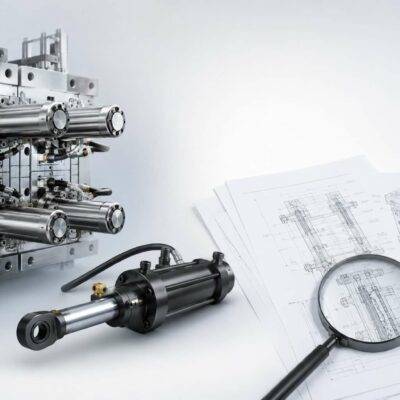

A Real Engineering Case on Preventing Internal Interference in Hydraulic Cylinders
The installation of hydraulic fittings is often considered a routine assembly operation. Once the fitting has been tightened and no external oil leakage is visible, the connection is usually assumed to be correct.
In reality, the installation of threaded hydraulic fittings is a critical engineering operation that directly affects the reliability, safety and service life of the entire hydraulic system.
One common misconception is that the deeper a fitting can be screwed into the cylinder, the safer the connection becomes. While an insufficient number of engaged threads certainly reduces the mechanical strength of the connection, excessive thread engagement can create equally serious problems by allowing the fitting to interfere with internal hydraulic components.
This real engineering case demonstrates how the Vega Technical Department solved a problem involving the installation depth of hydraulic nipples on mold cylinders, balancing thread engagement with the internal geometry of the cylinder head.
The Customer’s Concern
A mold manufacturer reported that the hydraulic fittings supplied with several cylinders engaged only about 8 mm, corresponding to approximately four threads.
Because the mold would operate at pressures up to 150 bar, the customer questioned whether this limited thread engagement was sufficient from both a functional and safety standpoint and requested that the cylinder threads be modified if necessary.
The concern was understandable.
Threaded hydraulic connections are subjected to internal pressure, tightening torque and dynamic mechanical loads during every machine cycle. Engineers naturally associate a greater number of engaged threads with increased safety.
However, the engineering evaluation revealed that the situation was more complex.
Increasing Thread Engagement Was Not the Real Solution
The first corrective action consisted of reworking the cylinder threads.
This operation allowed approximately three additional threads to engage compared with the original condition.
Although the improvement was measurable, the customer still considered the engagement less than ideal and expressed concern about operating the mold safely.
At this stage, simply extending the thread further might have appeared to be the obvious solution.
Instead, the Vega Technical Department performed a dimensional analysis of the cylinder head.
The Hidden Risk: Internal Interference
The engineering investigation identified the true design constraint.
The front cylinder head provided approximately 17.5 mm of usable material thickness around the threaded port, while the threaded portion of the hydraulic nipple measured between 17.5 and 18 mm.
Allowing the fitting to screw completely into the port would therefore create the risk of the nipple interfering with the internal seat of the cushioning bushing.
The objective was therefore not to maximize thread engagement.
Instead, the fitting had to stop at a precise position that guaranteed:
- sufficient engaged threads for mechanical strength;
- correct tightening torque;
- proper sealing;
- complete clearance from internal hydraulic components.
Defining the Correct Installation Position
Following the dimensional analysis, the Vega Technical Department established a precise installation criterion.
The hydraulic nipple should remain approximately 3 mm away from the hexagon after tightening.
This position provided enough adjustment to achieve the specified tightening torque while preventing any contact between the threaded end of the fitting and the cushioning seat inside the cylinder head.
This recommendation demonstrates an important principle of hydraulic engineering:
The correct installation position is determined by the internal design of the component, not by the maximum possible thread engagement.
Why Internal Interference Is Dangerous
Many designers focus exclusively on external leakage.
However, a fitting that extends too far inside the cylinder may create problems that are invisible during assembly.
Possible consequences include:
- interference with cushioning bushings;
- obstruction of internal oil passages;
- damage to moving hydraulic components;
- incorrect cushioning performance;
- contamination generated by mechanical contact;
- premature component failure.
Because these problems develop internally, they may remain undetected until the hydraulic system is already operating in production.
Operating Under Critical Conditions
Before the engineering analysis was completed, the customer considered the assembly to be operating under conditions close to the acceptable safety limit and planned to keep operating pressure as low as possible until a permanent solution became available.
Rather than accepting this temporary compromise, the Vega Technical Department defined a permanent dimensional correction for the remaining cylinders.
In addition, the cylinders already installed in the mold shipped to Germany were scheduled to be modified as soon as the mold returned to Italy.
This approach ensured that every cylinder would comply with the same dimensional standard.
Engineering Lessons Learned
This engineering case highlights several important design principles.
First, more engaged threads do not automatically produce a safer hydraulic connection.
A threaded connection must satisfy multiple requirements simultaneously:
- mechanical strength;
- sealing capability;
- correct tightening torque;
- compatibility with manufacturing tolerances;
- sufficient clearance from internal components.
Optimizing only one of these factors may compromise the entire hydraulic assembly.
Best Practices for Hydraulic Fitting Installation
Whenever threaded hydraulic fittings are installed on hydraulic cylinders, engineers should verify:
- thread engagement length;
- available material thickness;
- fitting thread length;
- internal component clearance;
- tightening torque specifications;
- sealing method;
- compatibility with maximum operating pressure.
These checks should always be completed during the design stage rather than after the mold has been assembled.
Conclusions
The safest hydraulic fitting is not the one that engages the greatest number of threads.
Instead, it is the fitting that has been designed to provide the correct balance between mechanical strength, sealing performance and internal clearance.
This real engineering case demonstrates how careful dimensional analysis allowed the Vega Technical Department to solve a potentially critical installation issue without redesigning the hydraulic cylinder itself. By understanding the interaction between the threaded connection and the cylinder’s internal geometry, it was possible to define a reliable assembly procedure that ensured both safety and long-term reliability.
Further Technical Reading
To further explore the engineering concepts discussed in this case, we recommend the following technical articles:
- Hydraulic Cylinder Troubleshooting Guide
https://www.icvega.com/hydraulic-cylinder-troubleshooting-guide/ - How to Calculate the Correct Hydraulic Cylinder Size for Injection Molds
https://www.icvega.com/how-to-calculate-the-correct-hydraulic-cylinder-size-for-injection-molds/ - Pilot Operated Check Valves: Working Principle and Installation
https://www.icvega.com/pilot-operated-check-valves-working-principle-and-installation/ - Hydraulic Cylinder Assembly Best Practices
https://www.icvega.com/hydraulic-cylinder-assembly-best-practices/