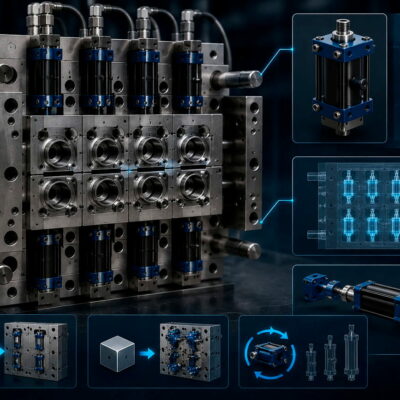

Oil leakage from a hydraulic cylinder connection can appear to be a minor problem. In an injection mold, however, even a small leak can create contamination, maintenance problems, pressure loss and unnecessary downtime.
A real Vega technical application highlights an important issue that is sometimes underestimated during hydraulic cylinder and mold design: the choice of the hydraulic port and thread standard.
The customer in this application reported oil leakage from the hydraulic ports. Sealing material and Loctite had already been used in an attempt to solve the problem, but the result was not satisfactory. The customer therefore asked whether BSP was preferable to NPT and whether an existing NPT 1/4 port could be changed to BSP 1/4.
Vega’s Technical Department recommended BSP as the better solution for avoiding the leakage problem, but also explained that the existing NPT ports could not simply be converted to BSP. The cylinder body would have to be replaced.
This relatively simple technical exchange illustrates a much broader engineering principle:
The hydraulic connection should be considered part of the cylinder design, not treated as an accessory that can always be changed after manufacturing.
Why the Hydraulic Port Standard Matters
NPT and BSP are different thread standards.
They should therefore not be considered interchangeable simply because they have similar nominal sizes.
A hydraulic connection involves several parameters, including:
- thread geometry;
- nominal size;
- pitch;
- thread angle;
- taper;
- sealing principle;
- mating fitting;
- installation method.
Consequently, specifying only a size such as 1/4 inch is not sufficient.
A correct technical specification should identify the complete connection standard.
For a cylinder manufacturer, the difference is particularly important because the threaded port is normally machined directly into the cylinder body.
Once the body has been manufactured with a particular thread, changing the connection standard may require a completely different machining operation or, as in this application, replacement of the body itself.
NPT and BSP Are Not Simply Alternative Names for the Same Connection
A common mistake in hydraulic applications is to assume that a fitting marked 1/4 NPT can simply be replaced with one marked 1/4 BSP.
The nominal size alone does not make two threaded connections compatible.
The thread geometry and sealing method must be considered together.
Trying to force incompatible threads together can result in:
- damaged threads;
- insufficient engagement;
- poor sealing;
- leakage;
- difficult assembly;
- difficult future maintenance.
This is particularly problematic in injection molds because hydraulic cylinders are often installed in restricted spaces where replacing a damaged fitting or repairing a port can require partial disassembly of the mold.
The Problem in the Vega Application
In the documented application, the customer had already attempted to address the leakage by using sealing material and Loctite around the oil port. However, the problem was not completely solved.
The customer then asked whether the solution should be to change the connection from NPT 1/4 to BSP 1/4.
Vega’s response was straightforward:
BSP was considered the better solution to avoid the leakage problem.
However:
the existing NPT port could not simply be modified to BSP.
The solution required a replacement cylinder body.
This is an important distinction.
Changing the thread specification on a drawing is easy.
Changing the thread geometry in an already manufactured cylinder body is a completely different engineering problem.
Why Adding More Sealant Is Not Always the Solution
When a threaded hydraulic connection leaks, the first reaction is often to add more sealing material.
This can sometimes work when the connection, sealing method and assembly procedure are all appropriate.
But sealing compound cannot compensate for every possible problem.
If the underlying issue is:
- incompatible thread standards;
- damaged threads;
- incorrect fitting;
- inadequate thread engagement;
- incorrect assembly;
- excessive mechanical stress;
then simply applying more sealant does not correct the fundamental problem.
The correct approach is to determine why the connection is leaking before deciding how to repair it.
This principle is consistent with Vega’s broader approach to hydraulic-cylinder troubleshooting: when leakage occurs, the visible leak should not automatically be assumed to identify the root cause.
Threading and Sealing Are Not Exactly the Same Thing
Another important engineering distinction is between the mechanical connection and the sealing function.
The thread provides mechanical engagement between two components.
The sealing system prevents hydraulic fluid from escaping.
Depending on the connection design, sealing may involve:
- the threaded interface;
- a sealing face;
- an O-ring;
- a gasket;
- a dedicated sealing element;
- an appropriate thread sealant.
Therefore, when a hydraulic port leaks, the first question should be:
How is this particular connection actually designed to seal?
Only after this has been established should the engineer determine whether the problem involves the thread, the fitting, the sealing element or the assembly procedure.
Why Excessive Tightening Is Not a Universal Solution
Another common reaction to a leaking hydraulic connection is to tighten the fitting further.
This may temporarily reduce leakage, but excessive tightening can introduce new problems.
Possible consequences include:
- thread deformation;
- damaged fittings;
- damaged sealing surfaces;
- excessive stress in the cylinder body;
- difficulty during future disassembly.
This is especially important when the threaded port is machined directly into the cylinder body.
If the body thread is damaged, replacing the fitting may no longer be sufficient.
The problem has moved from a relatively inexpensive component to a cylinder-body repair or replacement issue.
Vega has documented another hydraulic-cylinder application in which excessive tightening of a threaded component ultimately caused severe thread damage to the cylinder body.
That is a useful reminder that more torque is not necessarily more sealing.
Why the Existing NPT Port Could Not Simply Become BSP
The customer specifically asked whether the existing NPT 1/4 port could be changed to BSP 1/4.
Vega explained that this modification was not possible on the existing body and that a new body would be required.
The reason is fundamentally related to manufacturing geometry.
The hydraulic port is a precision-machined feature in the cylinder body.
Changing its thread standard requires sufficient material, appropriate geometry and the possibility of producing the new thread without compromising:
- wall thickness;
- port position;
- structural integrity;
- sealing geometry;
- compatibility with the cylinder design.
An already manufactured cylinder body cannot always accommodate such a modification safely.
Therefore, when a customer needs a different hydraulic connection, the most technically appropriate solution may be to manufacture the cylinder body with the required port specification from the beginning.
The Best Time to Choose the Connection Is Before Manufacturing
This leads to a fundamental design rule:
Specify the hydraulic connection before the cylinder is manufactured.
For a hydraulic cylinder used in an injection mold, the design specification should include:
- thread standard;
- port size;
- port position;
- port orientation;
- connection type;
- sealing method;
- hose routing;
- available installation space.
This avoids expensive modifications later.
Vega’s current configurator illustrates this approach. The V500CZ configuration system allows the designer to select the oil-port configuration and position as part of the cylinder definition. A documented V500CZ configuration uses BSP-threaded oil ports and specifies the port position directly in the product code.
Oil-Port Position Is as Important as the Thread
The thread standard is only one part of the hydraulic connection.
In an injection mold, the location of the port can be equally important.
A hydraulic cylinder may be surrounded by:
- mold plates;
- slides;
- cores;
- ejector systems;
- cooling channels;
- sensors;
- hydraulic hoses.
A theoretically correct connection can still create a practical problem if there is insufficient space to connect or service it.
The designer should therefore consider:
thread standard + port position + hose routing + accessibility
as one integrated design problem.
Vega’s V500CZ configurator specifically incorporates oil-port position into the cylinder configuration, demonstrating the importance of this parameter during product selection.
Hydraulic Connections and Mold Compactness
Injection molds generally require compact solutions.
Every millimeter of space around a hydraulic cylinder can matter.
The hydraulic connection therefore influences not only sealing reliability but also the overall architecture of the mold.
A poorly positioned connection may cause:
- hose interference;
- difficult assembly;
- excessive hose bending;
- reduced accessibility;
- longer maintenance operations.
For this reason, the hydraulic connection should be evaluated together with the mold’s mechanical layout.
Vega’s technical material on hydraulic cylinders also emphasizes the importance of compact hydraulic solutions and correct oil-port configurations in mold applications.
Why a Small Hydraulic Leak Can Become a Major Problem
A leak from a hydraulic port may initially appear insignificant.
But in an injection mold, the consequences can extend beyond the lost oil itself.
Potential effects include:
- contamination of the mold;
- contamination of the molded product;
- pressure instability;
- increased maintenance;
- unexpected downtime;
- difficult fault diagnosis;
- progressive deterioration of nearby components.
Vega emphasizes the importance of reliable sealing in hydraulic cylinders used for molds because leakage from rod seals, for example, can potentially contaminate the molded product.
The same system-level philosophy should be applied to hydraulic port connections.
How to Diagnose a Leaking Hydraulic Port
When oil appears around a hydraulic connection, the investigation should follow a structured procedure.
1. Identify the actual source
Do not assume that the visible oil comes from the fitting itself.
Oil can travel along surfaces before becoming visible.
2. Identify the connection standard
Confirm whether the port and fitting use:
- NPT;
- BSP;
- another thread standard.
3. Check compatibility
The fitting must be compatible with the cylinder port.
4. Inspect the thread
Look for:
- damaged threads;
- cross-threading;
- deformation;
- contamination;
- excessive tightening.
5. Check the sealing method
Determine how the connection is intended to prevent leakage.
6. Check the hydraulic pressure
Verify the actual operating pressure and whether pressure peaks are possible.
7. Check hose loading
A hose should not impose inappropriate lateral forces on the fitting or cylinder port.
8. Determine whether the port can be repaired
If the thread is machined directly into the cylinder body, repair possibilities may be limited.
Do Not Ignore the Hydraulic System
A hydraulic connection cannot be evaluated entirely independently of the circuit.
The operating conditions can influence the reliability of the connection.
Relevant factors may include:
- operating pressure;
- pressure peaks;
- temperature;
- vibration;
- hose movement;
- installation stresses;
- hydraulic fluid condition.
Vega’s technical literature repeatedly emphasizes that leakage analysis should consider the operating conditions rather than simply replacing the visible failed component.
This is particularly important when the same leakage problem appears on several cylinders connected to the same system.
When Several Cylinders Use the Same Connection
The original technical communication also asked how many cylinders were installed on the mold.
This is a practical but important detail.
If a mold contains multiple cylinders using the same hydraulic connection, changing the connection standard may involve multiple cylinder bodies.
The number of cylinders therefore affects:
- spare-parts requirements;
- modification cost;
- mold downtime;
- installation time;
- maintenance planning.
This is another reason why the hydraulic connection should be defined correctly at the beginning of the project.
Design for Future Maintenance
A good hydraulic connection is not only one that does not leak when the mold is new.
It should also be easy to inspect and maintain throughout the mold’s service life.
The designer should ask:
- Can the fitting be reached?
- Is there enough space for tools?
- Can the hose be disconnected without removing the cylinder?
- Can the connection be visually inspected?
- Is the thread standard compatible with the maintenance department?
- Can spare parts be sourced easily?
- Can the cylinder body be replaced if necessary?
These questions become particularly important in molds expected to operate for hundreds of thousands or millions of cycles.
NPT or BSP: The More Important Question
It would be too simplistic to reduce the engineering decision to:
“BSP is always better than NPT.”
The more useful lesson from the Vega application is:
Use the connection standard appropriate for the cylinder design, hydraulic system, fittings and application, and specify it correctly before manufacturing.
In the specific application documented by Vega, BSP was recommended as the better solution for avoiding the reported leakage problem.
That recommendation should not be generalized into a statement that one thread standard is universally superior in every hydraulic application.
The correct engineering choice depends on the complete system.
The Main Engineering Lessons
This application provides several practical lessons for mold designers and hydraulic engineers.
1. Specify the thread standard explicitly
Do not specify only the nominal connection size.
2. Do not assume NPT and BSP are interchangeable
Different thread standards require compatible components.
3. Do not rely on sealant to compensate for an unsuitable connection
The connection itself must be correctly designed.
4. Avoid excessive tightening
More torque does not necessarily mean better sealing.
5. Consider the cylinder body
The hydraulic port may be machined directly into the body and may not be easily modified later.
6. Define the connection before manufacturing
Changing the specification after production may require a replacement body.
7. Consider port position
Connection accessibility and hose routing are part of mold design.
8. Think about maintenance
The connection should remain accessible throughout the mold’s service life.
Conclusion
A hydraulic cylinder can be precisely manufactured, correctly sized and mechanically robust, yet still experience problems if the hydraulic connection is not properly selected.
The Vega application discussed here began with a relatively simple problem: oil leakage from the hydraulic port.
The customer had already tried sealing material and Loctite, but the problem remained. The technical discussion then focused on the difference between NPT and BSP.
Vega recommended BSP as the better solution for this particular application, while explaining that the existing NPT ports could not simply be converted. The cylinder body had to be replaced.
The broader lesson is more important than the specific connection standard:
Hydraulic ports should be treated as an integral part of cylinder and mold design.
Thread standard, sealing method, port position, hose routing, accessibility and future maintenance should all be considered before the cylinder is manufactured.
A small threaded connection may occupy only a few millimeters of the cylinder body, but its design can have a significant impact on the reliability of the entire hydraulic system.
Useful and Verified URLs
I checked the current official Vega website before selecting these links. I would use three or four internal links, rather than filling the article with unrelated URLs.
1. Vega Hydraulic Cylinder Configurator
This is the strongest internal link because the article discusses selecting the hydraulic port and its position. The V500CZ example specifically uses BSP threaded oil ports and includes the oil-port position in the configuration.
2. How to Choose the Fastest Hydraulic Cylinder and the Right Oil Ports
How to Choose the Fastest Hydraulic Cylinder and the Right Oil Ports
This is particularly relevant to the sections about port size, flow, pressure and hydraulic-cylinder configuration. The article is listed in Vega’s current Choosing section.
3. V500CZ Block Cylinder
Useful for linking the discussion to a specific Vega cylinder designed for mold construction. The technical page describes the V500CZ, including its threaded oil ports and pressure capabilities.
4. Beyond Seal Replacement: Finding the Real Cause of Hydraulic Cylinder Oil Leakage
This is a good supporting link for the troubleshooting section because it explains why replacing a seal without investigating the underlying conditions can lead to recurring leakage.