
A Real Engineering Case on Hydraulic Locking, Valve Connections and Safe Cylinder Installation
Pilot-operated check valves are widely used in hydraulic systems where a cylinder must maintain its position under load, even when hydraulic pressure is removed.
Although these valves appear simple, incorrect installation is one of the most common causes of cylinder malfunction, unexpected movement and pressure-related failures.
A pilot-operated check valve must not only be connected correctly to the cylinder ports, but also receive the proper pilot pressure to release the hydraulic lock when movement is required.
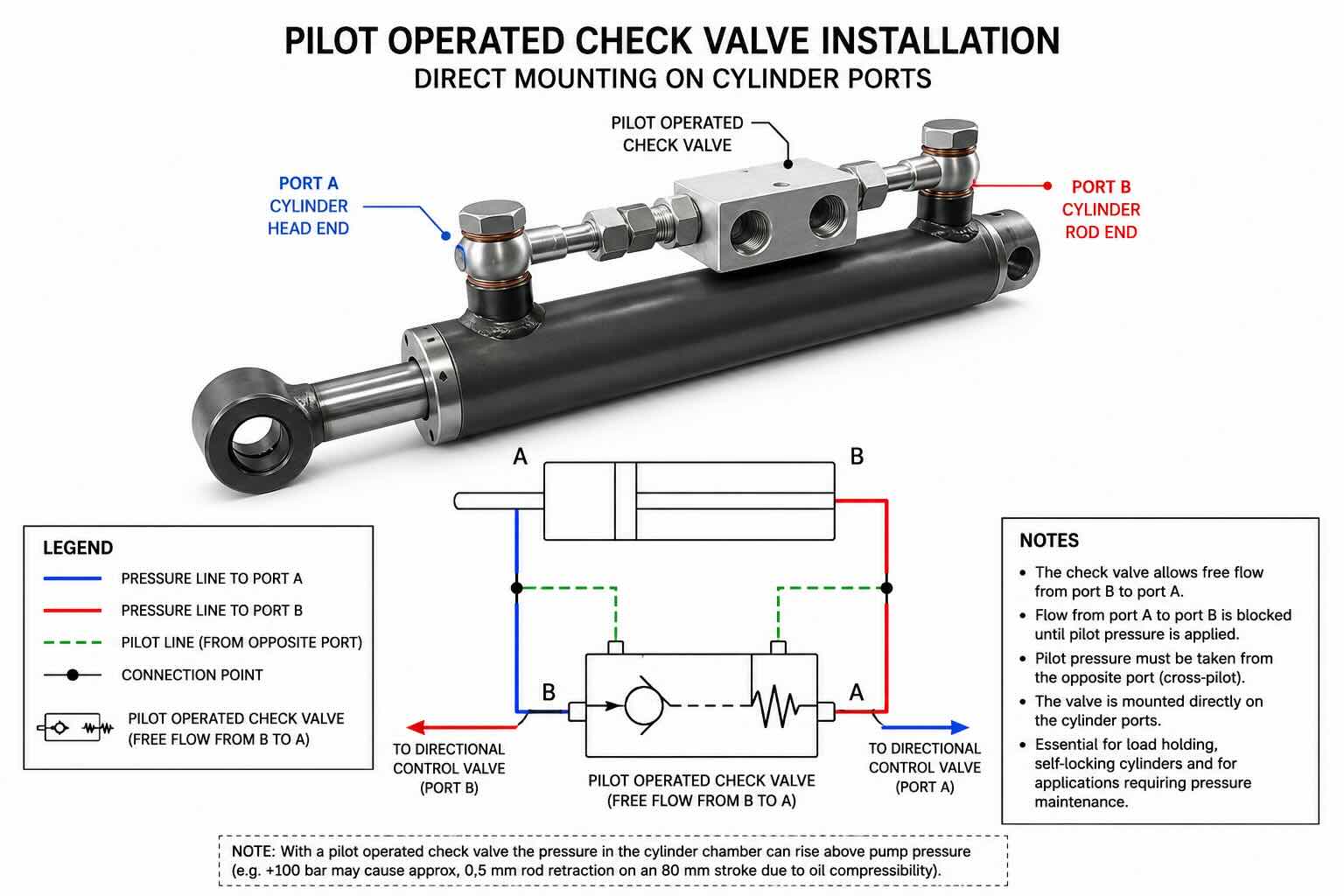
This real engineering case explains how the Vega Technical Department assisted a distributor requesting technical documentation regarding the installation of a pilot-operated check valve. Since the original technical manual was no longer available, the engineering department provided a dedicated installation diagram illustrating the correct hydraulic connections. The attached drawing clearly shows the oil inlet, pilot line and valve connections required for proper operation.
Why Pilot-Operated Check Valves Are Used
Standard directional control valves cannot always guarantee that a hydraulic cylinder will remain perfectly locked under external loads.
Internal leakage within the valve or pressure fluctuations may gradually allow the cylinder to move.
This phenomenon can create serious problems in applications such as:
- injection molds;
- die casting machines;
- lifting systems;
- vertical axes;
- heavy tooling;
- hydraulic presses.
Pilot-operated check valves eliminate this risk by mechanically locking hydraulic oil inside the cylinder chamber.
The cylinder remains immobile until pilot pressure intentionally unlocks the valve.
How a Pilot-Operated Check Valve Works
A pilot-operated check valve combines two functions into a single hydraulic component.
Under normal conditions it behaves like a conventional check valve.
Oil can flow freely in one direction while reverse flow is blocked.
When pilot pressure is applied from the opposite hydraulic line, the internal mechanism opens the valve and allows oil to flow in the reverse direction.
This enables the cylinder to move normally while maintaining complete hydraulic locking whenever pilot pressure is absent.
The result is both safety and positioning accuracy.
The Engineering Request
A distributor contacted the Vega Technical Department requesting technical documentation describing the correct installation procedure for pilot-operated check valves.
The distributor also referred to an older Vega technical manual containing detailed assembly information, including O-ring installation procedures, but this document was no longer available in the company archive.
To support the customer, the engineering department supplied a dedicated installation drawing explaining the correct hydraulic connections.
Understanding the Installation Diagram
The installation sketch provided by the Vega Technical Department illustrates the fundamental connections required for correct valve operation.
The drawing identifies three essential elements:
- the hydraulic oil input;
- the pilot connection;
- the hydraulic cylinder ports.
The oil inlet supplies pressure to the cylinder.
The pilot line transmits pressure from the opposite chamber to unlock the valve whenever cylinder movement is required.
Without this pilot signal, the valve remains closed and the cylinder stays hydraulically locked.
Although the diagram appears simple, every hydraulic connection performs a specific function that must be respected during installation.
The Importance of the Pilot Line
One of the most common installation mistakes concerns the pilot connection.
Some installers assume that connecting the hydraulic ports alone is sufficient.
In reality, the pilot line is the component that enables the valve to release the trapped oil.
If the pilot pressure is absent or connected incorrectly:
- the cylinder may remain locked;
- movement may become intermittent;
- pressure spikes may occur;
- the hydraulic system may appear defective even though every component functions correctly.
Correct pilot pressure is therefore essential for reliable operation.
Advantages of Pilot-Operated Check Valves
When installed correctly, pilot-operated check valves provide numerous benefits.
Among the most important are:
- secure load holding;
- prevention of unintended cylinder movement;
- improved operator safety;
- greater positioning accuracy;
- reduced hydraulic drift;
- improved machine stability;
- protection during emergency shutdowns.
For these reasons, pilot-operated check valves are widely used whenever hydraulic cylinders must safely support external loads.
Common Installation Mistakes
Technical support experience shows several recurring installation errors.
The most common include:
- incorrect pilot line connection;
- reversed valve orientation;
- confusing cylinder ports;
- insufficient pilot pressure;
- contamination during assembly;
- inadequate bleeding of trapped air.
These mistakes often lead technicians to suspect defective cylinders or faulty valves when the real problem is simply incorrect hydraulic plumbing.
Engineering Recommendations
Before commissioning any hydraulic system equipped with pilot-operated check valves, engineers should verify:
- valve orientation;
- pilot line routing;
- hydraulic port identification;
- operating pressure;
- cleanliness of hydraulic connections;
- free movement of the cylinder after pilot activation.
Performing these checks during installation greatly reduces troubleshooting time and improves long-term system reliability.
Engineering Conclusions
Pilot-operated check valves are essential safety components in many hydraulic systems.
Their correct operation depends not only on the quality of the valve itself but also on proper hydraulic installation.
In this real engineering case, the Vega Technical Department assisted the customer by providing a dedicated installation diagram after determining that the original technical documentation was no longer available. The supplied drawing clearly illustrated the relationship between the oil inlet, pilot connection and cylinder ports required for reliable hydraulic locking and controlled release.
The most important engineering lesson is straightforward:
A pilot-operated check valve is only as reliable as its installation. Correct pilot line routing and hydraulic connections are fundamental to ensuring safe cylinder operation, accurate positioning and long-term hydraulic reliability.