
A Real Technical Support Case on Reducing Overall Cylinder Length
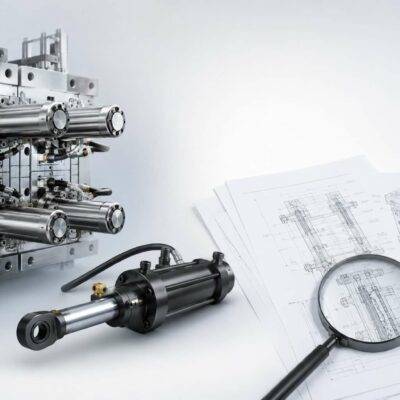
One of the most common requests received by hydraulic cylinder manufacturers is to reduce the overall dimensions of a cylinder without changing its stroke.
For mold designers, every millimeter saved can simplify mold construction, reduce machine size and create more room for cooling circuits, ejector systems and moving components.
From the customer’s perspective, the request often seems straightforward:
“Can you make the cylinder shorter?”
In reality, this is one of the most challenging questions in hydraulic cylinder design.
Every hydraulic cylinder is the result of a careful balance between stroke length, mechanical strength, guidance, sealing, operating pressure and durability.
Reducing the external dimensions beyond certain limits may compromise the structural integrity of the cylinder and significantly reduce its service life.
This real engineering case demonstrates how the Vega Technical Department evaluated a customer’s request, identified the physical limitations of the design and explained why further dimensional reductions were no longer technically acceptable.
The Customer’s Challenge
A customer requested a hydraulic cylinder with a 350 mm stroke but specified a maximum overall installation length of only 400 mm.
The available installation space inside the mold was extremely limited, making compact dimensions a critical design requirement.
At first glance, reducing the cylinder length may appear to be a relatively simple engineering modification.
However, the overall length of a hydraulic cylinder is determined by much more than the stroke itself.
It depends on numerous internal components that are essential for strength, guidance and safe operation.
Where Does the Overall Length Come From?
Many engineers outside the hydraulic industry assume that the cylinder body consists mainly of the stroke plus two end caps.
In reality, every millimeter inside the cylinder has a specific mechanical purpose.
The overall length includes:
- the piston;
- the piston rod connection;
- the rod guide system;
- sealing assemblies;
- end covers;
- cushioning chambers, when present;
- threaded connections;
- safety margins required for structural integrity.
None of these elements can simply be removed without consequences.
Every reduction requires a detailed engineering evaluation.
The Engineering Evaluation
After reviewing the customer’s drawings, the Vega Technical Department carefully analyzed every possible opportunity to reduce the cylinder dimensions.
The engineers concluded that the standard design allowed a reduction of approximately 20 mm.
Further improvements were achieved by redesigning the rear cylinder head and recessing the locking nuts.
Even with these modifications, however, the minimum achievable overall length remained approximately 491 mm, considerably longer than the requested 400 mm.
The requested dimensions were therefore beyond the physical limits of the existing design.
Why Further Reduction Was Impossible
The obvious question became:
“Why not shorten it even more?”
The answer lies in the internal mechanics of the hydraulic cylinder.
The Vega Technical Manager explained that reducing the cylinder further would require lowering the piston position inside the cylinder.
Although this would reduce the external dimensions, it would also create two serious engineering problems.
First, it would reduce the mechanical strength of the threaded connection between the piston rod and the piston itself.
Second, it would shorten the piston guidance system inside the cylinder.
Neither compromise was considered acceptable from an engineering standpoint.
Why the Rod-to-Piston Connection Is Critical
The threaded connection between the piston rod and the piston transmits the entire hydraulic force generated during every operating cycle.
This joint is subjected to:
- tensile loads;
- compression loads;
- cyclic fatigue;
- dynamic impacts;
- acceleration and deceleration forces.
Reducing the available thread engagement weakens one of the most heavily loaded parts of the entire hydraulic cylinder.
Although such a modification might initially appear to function correctly, its long-term reliability would be significantly reduced.
Professional engineering always considers the complete service life of the product, not only its initial assembly.
The Importance of Proper Guidance
The second limitation concerned the piston guidance system.
Hydraulic cylinders are designed so that the piston remains accurately aligned throughout its entire stroke.
The guide system prevents excessive lateral movement and distributes mechanical loads evenly.
Shortening the guide length increases the risk of:
- uneven wear;
- higher friction;
- seal damage;
- rod deflection;
- premature failure.
For high-cycle applications such as injection molds, proper guidance is essential to ensure consistent performance over millions of operating cycles.
Reducing guidance simply to obtain a shorter cylinder would not represent sound engineering practice.
Engineering Means Knowing When to Stop
One of the most valuable aspects of this case is that the Vega Technical Department did not attempt to satisfy the customer’s request at any cost.
Instead, the engineers clearly identified the point beyond which further dimensional reductions would compromise reliability.
This reflects an important engineering principle.
Good engineering is not about making every request possible.
It is about understanding where technical limits exist and refusing solutions that would create future reliability problems.
Customers benefit much more from an honest engineering assessment than from receiving a product that may fail prematurely.
A Better Solution Was Found
Following the engineering evaluation, the customer discussed the situation with the mold manufacturer.
Together they identified an alternative solution that allowed the project to be completed using standard hydraulic cylinders, which would be ordered directly from Vega.
This outcome demonstrates another important lesson.
Sometimes the best engineering solution is not redesigning the hydraulic cylinder.
Instead, making small modifications to the surrounding machine or mold design can eliminate unnecessary compromises while preserving the reliability of standard components.
Standard Products Versus Extreme Customization
Custom hydraulic cylinders are often the best solution for demanding applications.
However, customization should never compromise fundamental engineering principles.
Every design modification must preserve:
- structural strength;
- fatigue resistance;
- guidance accuracy;
- sealing reliability;
- long service life.
If achieving a requested dimension requires sacrificing these characteristics, the modification is no longer technically justified.
Professional engineering always prioritizes reliability over unrealistic dimensional targets.
Lessons Learned from This Real Engineering Case
This case demonstrates that reducing the dimensions of a hydraulic cylinder is not simply a matter of shortening its external body.
Every internal component performs an essential structural function.
When physical limits are reached, further reductions inevitably affect strength, guidance and durability.
Equally important, this case shows the value of collaboration between the hydraulic cylinder manufacturer and the mold designer.
By reconsidering the overall machine layout instead of forcing the cylinder design beyond its engineering limits, the customer ultimately achieved a practical and reliable solution.
Engineering Conclusions
This real technical support case demonstrates that compact hydraulic cylinder design is governed by engineering principles rather than geometric preferences.
The Vega Technical Department carefully evaluated every possible modification, recovering approximately 20 mm and proposing additional improvements through a redesigned rear head. Even so, the minimum achievable overall length remained approximately 491 mm, making the requested 400 mm physically unattainable.
Further dimensional reductions would have weakened the piston rod-to-piston threaded connection and reduced the effectiveness of the guidance system, compromising the mechanical reliability of the cylinder.
Rather than accepting an unsafe compromise, the engineering team clearly explained the technical limitations, and the customer ultimately adopted a solution based on standard hydraulic cylinders that met the application’s needs.
The key lesson is clear:
The most compact hydraulic cylinder is not always the best hydraulic cylinder. The best design is the one that achieves the required performance while preserving strength, reliability and long-term durability.