
A Real Engineering Case About Four Limit Switches and Double Cushioning
Hydraulic cylinders used in injection molds are often expected to perform functions that go well beyond generating linear force.
Modern molds require cylinders to provide accurate position feedback, controlled deceleration, high repeatability and compact installation.
As mold designs become more sophisticated, customers frequently ask for additional features to be integrated into standard hydraulic cylinders.
However, every standard product has physical and engineering limitations.
Knowing where those limits lie—and proposing the right alternative when they are reached—is one of the most valuable skills of an experienced technical department.
This real engineering case demonstrates how the Vega Technical Department evaluated a customer’s request, explained why the standard solution was technically impossible, and proposed an alternative based on previous engineering experience rather than simply rejecting the request.
The Customer’s Request
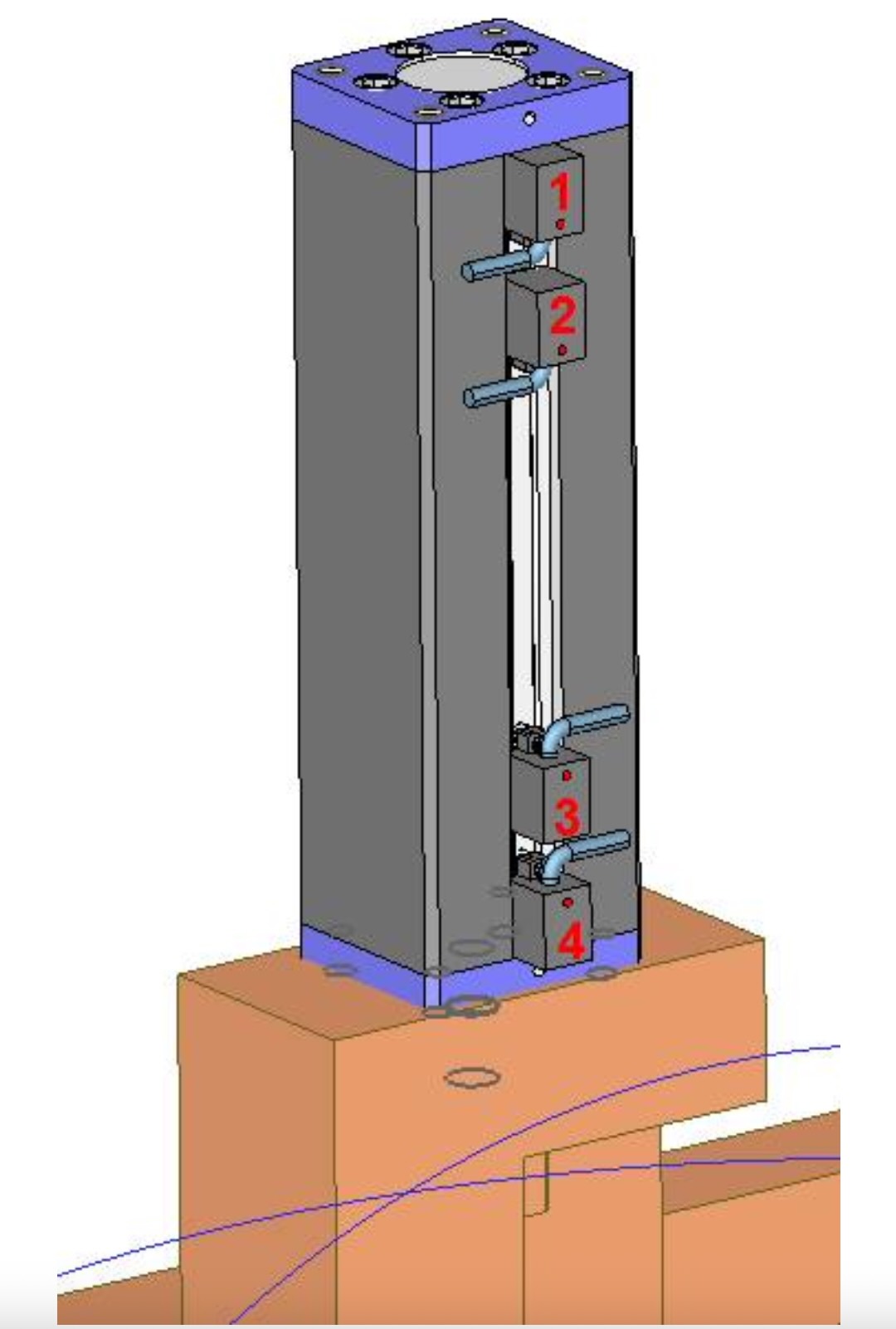
A mold manufacturer requested a quotation for a CC050BGMGM250 hydraulic cylinder equipped with four MSU4 magnetic limit switches.
The proposed configuration included:
- two switches to signal the beginning of the cushioning phase (slow-down);
- two switches to detect the final end positions of the cylinder.
At the same time, the customer asked whether it was possible to install hydraulic cushioning on both ends of the cylinder, allowing controlled deceleration during both extension and retraction.
From the customer’s perspective, the request appeared perfectly reasonable.
More sensors provide more information to the machine controller, while double cushioning reduces impact forces and improves motion control.
The engineering challenge was determining whether all these features could physically fit inside a standard hydraulic cylinder.
Why Four Limit Switches Cannot Always Be Installed
At first glance, adding two extra magnetic switches might appear to be a minor modification.
In reality, the installation of magnetic sensors depends entirely on the mechanical design of the cylinder body.
Standard hydraulic cylinders are manufactured with precision-machined grooves designed to accommodate a specific number of magnetic switches.
These grooves are positioned to ensure reliable sensor detection while maintaining the structural integrity of the cylinder.
Adding additional switches is therefore not simply a matter of drilling extra holes or extending the groove.
The available space inside the cylinder body is limited, and every machining operation affects the mechanical strength of the component.
The Engineering Evaluation
After reviewing the request, the Vega Technical Manager concluded that installing four MSU4 switches on the standard cylinder was not technically feasible.
The standard groove did not provide sufficient space for four switches.
Furthermore, machining an additional groove into the cylinder body was not considered a viable solution because it would interfere with the existing design and compromise the standard construction.
This response illustrates an important principle of mechanical engineering.
A standard product should never be modified beyond its design limits simply to satisfy a customer request.
Doing so may reduce reliability, complicate manufacturing and introduce unnecessary risks during operation.
Sometimes the correct engineering answer is not “yes,” but “not in this configuration.”
Explaining Technical Limitations Builds Customer Confidence
One of the most common mistakes in technical support is giving short answers such as:
“It cannot be done.”
Professional engineering support goes much further.
Customers deserve to understand why a request cannot be implemented.
In this case, the explanation was based on objective engineering constraints:
- insufficient installation space;
- standard groove dimensions;
- impossibility of adding a second groove without redesigning the cylinder body.
By providing clear technical reasons instead of simply refusing the request, the Vega Technical Department transformed a negative answer into a professional engineering consultation.
Looking Beyond the Standard Product
Although the requested configuration was impossible on the standard cylinder, the discussion did not end there.
Instead of closing the conversation, the Vega Technical Manager proposed an alternative.
The engineering team recalled that several months earlier Vega had successfully developed a special V220 hydraulic cylinder with a 32 mm bore equipped with hydraulic cushioning on both the forward and return strokes.
This previous project demonstrated that, although the standard product had reached its design limits, a custom-engineered solution could still satisfy the application’s requirements.
Standard Products Versus Special Designs
This case highlights the fundamental difference between standard hydraulic cylinders and custom-designed solutions.
Standard products are optimized for:
- reliability;
- interchangeability;
- manufacturing efficiency;
- fast delivery;
- cost effectiveness.
Special cylinders, on the other hand, are developed when the application requires features that exceed the capabilities of the standard range.
These projects may involve:
- modified bodies;
- additional hydraulic functions;
- custom sensor arrangements;
- special cushioning systems;
- application-specific dimensions.
Rather than forcing unsuitable modifications onto a standard product, engineers evaluate whether a dedicated design represents the better long-term solution.
Double Cushioning: Why Is It Important?
Hydraulic cushioning reduces the impact energy generated when the piston reaches the end of its stroke.
Without cushioning, the piston can strike the cylinder head at high speed, producing shock loads that increase wear, vibration and noise.
When cushioning is applied to both extension and retraction, the cylinder can decelerate smoothly in both directions.
This is particularly beneficial in injection molds where:
- heavy slides move at high speed;
- accurate positioning is required;
- mold components must be protected from repeated impacts;
- production cycles are highly repetitive.
Although not every application requires double cushioning, it can significantly improve the durability and operating smoothness of demanding molding systems.
Engineering Means Finding Solutions, Not Simply Saying No
One of the most valuable lessons from this case is that engineering support is not limited to determining whether a request is possible.
Its real purpose is to identify the most appropriate technical solution.
The easiest answer would have been to reject the customer’s request.
Instead, the Vega Technical Department explained the physical limitations of the standard cylinder and immediately proposed a proven alternative based on previous development experience.
This type of technical support creates confidence because customers understand that every recommendation is based on engineering rather than commercial convenience.
Lessons Learned from This Real Engineering Case
Several important engineering principles emerge from this case.
Not every customer request can be implemented on a standard hydraulic cylinder.
Physical dimensions, structural integrity and manufacturing constraints always define the limits of a product.
When those limits are reached, modifying the standard design is often not the best solution.
Instead, developing a dedicated custom cylinder may provide better performance, greater reliability and a more robust long-term solution.
Most importantly, professional technical support does not stop at explaining why something cannot be done—it continues by proposing a technically sound alternative.
Engineering Conclusions
This real technical support case demonstrates that engineering is often about balancing customer requirements with the physical limitations of a product.
The Vega Technical Department carefully evaluated the request for four magnetic limit switches and double cushioning, concluding that the standard cylinder could not accommodate four MSU4 switches because of the available installation space and the impossibility of adding another groove to the cylinder body.
Rather than ending the discussion, the engineering team proposed an alternative by referring to a previously developed custom cylinder featuring double cushioning on both strokes.
The key lesson is simple:
A well-designed standard hydraulic cylinder should never be modified beyond its engineering limits. When the application requires more, the correct solution is not compromise—it is a purpose-designed custom cylinder.