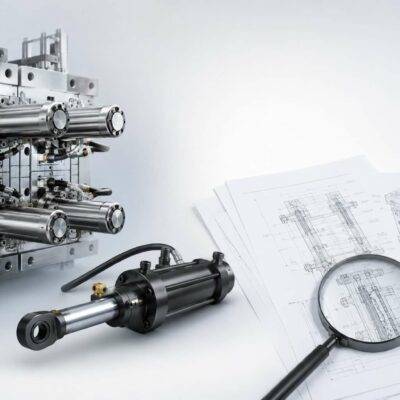

When a hydraulic cylinder starts leaking oil, the first reaction is almost always the same:
“The cylinder has failed.”
In many cases, that assumption seems reasonable.
After all, the oil is leaking from the cylinder, so the cylinder must be the problem.
But experienced engineers know that things are not always that simple.
Recently, Vega Technical Dep. was asked to investigate recurring oil leakage issues affecting several hydraulic cylinders installed on injection molding equipment.
At first glance, the situation appeared straightforward.
The cylinders were leaking.
The seals had been replaced multiple times.
Preventive maintenance was being performed regularly.
Yet the problem continued to reappear.
Rather than replacing components and hoping for a different outcome, Vega chose a different path:
a complete root cause analysis.
Looking Beyond the Leak
Three cylinders were disassembled and inspected jointly with the customer.
The objective was not simply to identify a damaged seal.
The objective was to understand why the seals were failing.
This distinction is important.
Replacing a seal solves today’s leak.
Understanding why the seal failed prevents tomorrow’s leak.
During the inspection, Vega Technical Dep. analyzed:
- Seal condition
- Rod condition
- Internal contamination
- Installation interfaces
- Maintenance procedures
- Hydraulic fluid condition
- Environmental influences
What emerged was a very different picture from what had initially been expected.
The First Discovery: External Contamination
The inspection revealed significant contamination in the area between the cylinder and the mounting flange.
Release agents, dust, and production residues had accumulated over time and were reaching the rod wiper area.
The function of a wiper seal is simple:
It prevents contaminants from entering the cylinder.
When large amounts of debris continuously reach the sealing area, the wiper deteriorates and its effectiveness decreases.
The result is predictable.
Contamination begins to enter the cylinder and accelerates wear of the sealing system.
The Hidden Enemy Inside the Hydraulic System
The second discovery was even more significant.
During the inspection of the seals and internal components, solid contaminants and metallic particles were found inside the cylinders.
Deposits were visible in sealing grooves and on internal components.
For hydraulic systems, contamination is one of the most destructive factors affecting reliability.
Every particle circulating through the hydraulic circuit behaves like an abrasive.
Over time, these particles damage seals, increase wear, and reduce component life.
The evidence suggested that the filtration level of the hydraulic system was insufficient for the operating environment.
The issue was therefore not limited to the cylinders.
It potentially affected the entire hydraulic system.
When Maintenance Creates New Problems
One of the most interesting findings emerged during the review of maintenance procedures.
The cylinders themselves showed evidence suggesting that some seal damage may have occurred during reassembly operations.
Hydraulic cylinders are precision components.
Even when maintenance is performed correctly, improper assembly techniques can damage seals before the cylinder ever returns to production.
The investigation highlighted the importance of:
- Proper assembly orientation
- Correct use of calibration tools
- Protection of sealing surfaces
- Accurate torque application
- Careful handling of rods and cartridges
Small deviations during maintenance can create conditions that later appear as premature seal failures.
In other words:
The leak may appear months later, but the damage may have occurred during assembly.
The Cost of Damaged Rod Surfaces
During the inspection, one cylinder displayed visible marks on the rod surface caused by gripping tools or improper handling.
At first glance, these marks appeared minor.
In reality, even small imperfections on a polished rod can have significant consequences.
Every time the rod moves through the seals, surface defects act like cutting tools.
The result is accelerated seal wear and eventual leakage.
The damaged rod had not caused the original problem.
But it had certainly contributed to making the situation worse.
An Unexpected Discovery: Water Contamination
The investigation uncovered another important issue.
One cylinder contained evidence of oil-water emulsion and localized corrosion inside the tube.
This indicated that moisture had entered the hydraulic system at some point.
Water contamination creates several risks:
- Reduced lubrication
- Corrosion of internal surfaces
- Seal degradation
- Reduced fluid performance
- Increased component wear
For any hydraulic system, the presence of water should always be considered a warning sign requiring further investigation.
What the Analysis Revealed
After completing the inspection of all three cylinders, Vega Technical Dep. reached an important conclusion.
No evidence was found indicating a manufacturing defect in the cylinders themselves.
Instead, the investigation identified several contributing factors:
- External contamination
- Insufficient hydraulic filtration
- Maintenance-related seal damage
- Rod surface damage
- Water contamination
- Installation and alignment issues
Each factor alone may have seemed minor.
Together, they created the perfect conditions for recurring leakage problems.
The Difference Between Repair and Engineering
This case highlights a common difference between maintenance and engineering.
Maintenance asks:
“Which component failed?”
Engineering asks:
“Why did it fail?”
The answers are not always the same.
If the cylinders had simply been repaired again, the underlying causes would have remained unchanged.
The leaks would likely have returned.
By identifying the root causes, the customer gained the opportunity to improve the entire system rather than repeatedly replacing seals.
Lessons Learned
This project highlights several important engineering principles.
1. Oil leaks do not automatically mean a defective cylinder
The visible symptom is not always the root cause.
2. Clean hydraulic fluid is critical
Contamination affects seals, cylinders, valves, pumps, and every component in the system.
3. Maintenance quality matters
Correct procedures are just as important as quality components.
4. Small details create large consequences
Minor damage to rod surfaces or sealing areas can dramatically reduce seal life.
5. Root cause analysis creates lasting solutions
Replacing components treats symptoms.
Understanding failures prevents recurrence.
Conclusion
When a hydraulic cylinder leaks, replacing seals is often the easiest solution.
But the easiest solution is not always the most effective one.
In this case, Vega Technical Dep. looked beyond the leak itself and investigated the entire operating environment.
The result was a comprehensive understanding of the factors contributing to the problem and a series of recommendations designed to improve reliability, reduce maintenance costs, and extend service life.
Because in hydraulic engineering, the most important question is not:
“What failed?”
It is:
“Why did it fail?”