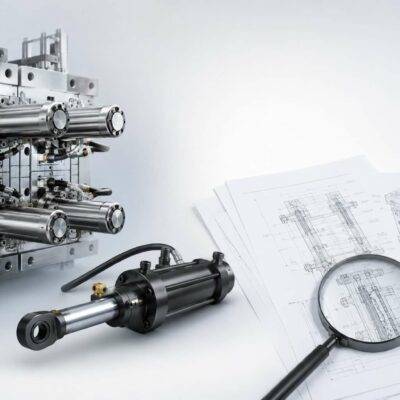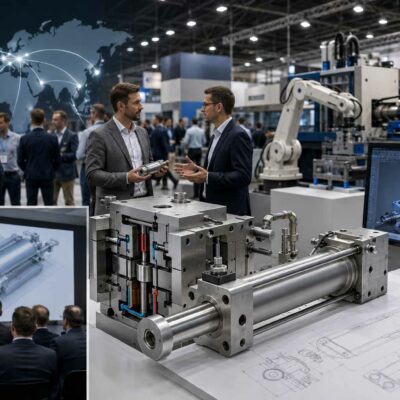

Position sensors are an important part of hydraulic-cylinder systems used in injection molds. They provide the machine with information about the position of the cylinder and allow the control system to manage the molding sequence correctly.
However, sensor reliability depends not only on the electrical circuit itself.
The mechanical construction and protection of the sensor are equally important.
A technical analysis carried out by the Vega Team on returned sensors provides a useful example. Several sensors had stopped working, and the investigation identified two different failure mechanisms: possible short-circuiting caused by liquid penetrating the sensor electronics, and liquid contamination inside sensor housings due to inadequate sealing.
The case highlights an important principle:
A position sensor must be protected against the real environmental conditions in which it operates.
For hydraulic cylinders installed in injection molds, this means paying particular attention to sealing, encapsulation, cable connections and possible exposure to liquids used during the molding process.
Position Sensors Are Part of the Hydraulic System
A hydraulic cylinder can perform its mechanical function correctly while its position sensor fails.
This distinction is important.
The cylinder provides the movement.
The sensor provides information about that movement.
The machine control system may use the sensor signal to determine whether the cylinder has reached the required position before allowing the next operation.
Vega’s current technical material confirms the importance of position sensing in injection-mold applications, where sensor signals can be used to verify cylinder position and coordinate subsequent mold movements.
Consequently, sensor reliability should be considered part of the overall cylinder-system reliability.
A Real Technical Investigation
In the technical report analysed by the Vega Team, several returned sensors were examined.
The investigation covered three groups of sensors.
The first sensor initially appeared to have suffered a short circuit. After functional testing, which produced a positive result, the sensor housing was removed to inspect the internal electronics.
The investigation revealed that some of the electronic leads were not completely embedded in the injected plastic material.
These areas showed signs of rust.
The technical conclusion was that release liquid had probably penetrated through these areas and caused the short circuit.
This is a particularly interesting failure mechanism because the problem was not necessarily caused by the electronic component itself.
The weakness was related to how the electronics had been encapsulated and protected.
Failure Mechanism 1: Incomplete Encapsulation
Encapsulation is used to protect electronic components from the external environment.
In this case, the Vega analysis identified two related issues:
- incomplete adhesion between the housing and the injected filling material;
- electronic leads that were too long and were not completely embedded in the filling plastic.
This created a potential path through which liquid could reach the electronic components.
Once liquid reaches conductive parts, several problems can occur:
- corrosion;
- electrical leakage;
- short circuits;
- intermittent operation;
- complete sensor failure.
The critical point is that the sensor may initially appear correctly manufactured from the outside while the internal protection is inadequate.
Why the Electronic Leads Matter
The technical report specifically identified leads that were too long and were not completely submerged in the encapsulating material.
This is a relatively small manufacturing detail, but it can have a significant effect on reliability.
If part of a lead remains insufficiently protected, the encapsulation may no longer provide a continuous barrier around the electronics.
This can create a localized vulnerability.
A reliable encapsulation process therefore requires not only the correct filling material, but also correct positioning and dimensions of the components being encapsulated.
The Importance of Complete Filling
The technical report also identified incomplete adhesion between the sensor housing and the injected filling material as a possible origin of the malfunction.
This means that two conditions need to be controlled:
Complete coverage
The electronic components and leads must be completely surrounded by the protective material.
Good adhesion
The encapsulating material must properly adhere to the housing so that liquids cannot create a path between the two surfaces.
If either condition is not achieved, the protective barrier can be compromised.
Injection Parameters Can Affect Sensor Reliability
The corrective action proposed by the Vega Team was not simply to change the sensor.
The report recommended reviewing the injection parameters of the press used for encapsulating the sensor.
This is an important manufacturing principle.
The quality of an encapsulated electronic component can depend strongly on the process used to produce it.
Parameters such as filling conditions, material behavior and component positioning can influence whether the encapsulating material completely fills the intended areas.
Therefore, when a sensor fails because of inadequate encapsulation, changing the electronic component alone may not solve the underlying problem.
The manufacturing process itself must also be reviewed.
Improving the Preparation of the Leads
The Vega analysis also recommended improving the trimming of the leads and reviewing their height so that complete coverage could be guaranteed.
This is a very practical corrective action.
If the leads extend too far from the circuit, they may not be sufficiently covered during encapsulation.
Reducing their height appropriately can therefore improve the reliability of the protective layer.
The objective is simple:
No exposed or insufficiently embedded conductive areas should remain where they could provide a path for liquid penetration.
The Sensor Housing Design Also Matters
The report went one step further.
The Vega Team proposed evaluating guides directly on the sensor housing to position the circuit correctly and maintain sufficient space around it for the encapsulating material.
This is an important design-for-manufacturing concept.
The housing should not merely contain the electronics.
It should also help ensure that the electronics are positioned correctly during the encapsulation process.
Proper positioning can provide sufficient space for the filling material to flow around the circuit and completely encapsulate the vulnerable areas.
Failure Mechanism 2: Liquid Inside the Sensor Housing
The second group of returned sensors showed a different but related problem.
Both sensors were found to be non-functional.
After removing the covers, the Vega Team found liquid and deposits inside the housings. One of the sensors also showed a disconnected power cable.
This is a direct indication that the internal environment of the sensor had been compromised.
Electronic components that are not designed to operate in the presence of liquid can be affected by:
- short circuits;
- corrosion;
- contamination;
- electrical contact degradation;
- cable failure.
In this case, the presence of liquid was considered a likely cause of the sensor failures.
Sealing Must Be Continuous
The technical report suspected that insufficient or discontinuous sealant had been applied between the sensor body and its cover.
This is an important observation.
A seal is only effective if it provides a continuous barrier.
A small unsealed area can become a potential entry point for liquid.
The problem may therefore not be the sealing material itself.
It may be:
- insufficient quantity;
- discontinuous application;
- poor surface preparation;
- incorrect assembly;
- inadequate contact between the housing and cover.
The corrective action proposed was therefore to improve the application of the sealing layer over the entire contact area.
How Liquid Can Reach an Electronic Sensor
In an industrial environment, sensors can be exposed to many forms of contamination.
Depending on the mold and process, the sensor may encounter:
- hydraulic oil;
- release agents;
- cleaning fluids;
- condensation;
- water;
- process residues.
The technical report specifically identified release liquid as the suspected contaminant in one of the failures.
This demonstrates why environmental exposure should be considered during sensor design.
A sensor that works perfectly in a clean laboratory environment may behave differently when installed on an industrial mold and exposed to liquids over thousands or millions of cycles.
Functional Testing Is Not the Same as Failure Analysis
An interesting aspect of the investigation is that the first sensor gave a positive functional test result before its housing was opened.
This is an important lesson for troubleshooting.
A component can pass a functional test and still contain evidence of a developing or intermittent failure mechanism.
For this reason, when a sensor is returned after an operational failure, a complete investigation may require:
- functional testing;
- external inspection;
- housing inspection;
- internal inspection;
- identification of contamination;
- examination of electrical connections;
- analysis of the manufacturing or installation conditions.
Testing only whether the sensor currently switches ON or OFF may not reveal why it failed in the application.
Another Important Observation: Signs of Previous Opening
For the second group of sensors, the technical report noted marks suggesting that the housings may have previously been opened.
The report did not state this as an absolute certainty.
Instead, it described it as an impression based on the ease with which the covers could be removed after the screws had been taken out.
This distinction is important.
A technical failure analysis should separate:
confirmed observations
from
possible explanations.
In this case, the presence of liquid inside the housings was evident, while the possibility that the sensors had previously been opened remained an observation rather than a confirmed fact.
Sensor Housing Integrity Should Be Preserved
If a sensor housing is opened after manufacture, its original sealing condition may no longer be guaranteed.
This is particularly relevant for sensors exposed to liquids.
Once a cover is removed and subsequently reassembled, the original seal may be:
- damaged;
- displaced;
- incomplete;
- contaminated;
- incorrectly replaced.
The technical report therefore provides a useful maintenance lesson:
Opening a sealed sensor housing can change the environmental protection of the component.
Where a sensor is designed as a sealed unit, inspection and maintenance procedures should take this into account.
Corrective Actions Should Address the Root Cause
The technical report did not propose a single generic solution.
Instead, the corrective actions were matched to the identified failure mechanism.
For the encapsulation-related failure
The proposed actions included:
- reviewing encapsulation injection parameters;
- improving lead trimming;
- controlling lead height;
- ensuring complete lead coverage;
- evaluating guides in the housing to improve circuit positioning;
- ensuring sufficient surrounding space for the filling material.
For the liquid-ingress failure
The proposed actions included:
- improving the application of sealant;
- ensuring sealing around the complete contact area;
- investigating possible liquid-entry points inside the sensor body.
This is a good example of root-cause-oriented corrective action.
Sensor Reliability Starts During Manufacturing
The first failure mechanism demonstrates that sensor reliability can be determined long before the sensor reaches the mold.
If the encapsulation process leaves vulnerable areas, the sensor may be exposed to environmental contamination during operation.
Therefore, sensor reliability depends on manufacturing controls such as:
- component positioning;
- lead preparation;
- encapsulation parameters;
- filling quality;
- adhesion;
- housing design.
This is why electronic sensors used in industrial environments require both electrical design and mechanical/environmental protection.
Sensor Reliability Also Depends on Installation
The second failure mechanism highlights another aspect: even a correctly manufactured sensor can be compromised if its housing or connections are not maintained correctly.
The installation environment should therefore be considered.
Important questions include:
- Is the sensor exposed to liquid?
- Is the housing protected from direct contamination?
- Are cables correctly routed?
- Can liquid accumulate around the sensor?
- Is the sensor likely to be opened during maintenance?
- Are the sealing surfaces kept clean?
- Is the sensor correctly mounted?
These considerations can be particularly important in injection molds, where hydraulic and process equipment operate in a compact and demanding environment.
Position Sensors Are Part of the Mold Control System
Current Vega technical documentation emphasizes that position sensors are not simply accessories.
In injection molds with multiple hydraulic cylinders, position signals can be integrated into the machine-control system to verify that the cylinders have reached the required positions before the molding sequence continues.
A sensor failure can therefore have consequences beyond the sensor itself.
It may result in:
- an interrupted molding cycle;
- incorrect position feedback;
- unnecessary machine stops;
- diagnostic difficulties;
- incorrect sequencing.
This makes sensor reliability an important part of overall mold reliability.
Sensor Selection Must Consider the Cylinder
Vega’s current technical documentation also emphasizes that sensor technology must be compatible with the specific hydraulic-cylinder construction.
For example, the available sensor technology can depend on the cylinder design and installation configuration.
This means that sensor selection should consider:
- cylinder construction;
- available mounting space;
- operating temperature;
- required sensing position;
- environmental exposure;
- electrical interface;
- maintenance requirements.
A sensor should therefore not be selected independently of the hydraulic cylinder.
A Practical Sensor Reliability Checklist
Before installing or troubleshooting a hydraulic-cylinder position sensor, it is useful to check the following.
Mechanical protection
- Is the housing intact?
- Are there signs of impact or deformation?
- Is the sensor correctly mounted?
Sealing
- Is the cover correctly sealed?
- Is the sealant continuous?
- Are there visible paths through which liquid could enter?
Electrical connections
- Are cables securely connected?
- Are there signs of corrosion?
- Are terminals protected?
Internal encapsulation
Where applicable:
- Are electronic leads completely embedded?
- Is the filling material continuous?
- Is there good adhesion to the housing?
- Are there voids or unprotected areas?
Environmental conditions
- Is the sensor exposed to hydraulic oil?
- Is it exposed to release agents or other liquids?
- Is there water or condensation?
- Is the sensor operating within its specified environmental conditions?
Functional verification
- Does the sensor switch correctly?
- Is the signal stable?
- Does the sensor behave correctly throughout the cylinder movement?
What This Technical Case Teaches
The sensor investigation provides several important lessons.
1. A sensor failure may be caused by environmental contamination
The electronic circuit may not be the original source of the problem.
2. Encapsulation quality matters
Incomplete filling or inadequate adhesion can create paths for liquid penetration.
3. Lead length and positioning matter
Leads that are too long may not be adequately protected by the encapsulating material.
4. The housing design influences manufacturing quality
Guides can help position the electronic circuit correctly and provide sufficient space for proper encapsulation.
5. Sealing must be continuous
Liquid inside a sensor housing can be sufficient to cause malfunction.
6. Corrective actions should address the manufacturing process
Changing the sensor alone may not resolve an encapsulation problem.
7. Functional testing alone may not explain a failure
Internal inspection can reveal evidence that is invisible during an electrical test.
Conclusion
Hydraulic-cylinder position sensors operate in demanding industrial environments, and their reliability depends on much more than the electronic switching element itself.
The technical investigation analysed here identified two different failure mechanisms.
In the first case, a sensor suspected of short-circuiting was inspected internally after a positive functional test. Rust was found on electronic leads that had not been completely embedded in the encapsulating plastic, leading to the conclusion that liquid had probably penetrated the sensor and caused the short circuit.
The corrective actions focused on the encapsulation process, lead preparation and positioning of the electronic circuit.
In the second case, two sensors were found to contain liquid and deposits inside their housings. The technical analysis identified liquid ingress as a likely cause and recommended improving the sealing process and investigating possible entry points.
The broader engineering lesson is clear:
Reliable sensor operation starts with correct design, continues with controlled manufacturing and depends on maintaining the environmental protection of the sensor during installation and service.
For hydraulic cylinders used in injection molds, sensor reliability should therefore be considered part of the complete hydraulic and control-system design—not as an afterthought.
Useful and Verified URLs
- Monitoring Hydraulic Cylinder Position Sensors on Injection Molds — Official Vega article explaining why position feedback is important and how sensor signals can be managed in injection-mold applications.
- How to Connect Multiple Hydraulic Cylinders to a PLC Using a Signal Interface Module — Official Vega article covering hydraulic-cylinder position sensors, sensor signals and their integration with mold-control systems.
- How to Connect Multiple Hydraulic Cylinder Position Sensors to a PLC — Official Vega technical article on electronic sensor connections and PLC integration.
- How Minimum Stroke Affects Position Sensor Performance in Hydraulic Cylinders — Official Vega article explaining how cylinder stroke and sensor adjustment range can affect reliable position detection.
- How to Select a Compact Short-Stroke Hydraulic Cylinder for Injection Molds — Official Vega technical article discussing sensor selection as part of the hydraulic-cylinder configuration.