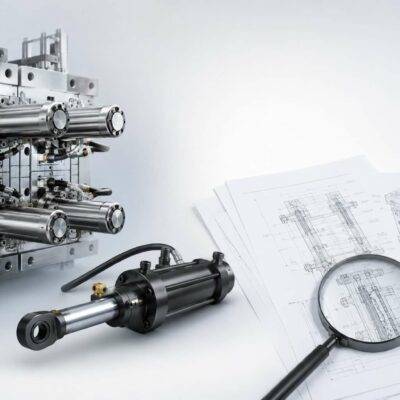

In hydraulic cylinder design, cushioning has traditionally been considered an essential feature whenever high operating speeds are involved.
For decades, engineers have relied on adjustable hydraulic cushions to slow the piston before it reaches the end of its stroke, reducing impact loads, minimizing vibration, and extending the service life of both the cylinder and the machine.
While this approach is still valid for many industrial applications, modern injection molding technology has introduced a different solution.
Today, many high-performance injection molding machines are equipped with proportional hydraulic valves and advanced motion control systems capable of continuously adjusting cylinder speed throughout the entire stroke.
When combined with an integrated linear position sensor, these systems allow the machine to decelerate the hydraulic cylinder electronically rather than hydraulically.
A real engineering case handled by the Vega Technical Department perfectly illustrates this evolution.
A customer requested a special hydraulic cylinder equipped with an integrated Balluff analog position sensor and, at the same time, expected the cylinder to include hydraulic cushions.
After reviewing the application, the Vega Technical Department explained that these two options could not be combined because the integrated position sensor occupied the internal space normally reserved for the cushioning system.
More importantly, the engineering team clarified that hydraulic cushions would provide little practical benefit in this application because the position sensor, working together with the injection molding machine and its proportional valve, could control speed and automatically reduce the cylinder velocity before reaching the end of the stroke.
This case highlights an important question for modern mold designers:
Do hydraulic cylinders still need mechanical cushioning when precise electronic motion control is available?
The Original Purpose of Hydraulic Cushions
Hydraulic cushioning was developed to solve a simple mechanical problem.
When a hydraulic cylinder moves at high speed, the piston possesses kinetic energy.
If the piston reaches the end of its stroke without deceleration, that energy is suddenly transferred to:
- the piston;
- the cylinder head;
- the rod;
- the mounting system;
- the machine structure.
Repeated impacts create:
- excessive vibration;
- increased noise;
- premature seal wear;
- mechanical fatigue;
- possible structural damage.
To prevent these problems, manufacturers introduced adjustable cushions that gradually restrict the hydraulic oil flow near the end of the stroke.
This controlled restriction slows the piston before impact occurs.
For decades, this represented the most effective solution available.
How Modern Motion Control Changed Everything
Today’s injection molding machines operate very differently from older hydraulic systems.
Instead of using fixed flow rates, many machines continuously regulate oil flow using proportional valves controlled by the machine PLC.
The cylinder speed is no longer constant.
It can be modified at any point during the stroke.
Acceleration, constant velocity and deceleration can all be programmed according to the specific requirements of the mold.
This transforms the hydraulic cylinder from a purely mechanical actuator into part of a fully controlled motion system.
The Importance of Integrated Position Feedback
Electronic motion control is only possible when the controller always knows the exact position of the piston.
This is where integrated linear position sensors become essential.
Unlike external switches that simply indicate whether the cylinder has reached a specific point, an analog position sensor continuously measures the piston position throughout the entire stroke.
This continuous feedback allows the machine controller to calculate:
- current position;
- movement speed;
- acceleration;
- remaining travel before the stop position.
Using this information, the proportional valve can progressively reduce oil flow, producing an extremely smooth deceleration.
Instead of stopping because of a hydraulic cushion, the cylinder stops because the machine has intelligently reduced its speed.
Why Cushions Become Unnecessary
The engineering case analysed by the Vega Technical Department demonstrates exactly this concept.
The customer requested both an integrated Balluff position sensor and hydraulic cushions.
However, the engineering team explained that the integrated sensor physically occupies the internal space normally required for the cushioning mechanism.
More importantly, they explained that the machine itself could perform the deceleration through its proportional hydraulic valve after suitable programming of the operating cycle.
From an engineering perspective, this solution offers several advantages.
There is no need to adjust cushion screws during commissioning.
Cylinder deceleration becomes programmable.
Motion profiles can easily be modified through software.
Different products can use different speed profiles without replacing any mechanical components.
Additional Benefits of Position-Controlled Cylinders
Besides eliminating the need for cushions in many applications, integrated position sensors provide numerous additional advantages.
Machine setup becomes significantly faster because engineers can monitor the exact cylinder position directly from the machine interface.
Process repeatability improves since every cycle follows the same programmed motion profile.
Machine diagnostics also become much easier.
Any unexpected variation in movement speed or stopping position can immediately be detected, helping maintenance personnel identify problems before production quality is affected.
For manufacturers producing high-value technical components, this higher level of motion control often translates into reduced scrap rates and improved process stability.
Engineering Considerations
Although electronic deceleration offers major advantages, it should not automatically replace hydraulic cushions in every application.
Its effectiveness depends on several conditions.
The hydraulic system must include proportional valves capable of continuously regulating oil flow.
The machine controller must support closed-loop motion control.
The position sensor must provide reliable, high-resolution feedback throughout the cylinder stroke.
Finally, the software controlling the movement must be properly programmed and tuned.
Only when these conditions are satisfied can electronic motion control fully replace traditional hydraulic cushioning.
This is why selecting a hydraulic cylinder today involves much more than choosing bore size and stroke.
Engineers must also evaluate how the cylinder will interact with the entire control system of the injection molding machine.
The real engineering challenge is no longer simply stopping a piston.
It is controlling every millimeter of its movement with maximum precision.
Engineering Limitations
Despite their numerous advantages, integrated position sensors are not the ideal solution for every hydraulic cylinder.
The decision should always be based on the specific application rather than current technological trends.
Traditional hydraulic cushions remain an excellent solution for:
- simple hydraulic power units;
- machines without proportional valves;
- applications operating at constant speed;
- systems where electronic position control is unavailable.
Conversely, integrated position sensors become particularly advantageous when:
- precise positioning is required;
- different movement profiles must be programmed;
- cycle times need continuous optimisation;
- the hydraulic cylinder is part of an automated manufacturing process;
- Industry 4.0 monitoring is required.
Choosing between hydraulic cushioning and electronic motion control is therefore not a matter of selecting the newest technology, but of selecting the most appropriate technology.
Design Considerations for Special Hydraulic Cylinders
The engineering case also highlights another important aspect of special cylinder design.
When the customer requested the complete 3D model, the Vega Technical Department supplied not only the CAD model but also detailed information regarding installation, spare parts and electrical connections.
Because the Balluff position sensor was supplied without the 90° connector, the installation required approximately 32 mm of additional clearance behind the cylinder.
The engineering team also specified that the connector contained eight terminals, although only three were required to interface the analog position sensor with the injection molding machine.
Complete Balluff documentation was provided to support installation and electrical wiring.
Although these details may appear minor, they frequently determine whether installation proceeds smoothly or unexpected interference problems arise during mold assembly.
Spare Parts Become More Important
Another interesting feature of this project was the documentation prepared for future maintenance.
Rather than simply supplying the hydraulic cylinder, the Vega Technical Department provided a complete list of standard and special spare parts, including:
- rod seal kits;
- complete rod cartridge;
- piston seal kit;
- replacement cylinder tube;
- special replacement rod;
- complete piston rod assembly;
- Balluff analog position sensor;
- metal shielded connector;
- position marker.
Providing this level of documentation allows maintenance departments to minimise machine downtime by ordering the correct components without dismantling the cylinder for identification.
Mechanical Simplicity vs Electronic Intelligence
For many years, improving hydraulic cylinder performance meant adding more mechanical components.
Today, engineering philosophy is changing.
Instead of increasing mechanical complexity, designers increasingly rely on intelligent electronic control.
A proportional valve, an integrated position sensor and appropriate PLC programming can often achieve better motion control than purely mechanical cushioning systems.
This approach offers several advantages:
- smoother deceleration;
- programmable movement profiles;
- simplified commissioning;
- improved repeatability;
- easier diagnostics;
- reduced maintenance.
Rather than forcing every cylinder to stop mechanically, engineers can now design cylinders that communicate continuously with the machine controller.
Future Trends in Injection Molding
The evolution toward electronically controlled hydraulic cylinders reflects a broader transformation within the plastics industry.
Modern injection molding machines are becoming increasingly data-driven.
Manufacturers demand:
- higher production speeds;
- greater positioning accuracy;
- predictive maintenance;
- process traceability;
- reduced setup times;
- Industry 4.0 integration.
Integrated position sensors support all of these objectives.
They transform the hydraulic cylinder from a passive actuator into an intelligent source of process information.
For many applications, the hydraulic cylinder is no longer simply moving a slide.
It is becoming part of the machine’s control system.
Conclusion
The engineering case discussed in this article demonstrates how advances in motion control technology are changing the design philosophy of hydraulic cylinders for injection molds.
When an integrated analog position sensor is combined with proportional hydraulic valves and appropriate PLC programming, electronic deceleration can often replace traditional hydraulic cushions.
As explained by the Vega Technical Department, the integrated Balluff position sensor occupies the space normally required for cushioning and, more importantly, makes mechanical cushioning largely unnecessary because speed reduction can be achieved directly by the machine control system.
At the same time, successful implementation requires careful attention to installation details, electrical connections, available space and future maintenance requirements.
The additional documentation supplied with this special cylinder—including the CAD model, spare parts list and sensor connection information—demonstrates how proper engineering support extends far beyond the hydraulic cylinder itself.
As injection molding technology continues to evolve, hydraulic cylinders equipped with integrated position sensors will play an increasingly important role in delivering faster, more precise and more reliable mold movements.
Related Technical Articles
To learn more about hydraulic cylinders for injection molds, explore these related articles on icvega.com:
- Guide to Hydraulic Core Pulling Systems
https://www.icvega.com/choosing-cylinder/guide-to-hydraulic-core-pulling-systems - Choosing the Right Hydraulic Cylinder for Mold Cores – Pushing Force
https://www.icvega.com/choosing-cylinder/choosing-the-right-hydraulic-cylinder-for-mold-cores-pushing-force - Choosing the Right Hydraulic Cylinder for Mold Cores – Stroke
https://www.icvega.com/choosing-cylinder/choosing-the-right-hydraulic-cylinder-for-mold-cores-stroke - Guide to Mold Slide Mechanisms
https://www.icvega.com/choosing-cylinder/guide-to-mold-slide-mechanisms - The 2 Millimeters That Could Have Stopped an Entire Mold
https://www.icvega.com/support/the-2-millimeters-that-could-have-stopped-an-entire-mold - Hydraulic Cylinder Misalignment: The Hidden Cause of Broken Rods
https://www.icvega.com/support/hydraulic-cylinder-misalignment-the-hidden-cause-of-broken-rods