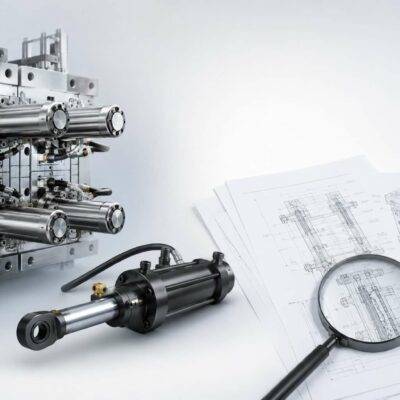

When customers purchase hydraulic cylinders for injection molds, they usually focus on technical specifications such as bore size, stroke, operating pressure or mounting dimensions.
However, in many industries another requirement becomes equally important:
the external appearance of the hydraulic cylinder.
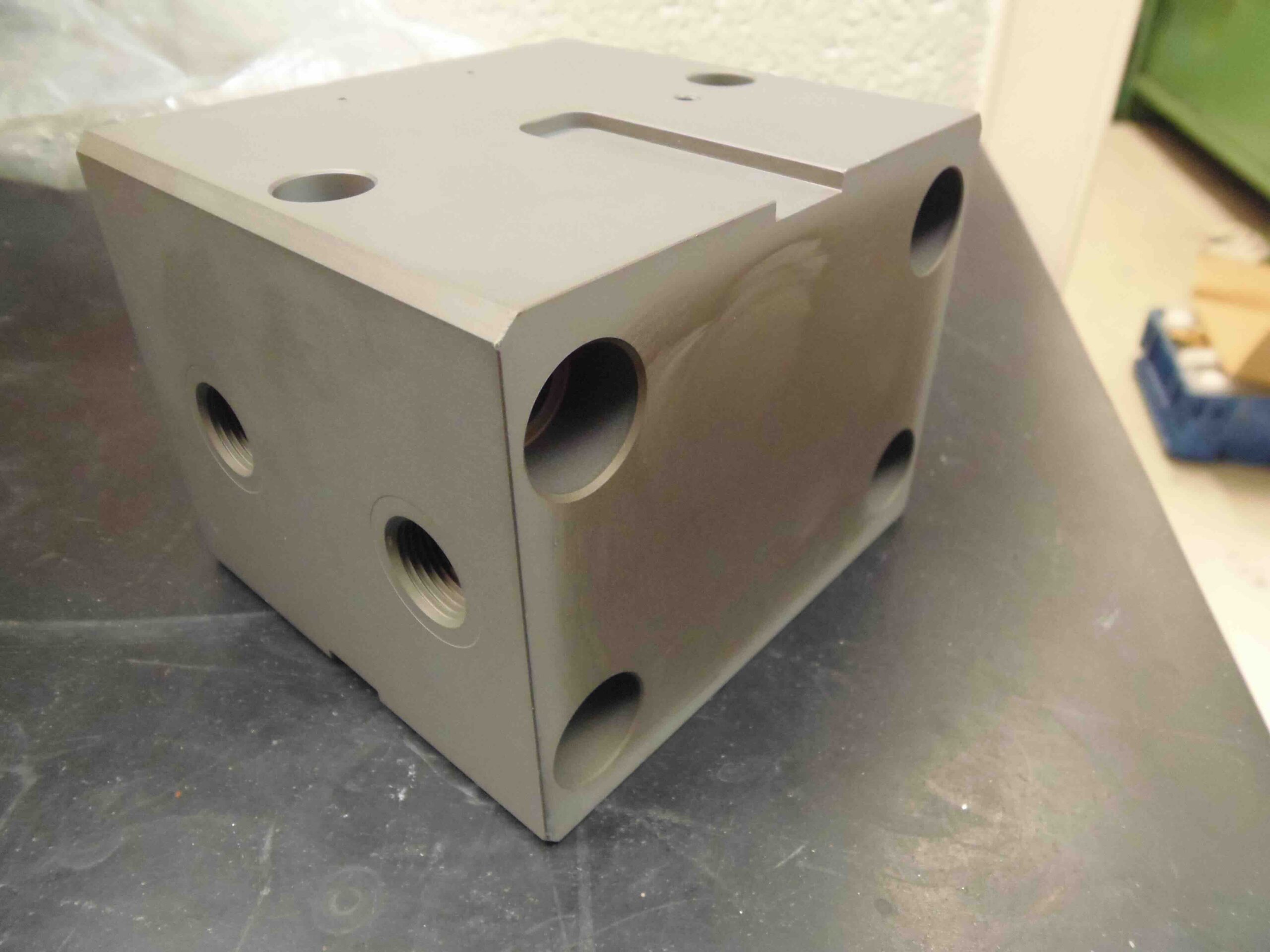
SPOTS ANODIZING
This is particularly true for blow molding machines, packaging equipment, pharmaceutical systems and automated production lines where hydraulic cylinders remain fully visible throughout machine operation.
In these applications, even a small colour variation between two cylinders may be perceived as a manufacturing defect.
A real engineering case handled by the Vega Technical Department demonstrates why achieving identical colour on anodized aluminium components is far more complex than it appears.
A customer reported three different non-conformities:
- lock nuts different from the approved drawing;
- visible stains on several cylinder bodies;
- significant colour differences between cylinders belonging to the same delivery.
Some cylinders appeared dark green, others grey, while several presented irregular surface stains. Because the cylinders remained visible on the finished machine, the customer could not accept components with different visual appearance.
Following an internal investigation, the Vega Technical Department explained that although every effort had been made—including stripping and re-anodizing the cylinder bodies—the required aesthetic quality could not be guaranteed.
Even testing black anodizing did not completely eliminate the visual imperfections.
To avoid similar problems in future production, Vega proposed evaluating a different cylinder series better suited to the customer’s aesthetic requirements.
This raises an important engineering question:
Why do anodized aluminium components manufactured to the same drawing often have different colours?
Anodizing Is Not Paint
One of the most common misconceptions is that anodizing works like painting.
It does not.
Paint creates a coloured layer deposited on the surface.
Anodizing creates a controlled oxide layer that becomes part of the aluminium itself.
During colouring, dyes penetrate the microscopic pores of the anodized layer before those pores are sealed.
Because the colour depends on the characteristics of the oxide layer itself, numerous process variables influence the final appearance.
Even when the same colour specification is used, identical visual results cannot always be achieved.
Why Colour Changes Between Production Batches
During the technical investigation, the Vega Technical Department explained that colour variation depends on several manufacturing variables.
Among the most important are:
- differences in aluminium alloy composition;
- anodizing bath chemistry;
- temperature variations;
- immersion time;
- impurities inside the anodizing tanks;
- sealing conditions after anodizing.
For these reasons, pigment intensity may vary from one production batch to another even when the process is correctly controlled.
This is not necessarily a manufacturing defect.
It is an intrinsic characteristic of the anodizing process itself.
Why Surface Stains Can Appear
Besides colour differences, customers sometimes observe localized stains or halos.
In this engineering case, the returned cylinders showed a visible halo on the cylinder end face after being stripped and anodized again.
Although the remaining surfaces exhibited a uniform appearance, the aesthetic quality still failed to satisfy the customer’s expectations.
Surface marks may originate from several causes, including:
- previous surface contamination;
- local variations in oxide growth;
- handling before treatment;
- microscopic differences in aluminium structure;
- repeated anodizing processes.
In many situations these imperfections are purely aesthetic and have no influence whatsoever on hydraulic cylinder performance.
Appearance Does Not Always Reflect Quality
One of the most important engineering principles is that cosmetic appearance and mechanical quality are two completely different subjects.
A cylinder body showing slight colour differences may still fully comply with:
- dimensional tolerances;
- pressure resistance;
- sealing performance;
- fatigue strength;
- corrosion resistance.
From a functional perspective, the hydraulic cylinder performs exactly as designed.
The challenge arises only when aesthetic consistency becomes a contractual requirement.
Industries producing premium machinery often require hydraulic components that appear visually identical because the final customer judges the complete machine as much by appearance as by performance.
How Vega Reduced Colour Differences
Rather than promising an unrealistic level of colour consistency, the Vega Technical Department adopted a practical engineering solution.
Whenever cylinders from different anodizing batches were available, they proposed selecting bodies with similar colour and supplying them in matching groups corresponding to the number of cylinders installed on each machine.
This significantly reduced visible colour differences once the cylinders were mounted together.
This solution illustrates an important aspect of engineering:
Sometimes the best technical solution is not changing the manufacturing process, but managing production and assembly more intelligently.
Related Technical Articles
For more engineering insights about hydraulic cylinders, injection molds and manufacturing quality, read these articles on icvega.com: