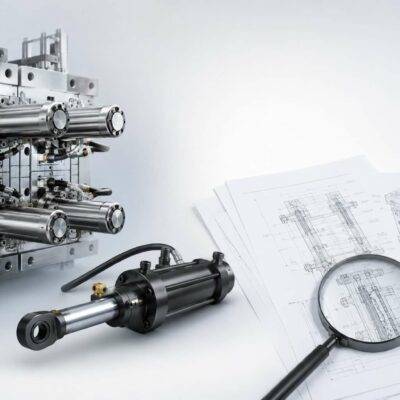

When a Standard Hydraulic Cylinder Is No Longer Enough
Selecting a hydraulic cylinder for an injection mold is often perceived as a straightforward process.
The designer defines the required bore, stroke and operating pressure, consults the manufacturer’s catalogue and selects the closest standard model.
In many applications this approach works perfectly.
However, modern injection molds are becoming increasingly compact and complex. Space is limited, moving components are positioned closer together, and every millimeter inside the mold must be used efficiently.
Under these conditions, the selection process changes completely.
Instead of asking “Which standard cylinder should we use?”, engineers begin asking a different question:
“Can a standard cylinder satisfy all the mechanical constraints of this mold?”
A real engineering case handled by the Vega Technical Department perfectly illustrates this situation and explains why custom hydraulic cylinders are sometimes the most efficient engineering solution.
The Customer’s Engineering Challenge
The request arrived through ALBA Enterprises, Vega’s distributor.
The customer was designing a new injection mold and needed two hydraulic cylinders based on the V220CC long stroke compact cylinder series.
At first glance, the request appeared relatively simple.
However, several important requirements immediately distinguished the application from a standard catalogue selection.
The customer required:
- a steel cylinder body;
- preparation for position sensors;
- extremely compact overall dimensions;
- stroke and final dimensions to be defined according to the mold layout.
These requirements already suggested that the solution would require more than selecting an existing catalogue model.
Space Is Often the Real Design Constraint
Hydraulic cylinders are frequently selected according to force and stroke.
In reality, mold designers often face a much more restrictive limitation:
available installation space.
Every component inside an injection mold competes for the same limited volume.
Core pulls, ejector systems, cooling circuits, hot runners, guide pillars and moving inserts all occupy valuable space.
As molds become smaller while incorporating more functions, cylinder dimensions become just as important as hydraulic performance.
This was exactly the challenge presented in this engineering case.
Why the Standard Cylinder Was Not Suitable
Before requesting a custom solution, an alternative had already been evaluated.
A standard CM040GOEGIQ160 hydraulic cylinder had been proposed.
After reviewing the mold design, however, the customer concluded that the standard cylinder was simply too long for the available installation space.
This is a situation familiar to many mold designers.
The cylinder may provide:
- sufficient pushing force;
- correct stroke;
- appropriate operating pressure;
yet still be impossible to install because its external dimensions exceed the available space.
When this occurs, increasing machine size is rarely an option.
Instead, the hydraulic cylinder itself must be redesigned.
Standard Products Already Offer Many Configuration Options
One important lesson from this case is that a standard hydraulic cylinder should never be considered a rigid, fixed product.
The V220CC series already offers an extensive range of configurable options before a fully custom design becomes necessary.
The catalogue allows engineers to select:
- different mounting styles;
- multiple oil port positions;
- threaded or manifold oil connections with O-rings;
- several rod-end configurations;
- magnetic or non-magnetic versions;
- standard or special strokes.
These configuration possibilities enable engineers to adapt a standard product to many different mold layouts without developing a completely new cylinder.
Magnetic Sensors Are Considered During the Design Stage
Another interesting aspect of this case concerns position sensing.
The customer required the cylinder to be prepared for sensors from the beginning of the project.
The V220CC catalogue provides two different cylinder versions:
- cylinders prepared for magnetic switches;
- non-magnetic cylinders without switch grooves.
This demonstrates an important design principle.
Sensor integration should be considered during the initial design phase rather than added later.
Doing so avoids mechanical modifications after production and ensures reliable sensor positioning.
Engineering Begins with Understanding the Mold
An experienced hydraulic cylinder manufacturer does not begin by selecting a product code.
Instead, engineers first analyse the mold itself.
Typical questions include:
- How much installation space is available?
- Where will hydraulic hoses be connected?
- Which mounting style simplifies assembly?
- Are position sensors required?
- Is a special body material needed?
- Can a configurable standard cylinder satisfy these requirements?
Only after answering these questions can the appropriate solution be identified.
This systematic engineering process reduces development time while ensuring reliable mold operation.
When Does a Standard Cylinder Become a Custom Cylinder?
One of the most valuable lessons from this engineering case is that the transition from a standard product to a custom design is gradual.
Engineers normally proceed through several stages:
- Evaluate the standard catalogue.
- Explore all available configuration options.
- Verify dimensional compatibility with the mold.
- Consider special strokes or optional features.
- Design a dedicated hydraulic cylinder only if the previous solutions remain unsuitable.
This methodology minimizes cost, shortens delivery times whenever possible and ensures that custom engineering is used only when it provides genuine technical advantages.
How Engineers Decide Between Modifying a Standard Cylinder and Designing a Custom Solution
In Part 1, we saw that selecting a hydraulic cylinder for an injection mold involves much more than choosing a bore size and stroke.
Modern molds often impose severe dimensional constraints that cannot always be satisfied using a standard catalogue product.
The engineering case handled by the Vega Technical Department demonstrates how experienced engineers evaluate whether a configurable standard cylinder is sufficient or whether a completely custom hydraulic cylinder should be developed.
A Custom Hydraulic Cylinder Is the Last Step, Not the First
One of the biggest misconceptions in mold design is that custom hydraulic cylinders are selected whenever a standard model is unavailable.
Professional engineering follows a very different process.
A custom cylinder is usually considered only after every standard configuration has been evaluated.
The V220CC compact long-stroke hydraulic cylinder already offers extensive configuration possibilities, including:
- multiple mounting configurations;
- various hydraulic port locations;
- threaded or O-ring manifold ports;
- several rod-end designs;
- magnetic and non-magnetic versions;
- standard and special stroke lengths.
These options allow many applications to be solved without creating an entirely new product.
When Standard Configurations Are No Longer Sufficient
Despite the flexibility of the V220CC series, some applications exceed the limits of catalogue configurations.
In this engineering case, the customer required:
- a steel cylinder body;
- sensor preparation;
- extremely compact dimensions;
- dimensions specifically adapted to the mold layout.
A previously proposed standard cylinder had already been rejected because its overall length exceeded the available installation space.
At this point, modifying catalogue options was no longer sufficient.
A dedicated engineering solution became necessary.
The Mold Defines the Hydraulic Cylinder
An important lesson from this case is that engineers do not design a custom hydraulic cylinder simply because a customer requests one.
Instead, the mold itself determines the cylinder design.
Every custom cylinder begins with an analysis of the mold’s requirements, including:
- available installation space;
- required stroke;
- operating force;
- body material;
- sensor integration;
- mounting arrangement;
- hydraulic connection layout.
The cylinder is then engineered around these requirements rather than forcing the mold designer to adapt the mold to a standard product.
This design philosophy often reduces assembly complexity and improves long-term reliability.
Material Selection Can Be Part of the Engineering Solution
The customer’s request also specified a steel cylinder body.
Material selection is not merely a manufacturing decision.
It may influence:
- structural rigidity;
- wear resistance;
- machining possibilities;
- compatibility with mold construction;
- service life under demanding operating conditions.
Choosing the appropriate body material therefore forms part of the overall engineering solution rather than being treated as an isolated specification.
Sensor Integration Should Never Be an Afterthought
Another significant aspect of this case is the early consideration of position sensing.
Instead of adding sensors after the mold had been completed, the customer required sensor preparation during the design phase.
The V220CC catalogue includes both magnetic and non-magnetic versions, allowing engineers to integrate sensor technology directly into the cylinder design.
Planning sensor integration early provides several advantages:
- simplified assembly;
- improved cable routing;
- greater protection against damage;
- easier maintenance;
- more reliable position feedback.
This approach reflects good engineering practice in modern injection mold design.
Custom Engineering Is About Optimising the Entire System
Many people associate custom hydraulic cylinders with higher costs.
In reality, a custom solution may reduce the overall cost of the mold by:
- simplifying mechanical design;
- reducing installation space;
- eliminating unnecessary adapters;
- reducing machining operations;
- improving accessibility for maintenance;
- increasing operational reliability.
When viewed from the perspective of the complete mold rather than the cylinder alone, a dedicated design often provides the most economical long-term solution.
Engineering Means Evaluating Every Alternative
One of the strongest aspects of this case is the methodology followed by the Vega Technical Department.
Instead of immediately developing a special cylinder, the engineers first evaluated available standard products.
After determining that the previously proposed standard solution could not satisfy the mold’s dimensional constraints, they prepared a quotation for a dedicated steel-body hydraulic cylinder, including alternative configurations, pricing and delivery information.
This structured process ensures that custom engineering is applied only when it provides genuine technical benefits.
Conclusion
This engineering case demonstrates that custom hydraulic cylinders are not developed simply because a customer requests a special product.
They are created when the mechanical constraints of the injection mold cannot be satisfied using even the most configurable standard solutions.
The Vega Technical Department first evaluated standard alternatives before proposing a dedicated steel-body hydraulic cylinder specifically adapted to the customer’s dimensional and functional requirements. Combined with the extensive configuration possibilities already available within the V220CC series, this case illustrates how professional engineering balances standardisation with customization to achieve the best technical solution.
This case reinforces one of the most important principles of injection mold engineering:
A custom hydraulic cylinder is not an exception to good engineering—it is often the most efficient solution when space limitations, sensor integration, mounting geometry or functional requirements exceed the capabilities of standard catalogue products.
Related Articles (Verified URLs on icvega.com)
- V220CC Compact Long Stroke Hydraulic Cylinder
https://www.icvega.com/products/v220cc - How to Find the Right Vega Cylinder or Accessory
https://www.icvega.com/choosing/find-right-vega-cylinder-accessory - Choosing the Right Cylinder: Stroke Selection
https://www.icvega.com/choosing/choosing-the-right-cylinder-for-your-mold-stroke - Choosing the Right Cylinder: Pushing Force
https://www.icvega.com/choosing/choosing-the-right-cylinder-for-your-mold-pushing-force - Hydraulic Cylinder Maintenance
https://www.icvega.com/maintenance/hydraulic-cylinder-maintenance