In plastic injection molds, real hydraulic cylinder speed depends on much more than operating pressure alone.
Actual movement speed is influenced by:
- available flow rate
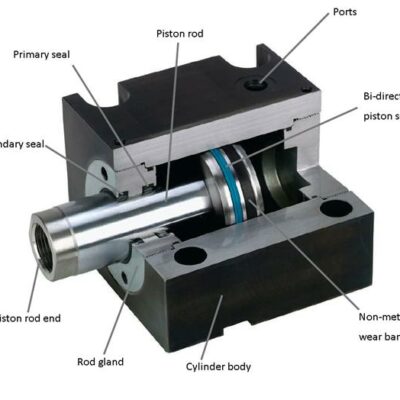
- oil port diameter
- internal cylinder volume
- oil passage length
- moving mass
- mechanical rigidity
- cavitation risk
- pressure spike management
Two cylinders with the same stroke and force may have completely different dynamic performance.
This article compares:
- Vega
- AHP Merkle
- HPS
analyzing:
- real speed capability
- oil port dimensions
- internal volume
- product codes
- application examples
- advantages and limitations
Basic Speed Formula
Theoretical cylinder speed depends on:
Q=V×SQ=V\times SQ=V×S
Where:
- Q = oil flow
- V = speed
- S = piston area
Speed can also be calculated as:
V=QSV=\frac{Q}{S}V=SQ
Real Example: Ø50 Cylinder
Example:
- Ø50 mm bore
- 100 mm stroke
- 20 l/min flow
Piston area:
S=πr2S=\pi r^2S=πr2
For Ø50:
- area ≈ 19.6 cm²
With 20 l/min:
- theoretical speed ≈ 170 mm/sec
However, real speed changes significantly depending on:
- oil port size
- hose routing
- dead volume
- cylinder rigidity
- internal geometry
Vega: High-Speed Compact Philosophy
Recommended series:
- V220CC
- V450CM
- V500CZ
Example: V500CZ
Characteristics:
- 500 bar
- compact heavy-duty
- advanced cushioning
- designed for high speed
Available bores:
- Ø32 → Ø100
Typical oil ports:
- G1/8
- G1/4
- G3/8
- G1/2
Example configuration:
- V500CZ-050-100
Where:
- 050 = Ø50 bore
- 100 = 100 mm stroke
Why Vega Is Extremely Fast
Vega focuses on:
- short oil passages
- integrated manifolds
- reduced dead volume
- compact connections
- lower hydraulic inertia
This allows:
- high acceleration
- faster response
- lower pressure losses
Highly effective for:
- fast ejectors
- multi-cavity molds
- rapid side actions
- automated systems
Choosing Oil Ports for Vega
G1/8
Ideal for:
- small cylinders
- controlled movements
- lower flow rates
Limitation:
- cavitation risk at high speed
G1/4
Excellent balance between:
- speed
- stable control
- compact size
Commonly used for:
- Ø32
- Ø40
- Ø50
G3/8 and G1/2
Ideal for:
- high speed
- large flow rates
- long strokes
- aggressive movements
Attention:
- increased water hammer risk
AHP Merkle: Stability Before Maximum Speed
Series:
- BZ
- BZN
- BZR
AHP follows a different philosophy:
- higher rigidity
- longer guidance
- greater stability
- improved precision
Example: AHP BZ
Typical configuration:
- BZ 50/100
Where:
- Ø50 bore
- 100 mm stroke
Characteristics:
- long guide sections
- robust structure
- excellent side-load stability
This improves:
- movement precision
- seal life
- dynamic control
However, it may reduce:
- maximum acceleration
- extreme speed
AHP Oil Ports
AHP often uses:
- more conservative ports
- controlled flow
- highly stable geometries
Excellent for:
- heavy movements
- long strokes
- large moving masses
When to Choose AHP
Ideal for:
- stability
- precision
- high side loads
- controlled movements
Less ideal for:
- maximum speed
- ultra-compact molds
HPS: Industrial Standard and Balanced Speed
Series:
- H160Co
- V72
HPS V72
Configuration:
- V72-50-100
Characteristics:
- 500 bar
- industrial compact design
- good speed
- strong standardization
Ports:
- standard BSP
- universal configurations
HPS Advantages
Very good for:
- retrofits
- quick replacements
- global standardization
- industrial systems
The V72 series offers:
- good compactness
- fast availability
- solid dynamic performance
How to Choose Oil Port Diameter
Oil ports directly influence:
- speed
- cavitation
- temperature
- stability
Ports Too Small
Problems:
- slower movement
- pressure drop
- cavitation
- overheating
Ports Too Large
Problems:
- water hammer
- hydraulic shocks
- difficult control
- vibration
General Guidelines
Small Cylinders Ø25–Ø40
Recommended ports:
- G1/8
- G1/4
Medium Cylinders Ø50–Ø63
Recommended ports:
- G1/4
- G3/8
Large Cylinders Ø80–Ø100
Recommended ports:
- G3/8
- G1/2
Which Cylinder Is the Fastest?
Vega
Generally best for:
- maximum speed
- compactness
- high acceleration
AHP Merkle
Generally best for:
- stability
- precision
- dynamic control
HPS
Generally best for:
- industrial simplicity
- standardization
- balanced performance
Final Considerations
The fastest cylinder is not simply the one with:
- the highest pressure
- the largest oil port
- the smallest body
Real speed depends on balancing:
- flow rate
- internal volume
- oil port dimensions
- rigidity
- moving mass
- pressure control
In modern injection molds:
- Vega excels in speed and compactness
- AHP Merkle excels in precision
- HPS excels in industrial simplicity
The best choice always depends on the real mold application.