In plastic injection molds, selecting the correct piston and rod diameter is essential to achieve:
- adequate force
- proper speed
- mechanical stability
- long service life
- reduced seal wear
- side-load resistance
- lower vibration
- rod bending safety
Many designers oversize cylinders believing this automatically improves reliability.
In reality, an oversized cylinder may create:
- slower movement
- higher oil consumption
- increased weight
- stronger pressure spikes
- greater inertia
An undersized cylinder may instead cause:
- rod deflection
- instability
- premature wear
- cavitation
- loss of control
This article compares:
- Vega
- AHP Merkle
- HPS
using:
- real formulas
- calculation examples
- dimensions
- product codes
- real applications
to help customers select the correct solution.
Basic Force Formula
Cylinder force depends on:
F=P×SF=P\times SF=P×S
Where:
- F = force
- P = pressure
- S = piston area
Piston area is calculated as:
S=πr2S=\pi r^2S=πr2
Real Example: Ø50 Piston
Assume:
- pressure = 250 bar
- bore = Ø50 mm
Piston area:
- approximately 19.6 cm²
Theoretical force:
F=250×19.6F=250\times19.6F=250×19.6
Result:
- approximately 4900 daN
- approximately 49 kN
This means a Ø50 cylinder at 250 bar produces almost:
- 5 tons of pushing force
When Is a Larger Bore Needed?
A larger piston is required when:
- moving masses increase
- friction increases
- higher force is required
- strong side-loads exist
- movement stability becomes critical
Disadvantages of Oversized Pistons
A larger piston increases:
- oil volume
- energy consumption
- inertia
- pressure spike risk
Speed decreases because piston area increases:
V=QSV=\frac{Q}{S}V=SQ
For this reason, fast mold systems often aim for:
- the smallest possible piston
- while still maintaining the required force
Vega: Compact High-Pressure Philosophy
Recommended series:
- V220CC
- V450CM
- V500CZ
Vega frequently uses:
- high operating pressures
- compact bodies
- reduced bore size
- optimized rods
This allows:
- high force in small spaces
- reduced weight
- higher speed
- lower oil volume
Vega V500CZ Example
Code:
- V500CZ-050-100
Where:
- Ø50 bore
- 100 mm stroke
Pressure:
- 500 bar
Theoretical force:
F=500×19.6F=500\times19.6F=500×19.6
Result:
- approximately 9800 daN
- almost 10 tons
Major advantage:
- high force without significantly increasing dimensions
How Vega Sizes Rods
Vega balances:
- speed
- rigidity
- compactness
Rods are often:
- lighter
- optimized for fast cycles
- ideal for compact molds
Very effective for:
- ejector systems
- multi-cavity molds
- rapid movements
AHP Merkle: Stability and Strong Guidance
Series:
- BZ
- BZN
- BZR
AHP frequently uses:
- stronger rods
- longer guide sections
- conservative geometries
This improves:
- stability
- side-load resistance
- movement precision
AHP BZ 50/100 Example
Configuration:
- Ø50 bore
- 100 mm stroke
Typically uses:
- a more robust rod compared to ultra-compact systems
Advantages:
- lower deflection
- greater precision
- improved control
Disadvantages:
- higher weight
- greater inertia
- slightly lower speed
Simplified Rod Deflection Considerations
Rod stability depends on:
- rod diameter
- free length
- applied load
Risk increases when:
- stroke becomes longer
- rod diameter becomes smaller
- side-loads increase
AHP Merkle strongly emphasizes buckling and stability calculations.
HPS: Balanced Industrial Approach
Series:
- H160Co
- V72
HPS follows:
- standard dimensions
- ISO geometries
- traditional rod-to-bore ratios
HPS V72 Example
Code:
- V72-50-100
Characteristics:
- 500 bar
- industrial compact design
- solid robustness
- good overall balance
Very useful for:
- retrofits
- industrial applications
- standardization
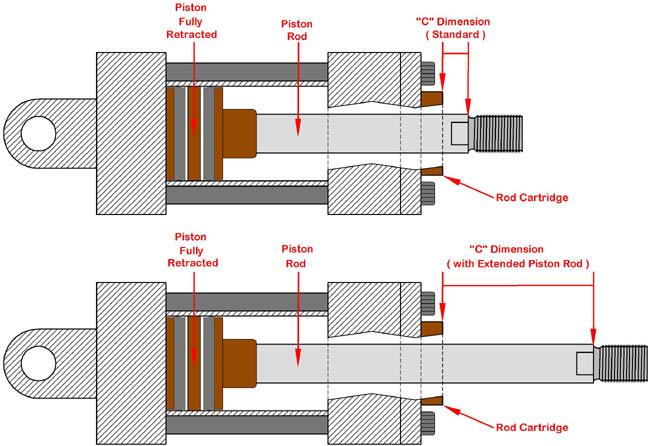
How to Select Rod Diameter
Rod diameter must consider:
- stroke
- side-loads
- moving mass
- speed
- acceleration
Rod Too Small
Problems:
- deflection
- vibration
- guide wear
- seal damage
Rod Too Large
Problems:
- higher weight
- reduced return speed
- greater inertia
- increased friction
General Mold Guidelines
Short Strokes
Possible to use:
- smaller rods
- faster systems
Long Strokes
Require:
- stronger rods
- longer guides
- greater rigidity
Which Brand Should You Choose?
Vega
Ideal for:
- high speed
- compactness
- high pressure
- reduced oil volume
Excellent for:
- multi-cavity molds
- fast ejectors
- automation
AHP Merkle
Ideal for:
- high side-loads
- precision
- large movements
- maximum stability
Very effective for:
- large side cores
- long movements
- heavy systems
HPS
Ideal for:
- standardization
- simplicity
- retrofits
- global availability
Final Considerations
The correct piston and rod size directly influence:
- speed
- force
- reliability
- durability
- stability
- energy consumption
The best cylinder is not simply:
- the largest
- the most powerful
- the most compact
The ideal solution always comes from balancing:
- required force
- speed
- rigidity
- stroke
- available space
- real mold dynamics