Collaborative Robots at Interpack 2026: How Cobots Are Transforming Packaging Automation
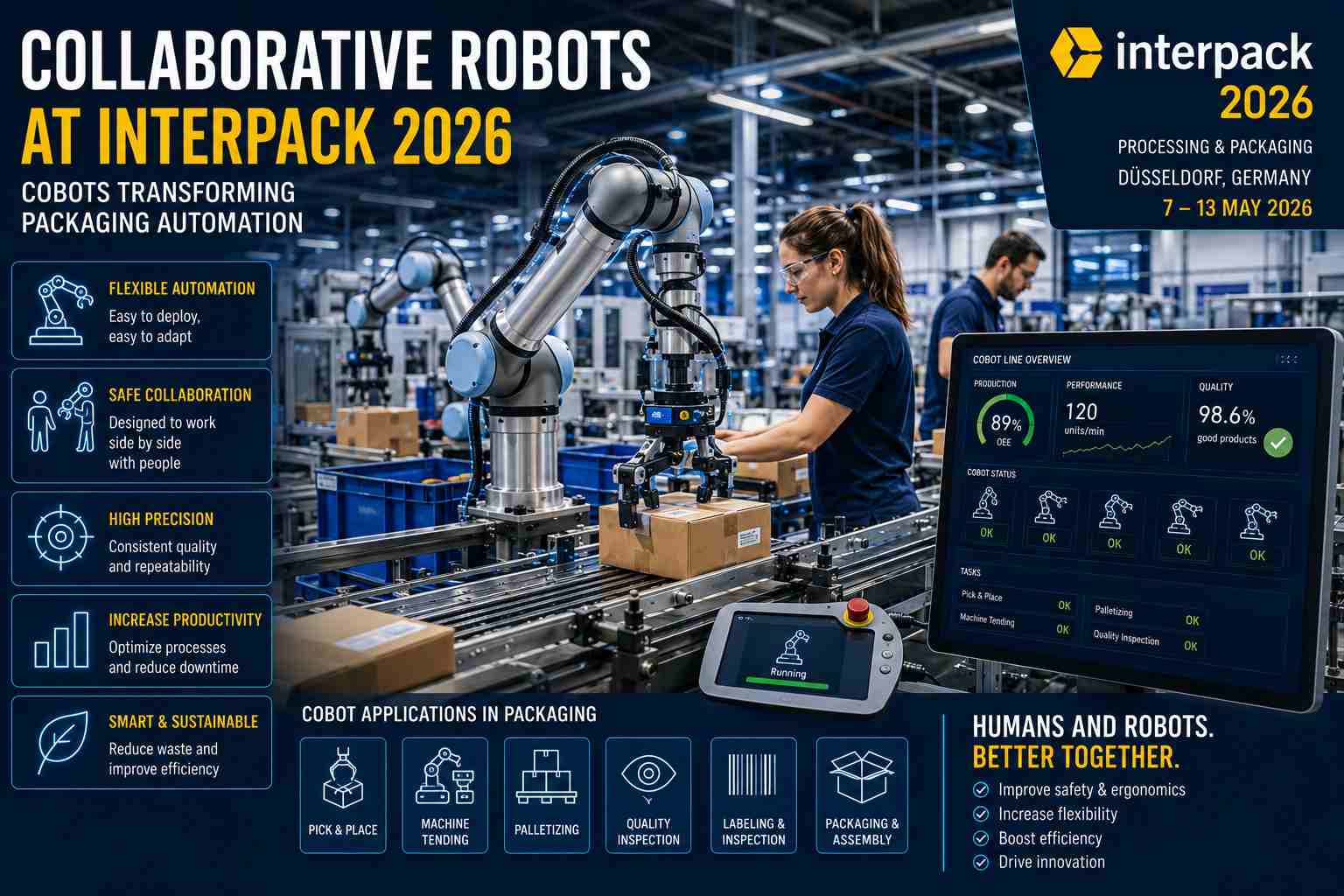
Collaborative robots, commonly known as cobots, are rapidly changing the way packaging manufacturers design and operate production lines. Unlike traditional industrial robots that work inside safety cages, cobots are designed to operate safely alongside human workers, combining automation with flexibility.
At Interpack 2026, collaborative robotics is expected to be one of the fastest-growing technology sectors. Manufacturers are increasingly investing in cobots to improve productivity, simplify repetitive tasks and respond to growing labor shortages while maintaining high product quality.
From packaging and palletizing to inspection and machine tending, collaborative robots are becoming an essential part of the modern smart factory.
What Is a Collaborative Robot?
A collaborative robot is an industrial robot specifically designed to interact safely with human operators.
Unlike conventional robotic systems, cobots include integrated safety technologies such as:
- force limitation
- collision detection
- speed monitoring
- safe stop functions
- advanced vision systems
These capabilities allow humans and robots to work together without permanent safety barriers in many applications.
Why Cobots Are Growing So Quickly
Manufacturers are under constant pressure to:
- increase production
- reduce labor shortages
- improve quality
- increase flexibility
- reduce operating costs
Cobots help solve these challenges because they are easier to install, easier to program and can often be redeployed to different tasks with minimal effort.
Applications in Packaging
Collaborative robots are now widely used throughout packaging production.
Typical applications include:
Pick-and-Place Operations
Cobots can handle products at high speed while maintaining exceptional positioning accuracy.
Typical products include:
- bottles
- cartons
- trays
- pouches
- medical products
- consumer goods
Machine Tending
Cobots automatically load and unload:
- packaging machines
- labeling equipment
- inspection stations
- sealing machines
- assembly systems
This improves production consistency while reducing operator workload.
Palletizing and Depalletizing
Modern cobots can stack products safely and efficiently.
Benefits include:
- reduced manual handling
- improved ergonomics
- consistent pallet quality
- lower injury risk
Quality Inspection
Integrated vision systems enable cobots to inspect:
- labels
- barcodes
- packaging integrity
- fill levels
- component presence
AI-powered vision allows robots to identify complex quality defects in real time.
Artificial Intelligence Makes Cobots Smarter
Artificial Intelligence significantly expands robotic capabilities.
AI enables cobots to:
- recognize products
- adapt movements
- optimize cycle times
- learn new tasks
- detect anomalies
- improve production efficiency
Machine learning allows robotic systems to become increasingly efficient over time.
Vision Systems and Cobots
Machine vision provides cobots with “eyes.”
Industrial cameras help robots:
- locate products
- identify orientation
- inspect quality
- detect defects
- verify packaging
Vision-guided robotics greatly increases operational flexibility.
Motion Control Remains Essential
Although cobots use advanced software, precise motion control remains fundamental.
Robotic systems depend on:
- servo drives
- precision gearboxes
- linear motion
- synchronized positioning
- high-performance actuators
Accurate movement ensures repeatable production quality.
Human-Robot Collaboration
One of the greatest strengths of cobots is their ability to complement human skills.
Humans remain responsible for:
- decision-making
- problem solving
- process optimization
- supervision
Cobots handle repetitive, physically demanding or highly repetitive tasks.
Together they create more efficient production environments.
Sustainability Benefits
Collaborative robotics also supports sustainability.
Automation helps manufacturers:
- reduce waste
- optimize material handling
- improve energy efficiency
- minimize defective products
- increase equipment utilization
Higher production efficiency contributes directly to lower environmental impact.
Industries Using Cobots
Collaborative robots are increasingly adopted in:
- food packaging
- beverage production
- pharmaceutical manufacturing
- cosmetics
- electronics
- logistics
- industrial manufacturing
Every sector benefits from greater flexibility and consistent quality.
Frequently Asked Questions
What is a cobot?
A collaborative robot is an industrial robot designed to safely work alongside human operators.
Why are cobots important?
They improve productivity, reduce repetitive manual work, increase flexibility and simplify automation.
Will cobots be featured at Interpack 2026?
Yes. Collaborative robotics is expected to be one of the exhibition’s fastest-growing technology areas.
Can cobots perform quality inspection?
Yes. Combined with AI-powered vision systems, cobots can inspect labels, packaging integrity and product quality automatically.
Which industries use collaborative robots?
Food, beverages, pharmaceuticals, cosmetics, logistics and many other manufacturing sectors.
Looking Ahead
Collaborative robots are reshaping packaging manufacturing by combining flexibility, safety and intelligent automation.
As Artificial Intelligence, machine vision and motion control continue to evolve, cobots will become an increasingly important part of smart packaging production.
Interpack 2026 is expected to demonstrate how human-robot collaboration is creating more efficient, flexible and sustainable factories.