Industry 5.0 at Interpack 2026: The Human-Centered Future of Packaging Manufacturing
For more than a decade, Industry 4.0 has transformed manufacturing through automation, connectivity and data-driven production. Today, however, the industrial world is entering a new phase known as Industry 5.0, where advanced technologies are combined with human creativity, sustainability and resilience.
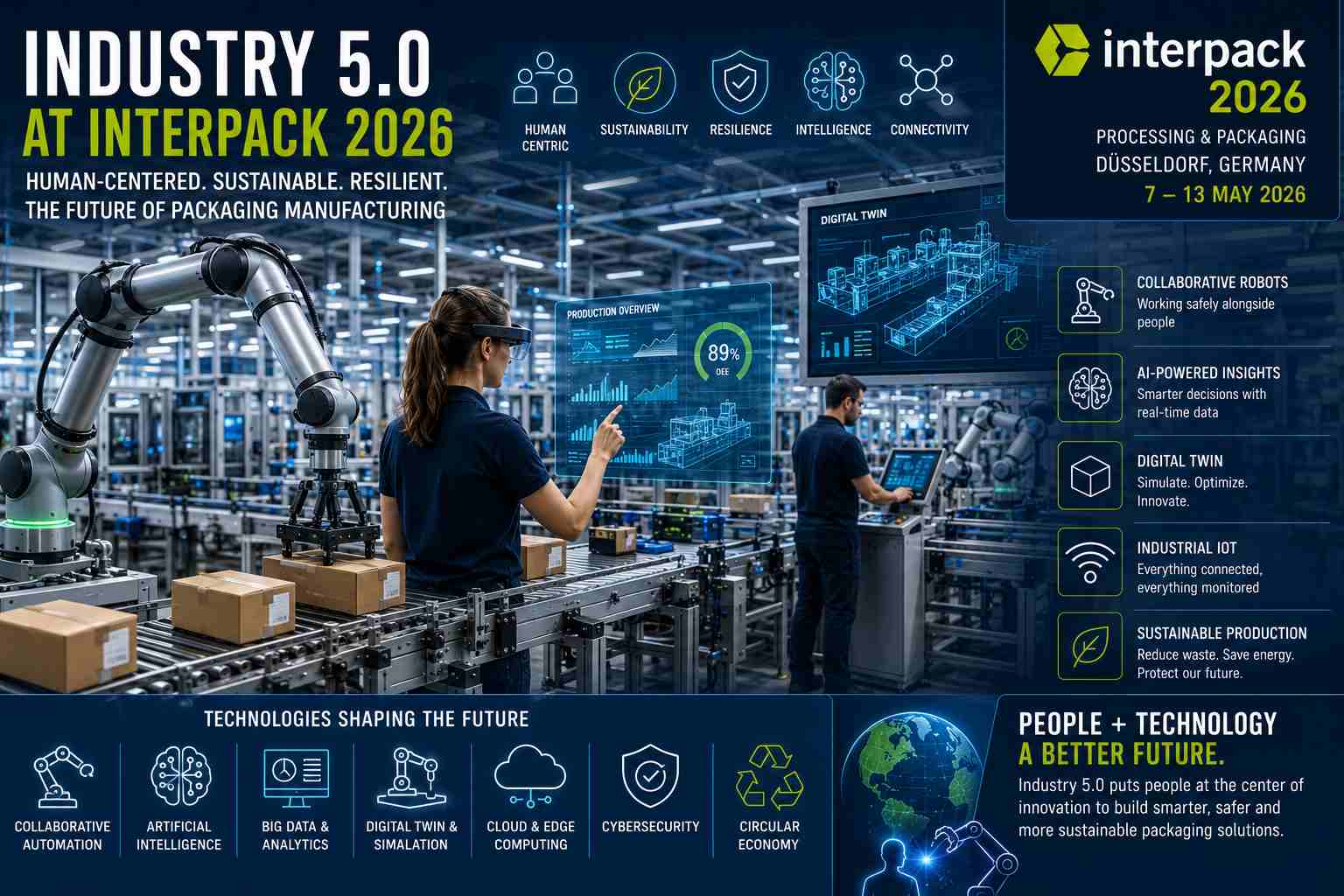
At Interpack 2026, Industry 5.0 is expected to become one of the defining themes across packaging, processing and industrial automation. Artificial Intelligence, collaborative robotics, Digital Twins and Industrial IoT will continue to evolve, but with a stronger focus on supporting people rather than replacing them.
Packaging manufacturers are increasingly investing in technologies that improve productivity while creating safer, more flexible and environmentally responsible production environments.
What Is Industry 5.0?
Industry 5.0 builds upon the digital transformation introduced by Industry 4.0.
While Industry 4.0 emphasized automation and connectivity, Industry 5.0 adds three fundamental priorities:
- Human-centric manufacturing
- Sustainability
- Industrial resilience
Technology is no longer viewed only as a productivity tool, but as a way to empower people and create smarter decision-making.
Human-Centered Manufacturing
People remain at the center of modern factories.
Industry 5.0 technologies are designed to support operators through:
- collaborative robots
- augmented reality
- digital work instructions
- AI-assisted decision making
- ergonomic workstations
- intelligent automation
Instead of replacing workers, technology enhances their capabilities.
Artificial Intelligence as a Decision Support Tool
Artificial Intelligence is becoming an industrial assistant.
Rather than making every decision autonomously, AI increasingly helps engineers and operators by:
- identifying production bottlenecks
- optimizing machine parameters
- predicting maintenance
- reducing waste
- improving product quality
- supporting production planning
Human expertise remains essential for interpreting and validating recommendations.
Collaborative Robotics
Collaborative robots are one of the best examples of Industry 5.0.
Cobots safely work alongside operators to perform repetitive or physically demanding tasks such as:
- pick-and-place
- palletizing
- machine tending
- packaging
- quality inspection
This combination of human flexibility and robotic precision creates more efficient production systems.
Digital Twins and Virtual Engineering
Digital Twin technology enables manufacturers to simulate production before implementing physical changes.
Applications include:
- line balancing
- machine layout optimization
- process simulation
- energy analysis
- predictive maintenance
- operator training
Virtual engineering reduces development time while minimizing production risks.
Sustainable Manufacturing
Industry 5.0 places sustainability at the heart of industrial strategy.
Packaging manufacturers are investing in:
- energy-efficient machinery
- recyclable materials
- lightweight packaging
- circular economy solutions
- renewable energy integration
- waste reduction
Sustainability is becoming a competitive advantage rather than a regulatory obligation.
Industrial Resilience
Global supply chain disruptions have highlighted the importance of resilient manufacturing.
Industry 5.0 technologies improve resilience through:
- connected factories
- remote monitoring
- predictive analytics
- flexible automation
- cloud manufacturing
- decentralized production
These capabilities help manufacturers respond quickly to changing market conditions.
Motion Control in Industry 5.0
Although digital technologies receive much attention, mechanical precision remains fundamental.
Packaging machinery continues to depend on:
- servo systems
- linear motion
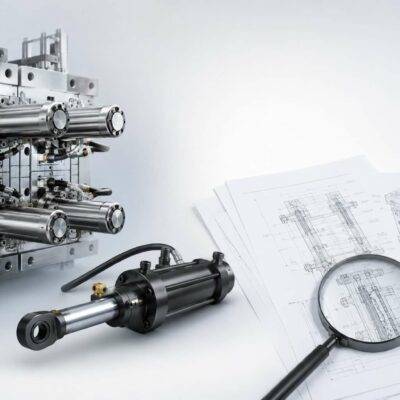
- hydraulic cylinders
- electric actuators
- synchronized positioning
- precision control
Reliable motion systems provide the physical foundation for intelligent automation.
Industrial IoT Connects Everything
Industry 5.0 relies on connected equipment.
Industrial IoT continuously monitors:
- production status
- machine performance
- energy consumption
- hydraulic pressure
- vibration
- quality indicators
Real-time information supports faster and more accurate decision-making.
Benefits for Packaging Manufacturers
Industry 5.0 helps companies achieve:
- higher productivity
- greater flexibility
- improved product quality
- reduced downtime
- enhanced worker safety
- lower environmental impact
- stronger competitiveness
The result is a manufacturing environment where technology and people work together.
Frequently Asked Questions
What is Industry 5.0?
Industry 5.0 is the next stage of industrial development, combining advanced automation with human-centered design, sustainability and resilience.
How is Industry 5.0 different from Industry 4.0?
Industry 4.0 focused on connectivity and automation. Industry 5.0 adds greater emphasis on people, environmental responsibility and adaptable manufacturing.
Will Industry 5.0 be a major theme at Interpack 2026?
Yes. Many exhibitors are expected to showcase technologies aligned with Industry 5.0 principles, including AI, collaborative robotics, Digital Twins and sustainable production.
Does Industry 5.0 replace automation?
No. It integrates automation with human expertise to create more flexible and efficient production systems.
Why is Industry 5.0 important for packaging?
It enables manufacturers to improve productivity while supporting workers, reducing waste and creating more sustainable factories.
Looking Ahead
Industry 5.0 represents more than the next technological trend—it reflects a broader transformation in manufacturing philosophy.
By combining Artificial Intelligence, collaborative robotics, Digital Twins, Industrial IoT and sustainable engineering, packaging manufacturers can build factories that are not only more efficient, but also more resilient and human-centered.
Interpack 2026 is expected to highlight how Industry 5.0 will shape the future of packaging production over the coming decade.