Packaging Trends 2026: The Innovations Expected to Shape the Future at Interpack
The global packaging industry is entering a period of rapid transformation driven by automation, sustainability, digitalization and changing consumer expectations. Manufacturers are no longer focused solely on increasing production speed; they must also improve flexibility, reduce environmental impact and respond quickly to evolving market demands.
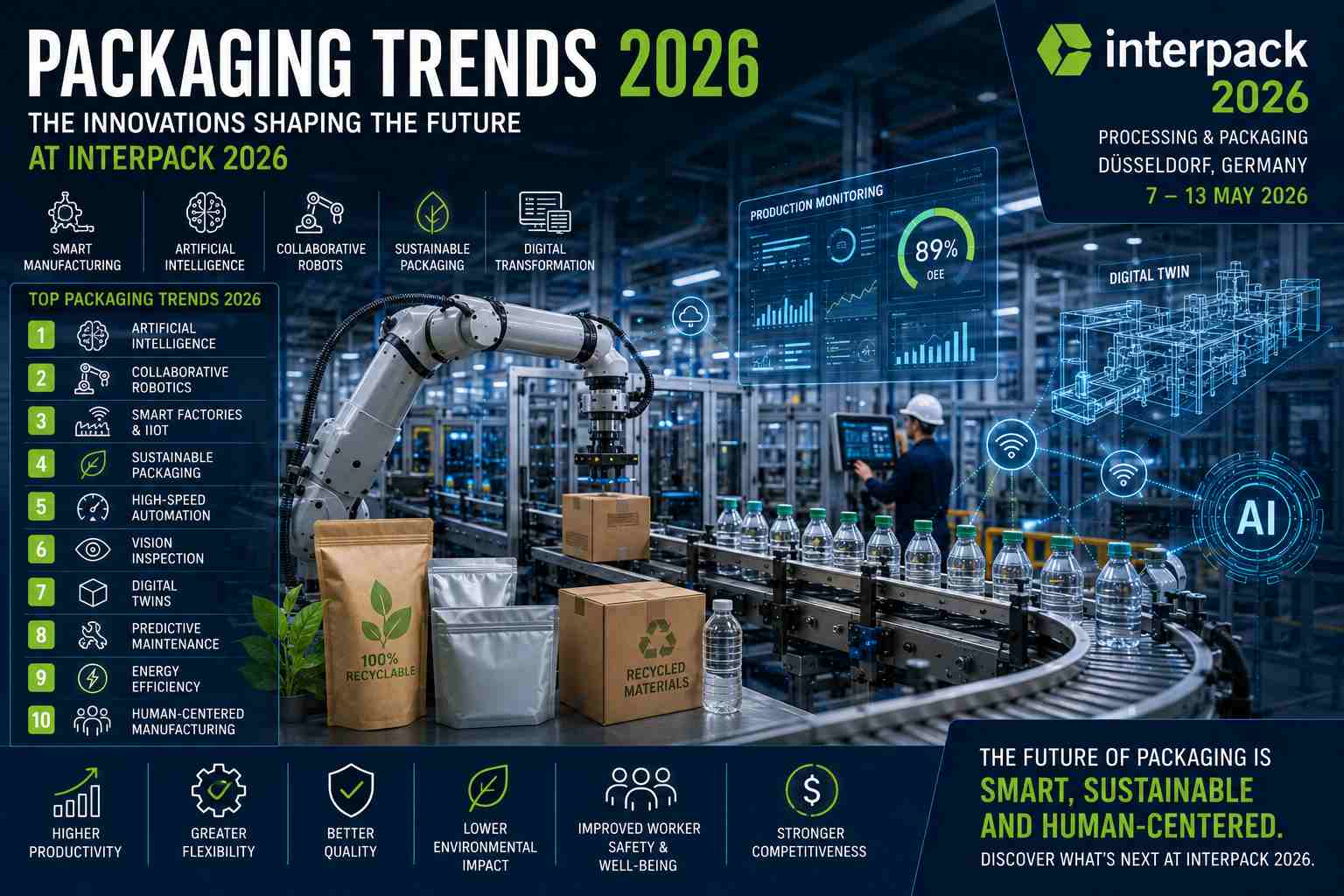
Interpack 2026 is expected to become the world’s most important showcase for the technologies that will define the future of packaging over the next decade.
From Artificial Intelligence and collaborative robotics to recyclable materials and smart factories, visitors will discover innovations designed to improve efficiency while supporting a more sustainable and resilient manufacturing industry.
Why Packaging Is Changing Faster Than Ever
Several global factors are accelerating innovation:
- rising energy costs
- labor shortages
- stricter environmental regulations
- growth of e-commerce
- demand for sustainable packaging
- increasing automation
- digital transformation
Manufacturers must continuously invest in new technologies to remain competitive.
Trend 1 – Artificial Intelligence Everywhere
Artificial Intelligence is rapidly becoming one of the most influential technologies in packaging manufacturing.
AI applications include:
- predictive maintenance
- machine optimization
- quality inspection
- production scheduling
- energy optimization
- autonomous process control
AI helps manufacturers improve productivity while reducing waste and operating costs.
Trend 2 – Collaborative Robotics
Cobots continue expanding across packaging production.
Expected applications include:
- pick-and-place
- palletizing
- machine tending
- quality inspection
- packaging assembly
Collaborative robots improve flexibility while allowing operators and machines to work safely together.
Trend 3 – Smart Factories
Packaging factories are becoming increasingly connected.
Key technologies include:
- Industrial IoT
- Digital Twins
- cloud manufacturing
- edge computing
- predictive analytics
- real-time dashboards
Connected factories provide greater visibility into production performance.
Trend 4 – Sustainable Packaging
Sustainability remains one of the industry’s highest priorities.
Expected innovations include:
- recyclable packaging
- mono-material solutions
- paper-based packaging
- biodegradable materials
- lightweight packaging
- circular economy strategies
Environmental performance is becoming a major competitive advantage.
Trend 5 – High-Speed Automation
Manufacturers continue increasing production capacity through:
- faster servo systems
- advanced motion control
- intelligent conveyors
- robotics
- synchronized machine movements
Higher productivity helps reduce manufacturing costs while meeting growing demand.
Trend 6 – Vision Inspection
AI-powered inspection systems continue replacing manual quality control.
Modern vision systems inspect:
- labels
- barcodes
- seals
- fill levels
- print quality
- packaging integrity
Automated inspection significantly improves product consistency.
Trend 7 – Digital Twins
Digital Twin technology allows manufacturers to:
- simulate production
- optimize layouts
- test new packaging formats
- improve maintenance planning
- reduce commissioning time
Virtual production environments reduce implementation risks.
Trend 8 – Predictive Maintenance
Packaging companies increasingly rely on smart sensors and AI to predict equipment failures before they occur.
Benefits include:
- lower maintenance costs
- fewer breakdowns
- improved equipment life
- greater production reliability
Trend 9 – Energy Efficiency
Energy efficiency has become essential.
Expected solutions include:
- regenerative servo drives
- efficient hydraulic systems
- intelligent power management
- optimized motion profiles
- energy monitoring software
Reducing energy consumption lowers both costs and carbon emissions.
Trend 10 – Human-Centered Manufacturing
Industry 5.0 emphasizes collaboration between people and technology.
Future packaging factories combine:
- AI
- collaborative robots
- Digital Twins
- intelligent software
- skilled operators
Technology supports human expertise rather than replacing it.
What Visitors Can Expect at Interpack 2026
Professionals attending the exhibition are expected to discover:
- next-generation packaging machinery
- automation technologies
- robotics
- AI software
- smart sensors
- sustainable materials
- motion control systems
- industrial software
- digital factory solutions
Interpack continues to provide a comprehensive overview of the future of packaging manufacturing.
Frequently Asked Questions
What are the biggest packaging trends for 2026?
Artificial Intelligence, collaborative robotics, Smart Manufacturing, sustainable packaging, Digital Twins, Industrial IoT and predictive maintenance are expected to dominate the industry.
Why is Interpack important?
Interpack is the world’s leading trade fair for processing and packaging technologies, bringing together global manufacturers and technology suppliers.
Will sustainability remain a major trend?
Yes. Sustainability is expected to influence machinery design, packaging materials, energy efficiency and production processes.
How is AI changing packaging?
AI improves quality inspection, predictive maintenance, machine optimization and production planning.
Why should engineers follow packaging trends?
Understanding emerging technologies helps manufacturers plan investments and remain competitive in rapidly changing markets.
Looking Ahead
Packaging manufacturing is evolving toward a future defined by intelligence, connectivity and sustainability.
The innovations expected at Interpack 2026 demonstrate that tomorrow’s factories will be smarter, faster and more environmentally responsible than ever before.
Companies that embrace these technologies early will be better positioned to succeed in an increasingly competitive global market.