For more than 20 years, the V260CF has been one of the reference self-locking hydraulic cylinders for injection molds. Its mechanical locking system has proven reliable in thousands of applications, allowing mold makers to safely hold slides and cores even under very high injection pressures.
However, technology evolves, and so do customer expectations.
This is why Vega developed the V270CG: not to replace the V260CF because it was unreliable, but to create a new generation that is more compact, easier to use, more precise and significantly more economical.
The V260CF: a proven technology
The V260CF introduced an automatic mechanical locking system that eliminates the need for complex external locking devices.
Once the piston reaches the end of its stroke, the cylinder locks mechanically and automatically unlocks when the return hydraulic command is given. No additional valves or special hydraulic circuits are required.
Its main strengths include:
- Proven mechanical locking system
- High holding forces
- Excellent reliability
- More than two decades of successful applications
- Adjustable preload flange available
For many mold makers, the V260CF became the standard solution whenever high locking forces were required.
Why develop the V270CG?
Although the V260CF performed extremely well, Vega engineers identified several areas that could be improved.
The new V270CG was designed to:
- reduce manufacturing costs;
- simplify installation;
- improve sensor reliability;
- increase available stroke lengths;
- make the cylinder easier to adjust inside the mold.
The goal was simple: keep the advantages of the V260CF while eliminating its most common limitations.
1. Better integrated sensors
One of the biggest improvements concerns the end-of-stroke sensors.
The V260CF uses integrated sensors that require adjustment during installation.
The V270CG introduces a completely redesigned sensor system with new inductive sensors mounted inside the cylinder body. They are:
- more accurate;
- protected against hydraulic pressure;
- factory positioned;
- no adjustment required after installation.
This reduces installation time and minimizes setup errors.
2. Lower purchase cost
Producing a self-locking cylinder requires extremely precise machining.
During the redesign, Vega engineers simplified several components without compromising the locking mechanism.
The result is a cylinder that offers essentially the same operating principle but at a considerably lower manufacturing cost, making self-locking technology accessible to a wider range of molds.
3. Longer available strokes
One limitation of the first-generation cylinder was the available stroke range.
The V270CG was designed with longer standard strokes, making it suitable for a wider variety of slide movements without requiring special custom versions. The presentation also highlights that one of the improvements over the first generation was the availability of longer strokes.
4. Improved reliability
The presentation identifies several issues that were addressed during the redesign:
- oil leakage around the sensors;
- insufficient locking pressure in some situations;
- limited stroke lengths;
- unlocking spring failures;
- completely redesigned sensor mounting system.
These improvements increase long-term reliability while simplifying maintenance.
5. Higher working pressure
The V260CF operates up to 260 bar.
The new V270CG increases the maximum working pressure to 270 bar, providing a small but useful increase in available operating force while remaining fully compatible with demanding injection molding applications.
6. Same proven locking principle
One aspect has deliberately remained unchanged.
The mechanical locking ring that made the V260CF successful has been retained because its reliability has already been demonstrated over many years of operation.
According to Vega’s presentation, the design philosophy continues to rely on a locking system with a long service history and no recorded rod failures over more than twenty years.
Quick comparison
| Feature | V260CF | V270CG |
|---|---|---|
| Mechanical locking | ✔ | ✔ |
| Maximum pressure | 260 bar | 270 bar |
| Sensor technology | First generation | New integrated inductive sensors |
| Sensor adjustment | Required | Factory preset |
| Manufacturing cost | Higher | Lower |
| Standard strokes | More limited | Extended |
| Installation | More complex | Easier |
| Reliability | Proven | Improved with redesigned components |
Which cylinder should you choose?
The V260CF remains an excellent self-locking cylinder with a long history of successful applications.
The V270CG builds on that experience and introduces several practical improvements that simplify installation, reduce costs and improve usability, while maintaining the same proven mechanical locking philosophy.
For new mold designs, the V270CG represents the natural evolution of the V260CF, combining decades of experience with a more modern, economical and user-friendly design.
7. A Completely Redesigned Mechanical Layout
Although both cylinders use the same proven mechanical locking principle, the external architecture has been completely redesigned.
The V270CG was developed with three clear objectives:
- reduce the overall dimensions;
- simplify installation;
- reduce machining operations inside the mold.
The result is a cylinder that occupies less space while offering easier installation and maintenance.
Smaller Overall Dimensions
One of the most noticeable differences is the overall length.
Let’s compare the most common size (45 mm bore).
| Feature | V260CF | V270CG |
|---|---|---|
| Body diameter | 64 mm | 64 mm |
| Front flange thread | M60×1.5 | M60×1.5 |
| Body length (without stroke) | 149.7 mm | 207.5 mm* |
| Maximum standard stroke | 150 mm | 150 mm |
*The V270CG has a different internal architecture that incorporates the new locking system and integrated sensor arrangement, so direct body-length comparisons should always be evaluated together with the installation concept and flange design rather than as a standalone dimension.
The real advantage is therefore not simply the cylinder length, but the reduction of the space required around the cylinder once installed in the mold.
Second-Generation Sensor Technology
Probably the biggest innovation is hidden inside the cylinder.
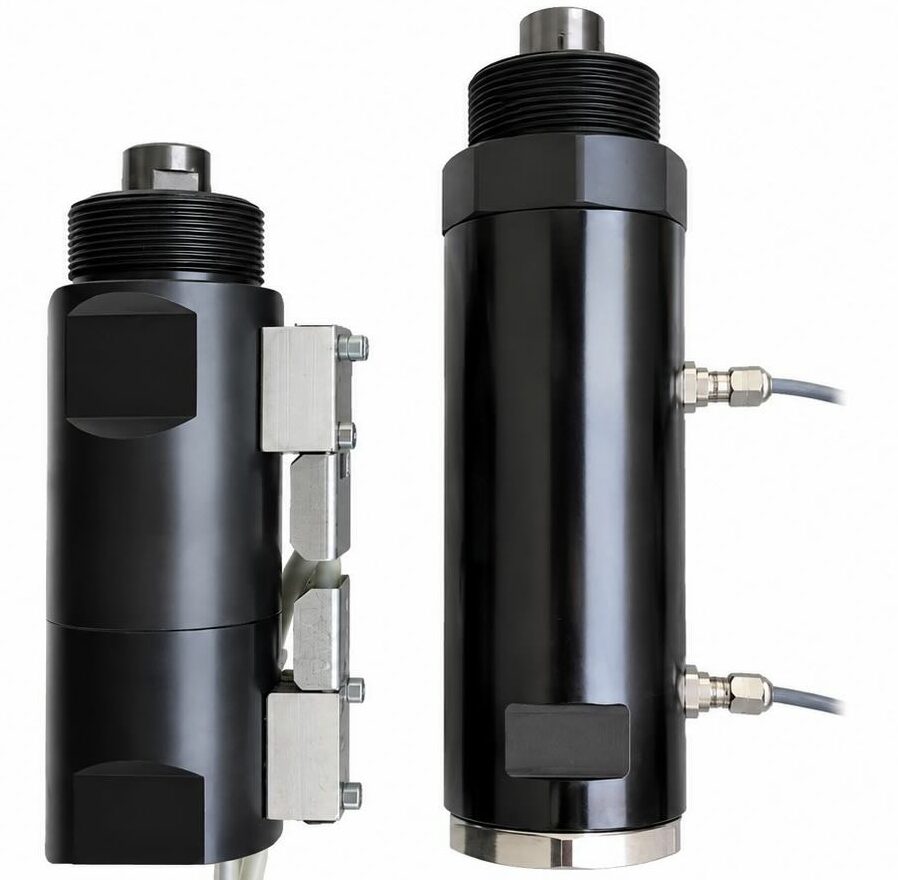
The V260CF uses two external inductive sensors mounted on dedicated aluminum supports fixed to the cylinder body. These supports include protection covers, fixing brackets, actuator pins and several additional components.
The new V270CG completely redesigns this concept.
The inductive sensors are integrated directly into the cylinder body, eliminating most of the external hardware.
This provides several advantages:
- cleaner design;
- fewer components;
- easier wiring;
- reduced assembly time;
- better protection against accidental impacts;
- lower risk of oil leakage around the sensor area.
The presentation itself identifies new sensors and a completely redesigned sensor mounting system as one of the major improvements over the first generation.
New Flange Philosophy
The preload adjustment philosophy has also evolved.
The V260CF was designed around a dedicated adjustable preload flange, allowing mold makers to manually regulate the preload during installation. This flange is fully machined and includes an integrated adjustment system.
The V270CG introduces a completely new round flange concept.
Compared with the previous generation, the new flange offers:
- much higher positioning accuracy;
- simpler installation;
- no grinding operations during installation;
- easier preload adjustment while the mold is hot.
According to Vega’s comparison, the new round flange provides 0.01 mm positioning accuracy, allows adjustments with the mold at operating temperature, maintains oil pressure during preload adjustment, and does not require flange grinding.
Cleaner Mold Design
Because of the new sensor arrangement and flange design, the mold itself becomes easier to manufacture.
Compared with the V260CF, designers can benefit from:
- fewer machined pockets;
- fewer mounting screws;
- fewer external components;
- easier maintenance;
- cleaner cable routing.
The result is a more compact and modern mold layout.
Side-by-Side Comparison
| Feature | V260CF | V270CG |
|---|---|---|
| Working pressure | 260 bar | 270 bar |
| Mechanical locking | ✔ Proven | ✔ Same proven concept |
| Sensor design | External inductive sensors with support brackets | Fully integrated inductive sensors |
| Sensor protection | External covers | Internal protected installation |
| Number of sensor components | Higher | Significantly reduced |
| Standard strokes | Up to 150 mm | Up to 150 mm with redesigned architecture |
| Preload adjustment | Adjustable preload flange | New round flange technology |
| Hot mold adjustment | Limited | Yes |
| Positioning accuracy | Traditional | 0.01 mm |
| Flange grinding required | Possible | No |
| Overall installation | More complex | Simpler and cleaner |
-
About Vega Cylinders – 40 Years of Hydraulic Innovation