When engineers think about magnetic position sensing in hydraulic cylinders, the first question is often:
“Why not simply use the strongest magnet available?”
At first glance, the answer seems obvious. A stronger magnetic field should produce a stronger signal, making the sensor more reliable.
In reality, hydraulic cylinder design is far more complex.
The magnetic system is carefully engineered to provide the right magnetic field, not necessarily the strongest one.
This is why high-quality hydraulic cylinder manufacturers use different grades of neodymium magnets depending on the application rather than relying on a single solution.
The Magnet Is Just as Important as the Sensor
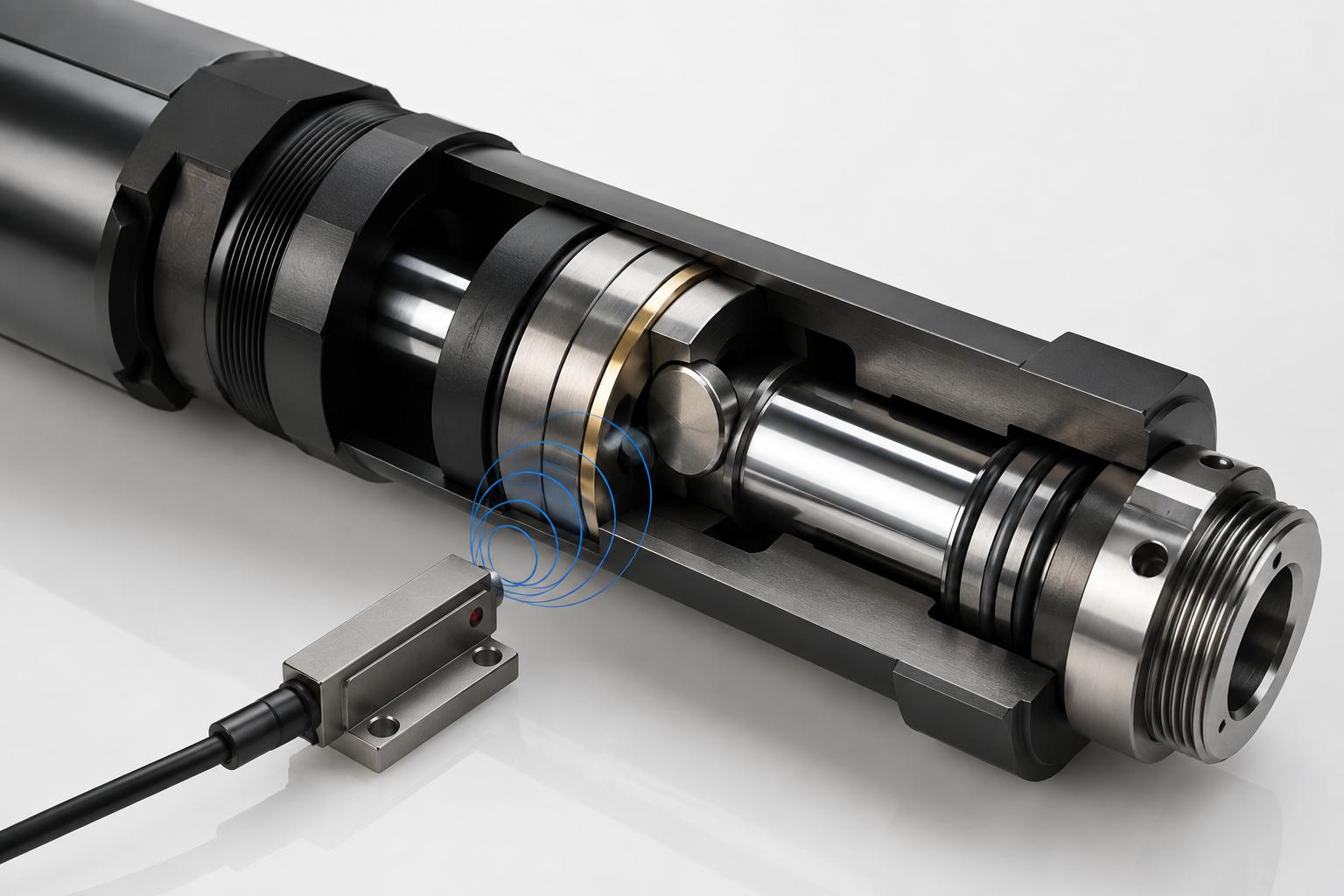
Magnetic end-position detection works because a permanent magnet is installed inside the piston.
As the piston moves, the magnetic field moves with it.
External magnetic sensors detect this field and send the position signal to the PLC without any mechanical contact.
The accuracy of the entire system depends on the interaction between:
- the magnet;
- the piston geometry;
- the cylinder tube;
- the sensor technology;
- the magnetic field distribution.
A well-designed sensing system is therefore the result of careful engineering rather than simply selecting the strongest available magnet.
Why Vega Uses Different Magnet Grades
Many people assume that one magnet grade can be used for every hydraulic cylinder.
In practice, this is rarely the best solution.
According to Vega’s purchasing specifications, different hydraulic cylinders use different NdFeB (Neodymium Iron Boron) magnet grades, including N30H, N42H and N52H, depending on the specific application.
This is not about product quality.
It is about engineering optimization.
Understanding Magnet Grades
The number associated with a neodymium magnet represents its maximum energy product.
In simple terms, it indicates how much magnetic energy the material can generate.
| Magnet Grade | Relative Magnetic Strength |
|---|---|
| N30 | Medium |
| N42 | High |
| N52 | Very High |
Higher numbers produce stronger magnetic fields.
However, stronger is not always better.
What Does the “H” Mean?
Besides the energy level, the letter following the grade is equally important.
The magnets used by Vega belong to the H series, such as N30H, N42H and N52H.
The “H” designation identifies magnets designed for elevated operating temperatures.
Hydraulic cylinders frequently operate in demanding industrial environments where oil temperatures can become significantly higher than ambient conditions.
Selecting a temperature-resistant magnet helps maintain stable magnetic performance over time.
Why the Strongest Magnet Is Not Always the Best Choice
Many engineers are surprised to discover that an excessively strong magnet may actually reduce sensing performance.
An oversized magnetic field can:
- activate sensors earlier than expected;
- reduce switching accuracy;
- increase hysteresis;
- influence nearby magnetic sensors;
- complicate precise positioning.
For this reason, engineers aim to generate the optimal magnetic field, not the maximum possible one.
Magnetic Engineering Is About Balance
Choosing the correct magnet requires balancing several parameters simultaneously.
Engineers evaluate:
- magnetic field intensity;
- operating temperature;
- sensor sensitivity;
- cylinder geometry;
- long-term stability;
- production cost.
Only after considering all these factors can the most suitable magnet grade be selected.
Surface Protection Matters Too
Neodymium magnets are extremely powerful but naturally susceptible to corrosion.
For industrial hydraulic applications they therefore require a protective coating.
Vega specifies nickel-plated neodymium magnets (Ni or NiCuNi coating), improving corrosion resistance and long-term durability in environments exposed to hydraulic oil and humidity.
Engineering Before Marketing
Using the highest available magnet grade may sound impressive from a marketing perspective.
From an engineering perspective, however, the best solution is the one that delivers:
- repeatable switching;
- accurate positioning;
- thermal stability;
- long service life;
- reliable operation over millions of cycles.
Sometimes that solution is an N52H magnet.
Sometimes it is an N42H.
Sometimes an N30H provides the best overall performance.
The objective is never to maximize magnetic strength—it is to optimize the complete sensing system.
Conclusion
Magnetic sensing inside hydraulic cylinders is much more sophisticated than simply placing a permanent magnet inside the piston.
The choice of magnet grade, temperature resistance and protective coating all influence the reliability of the entire position sensing system.
For this reason, advanced hydraulic cylinder manufacturers select different neodymium magnet grades according to the specific application rather than adopting a one-size-fits-all approach.
A properly engineered magnetic system delivers something far more valuable than maximum magnetic force: consistent, repeatable and reliable performance throughout the life of the hydraulic cylinder.
Suggested Internal Links (Verified)
These internal links fit naturally within the article:
- Vega Excellence—Materials (when discussing material selection and engineering philosophy)
Vega Excellence—Materials - Within Reach (when mentioning the evolution of Vega products and engineering improvements)
Within Reach - Vega Innovation—Interview About V270CG Cylinders (when discussing design choices and sensor technology)
Vega Innovation—Interview About V270CG Cylinders