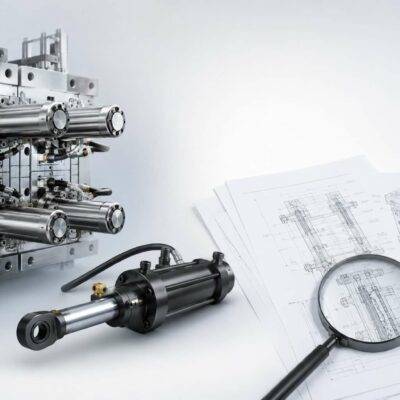

One of the most common questions asked during mold design is surprisingly simple:
“Can we use a smaller cylinder?”
At first glance, the question makes sense.
A smaller cylinder usually means:
- Lower cost
- Less installation space
- Reduced weight
- Easier integration into the mold
However, when hydraulic cylinders are used to move large side cores, selecting a cylinder based only on size can become an expensive mistake.
Recently, Vega Technical Dep. was involved in a project that perfectly illustrates why cylinder sizing should never be based on assumptions.
The Challenge
A mold maker, identified here only as C.H., was developing a large injection mold for a polypropylene component.
The project included:
- Two cavities
- A side core movement with approximately 1000 mm stroke
- A single hydraulic actuation system
- A molded component with a very large contact surface
Before finalizing the design, the customer requested a technical review of the cylinder selection.
The objective was straightforward:
Could a smaller hydraulic cylinder be used successfully?
Starting with the Numbers
Rather than providing an immediate answer, Vega Technical Dep. requested the engineering data and reviewed the customer’s calculations.
The analysis showed:
- Total side surface area approximately 2,938 cm²
- Material: Polypropylene homopolymer
- Stroke length approximately 1000 mm
The customer had already estimated the stripping forces using different adhesion coefficients.
Depending on the assumptions used, the required extraction force ranged from approximately:
14,700 kgf
to more than
44,000 kgf
under the most demanding conditions.
These values immediately indicated that the application was operating in a force range where cylinder selection becomes critical.
Why Large Surfaces Create Large Forces
Many engineers focus primarily on cylinder bore size and hydraulic pressure.
However, in mold applications, the geometry of the molded part often determines the real challenge.
As the contact surface between the plastic component and the side core increases, the adhesion force increases as well.
Even materials considered relatively easy to mold, such as polypropylene, can generate extremely high extraction forces when:
- Contact surfaces are large
- Strokes are long
- Multiple cavities are involved
- Cycle consistency is required
In these situations, a small error during the design phase can lead to major reliability problems later.
The Question Everyone Wants to Ask
After reviewing the preliminary calculations, the customer raised a very common question:
“Can we use a smaller cylinder?”
From a commercial perspective, it would have been easy to approve the request and supply the requested component.
But engineering decisions should not be based on what is easiest to sell.
They should be based on what is most likely to work reliably.
For this reason, Vega Technical Dep. performed an independent review of the 3D model and the calculated forces.
The conclusion was clear.
The side core surface involved in the application was simply too large to justify a significant reduction in cylinder capacity.
Looking Beyond the Cylinder
One of the most valuable aspects of engineering support is recognizing that the best solution is not always the most obvious one.
Rather than focusing exclusively on cylinder size, Vega evaluated the complete mechanical system.
The review considered:
- Core geometry
- Stroke length
- Force transmission
- Hydraulic pressure
- Installation orientation
- Long-term reliability
The objective was not merely to identify a cylinder capable of moving the core.
The objective was to identify a solution capable of doing so reliably for thousands or millions of production cycles.
The Proposed Solutions
Following the engineering review, Vega Technical Dep. proposed two possible solutions.
Solution 1: Single Large Cylinder
A large hydraulic cylinder with approximately 1000 mm stroke could be used, provided that the installation was configured to exploit the maximum available pushing force.
Solution 2: Two Opposed Cylinders
An alternative configuration using two opposed hydraulic cylinders with shorter strokes was proposed.
Based on previous experience with similar applications, this solution was considered the preferred option.
Why?
Because distributing the load across two cylinders offers several advantages:
- Better load distribution
- Reduced stress on individual components
- Improved stability during movement
- Lower risk of misalignment
- Increased reliability over the life of the mold
In many demanding applications, the most reliable solution is not necessarily the simplest one.
Engineering Before Manufacturing
One of the most important aspects of this case is that there was no failure.
No broken cylinder.
No production downtime.
No emergency repair.
The engineering review took place before the mold was built.
This is exactly where technical support creates the greatest value.
Identifying a sizing issue during the design phase is dramatically less expensive than discovering it after the mold enters production.
At that stage, modifications may involve:
- Mold rework
- Production delays
- Additional machining
- New hydraulic circuits
- Replacement components
All of which can cost far more than the original cylinder.
The Most Expensive Cylinder Is the One That Is Too Small
Many people assume that selecting a smaller cylinder reduces costs.
Sometimes the opposite is true.
An undersized cylinder may initially save money, but it can create:
- Reduced service life
- Higher maintenance costs
- Increased downtime
- Unpredictable operation
- Costly design modifications
The most expensive cylinder is often not the largest one.
It is the one that was incorrectly sized from the beginning.
Lessons Learned
This project highlights several important engineering principles.
1. Cylinder sizing should never be a guess
Accurate force calculations are essential for reliable mold operation.
2. Large surfaces generate large extraction forces
Even common plastics can create substantial loads when the contact area is significant.
3. Reliability matters more than minimum size
The smallest solution is not always the best solution.
4. Prevention is better than correction
Finding a problem during design is far less expensive than solving it after production begins.
5. Technical support creates value before failures occur
The best engineering intervention is often the one that prevents a problem from ever happening.
Conclusion
At Vega, technical support does not begin after a failure.
It begins during the design phase.
By reviewing 3D models, validating calculations, and evaluating real operating conditions, our engineering team helps customers make informed decisions before a mold is built.
In this case, the question was simple:
“Can we use a smaller cylinder?”
The answer required much more than a catalogue.
It required engineering.