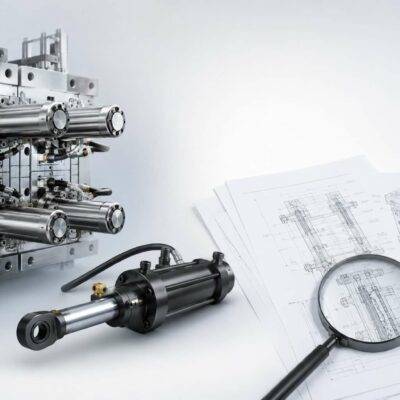

A Customer Case on temperature, guide materials, rod loading and pressure limits
Hydraulic cylinders installed directly on injection molds can operate under demanding combinations of temperature, pressure, mechanical load and alignment requirements.
When these conditions approach the limits of a standard cylinder, simply selecting a different seal or increasing the hydraulic pressure is not always sufficient.
A technical discussion between a Customer and the Vega Team provides a useful example of how these limits should be evaluated.
The application involved several V450CM-series cylinders, including configurations exposed to elevated mold temperatures, as well as other cylinders requiring operation at pressures up to and above 300 bar. The technical evaluation focused on three fundamental questions:
- What is the maximum operating temperature?
- What happens when the standard pressure limit is reached?
- When does the application require a special cylinder rather than a standard configuration?
The answers show that temperature and pressure limits are determined by the complete cylinder design, not by a single component.
1. Temperature Is a System-Level Parameter
For V450CM cylinders without sensors, the technical information supplied by the Vega Team specifies a maximum operating temperature of:
160°C.
Importantly, the temperature limit is not described simply as a limitation of the steel body.
The Vega Team specifically explains that the maximum temperature is closely related to the material used for the guide rings.
This is a key engineering principle.
A hydraulic cylinder may have a steel body capable of tolerating a high temperature, while another internal component can become the actual limiting factor.
Therefore:
The maximum operating temperature of a hydraulic cylinder must be evaluated considering the complete sealing and guiding system.
2. Why Guide Rings Become Critical at High Temperature
Guide rings perform an important mechanical function inside a hydraulic cylinder.
They help guide the moving components and limit direct metal-to-metal contact.
However, the mechanical properties of the guide material can change significantly as temperature increases.
The Vega Team explains that an alternative solution is possible when temperatures exceed the standard limit: the guide rings can be replaced with PTFE-based alternatives.
But this solution introduces another engineering consideration.
The resistance to compression and crushing decreases drastically with the alternative guide material.
Therefore, simply replacing the guide rings does not automatically solve the application problem.
The surrounding mechanical design must also be reviewed.
3. High Temperature Requires Better Alignment
When alternative PTFE guide rings are used for higher-temperature applications, the Vega Team specifically recommends ensuring perfect alignment between the cylinder and the moving component.
Why?
Because when the guide material has lower resistance to compression, any lateral load or misalignment can become much more critical.
A cylinder should ideally transmit the intended axial force.
If the connected mold component introduces:
- lateral forces;
- angular misalignment;
- bending loads;
- uneven contact;
the guide system can be subjected to additional loads.
At high temperature, these loads can become even more significant.
4. A Floating Connection Can Protect the Cylinder
The Vega Team recommends using a floating connection, described in the technical communication as a hammer-head connection, together with the appropriate mating clearance.
The purpose is to avoid forcing the cylinder to compensate for small alignment errors in the mold mechanism.
Conceptually, the system should work like this:
Cylinder
↓
Floating connection
↓
Moving mold component
Instead of:
Cylinder
↓
Rigid connection
↓
Misaligned moving component
The floating connection allows the moving assembly to accommodate the necessary movement while reducing undesirable lateral loading on the cylinder.
5. Why Alignment Matters More at High Temperature
This Customer Case illustrates an important relationship:
Higher temperature
→ changes guide-material properties
→ lower resistance to compression may become relevant
→ lateral loads become more critical
→ alignment becomes increasingly important.
Therefore, when a hydraulic cylinder is installed close to a hot mold component, temperature should not be evaluated independently from the mechanical installation.
The correct question is not simply:
“Can the cylinder withstand 160°C?”
It is:
“Can the complete cylinder and mechanical connection operate reliably at the required temperature and under the actual loads?”
6. Pressure Limits Are Also Configuration-Dependent
The same technical evaluation addressed another important issue: maximum hydraulic pressure.
For the CM100EGHG#100 and CM100EGMG#100 configurations, the specified maximum operating pressure was:
300 bar.
The Vega Team also indicated that, when operating at the maximum performance level, a pressure of up to approximately:
320 bar
could be considered under specific conditions.
This is not presented as a generic permission to operate every cylinder above 300 bar.
Instead, the technical response identifies a specific engineering modification that may be appropriate for such an application.
7. Why the Rod Becomes the Limiting Component
At high hydraulic pressure, the pressure acting on the piston generates a substantial axial force.
That force must ultimately be transmitted through the rod and its connection to the mold.
As pressure increases:
Hydraulic pressure ↑
→ Cylinder force ↑
→ Rod tensile load ↑
Therefore, increasing pressure is not simply a matter of adjusting a hydraulic valve.
The mechanical strength of the rod and its connection must also be considered.
8. A Male Rod Can Increase Tensile Resistance
For applications requiring operation at the upper pressure range, the Vega Team suggested evaluating a male-threaded rod, which was not part of the standard configuration, combined with a dedicated hammer-head connection.
The purpose of this configuration is to increase the mechanical tensile resistance of the rod.
This is another example of application-specific engineering.
The solution is not:
“Use the standard cylinder at a higher pressure.”
Instead, it is:
“Modify the mechanical configuration so that the cylinder can safely address the additional load.”
9. Why the Connection Is Part of the Pressure Rating
The hydraulic cylinder does not work independently of its rod-end connection.
The load path is:
Hydraulic pressure
↓
Piston
↓
Rod
↓
Rod-end connection
↓
Mold component
If one part of this chain has insufficient mechanical resistance, increasing the pressure can create a failure risk.
This is why the Vega Team considered the rod-end configuration when discussing pressures above the standard operating range.
10. What Happens Above the Recommended Pressure Range?
The technical response makes an important distinction.
For applications requiring significantly higher pressures, a standard cylinder configuration is no longer considered sufficient.
The Vega Team states that a specific study and design for special high-pressure cylinders would be required, with lead time and costs to be defined.
This is an important engineering rule:
When an application exceeds the validated operating envelope of a standard cylinder, the correct solution is a special design—not simply operating the standard cylinder beyond its rating.
11. High Pressure Requires a Complete Engineering Review
When pressure increases substantially, several parameters must be evaluated together:
- cylinder bore;
- rod diameter;
- rod-end geometry;
- connection type;
- body strength;
- sealing system;
- mounting arrangement;
- expected number of cycles;
- external mechanical loads.
The nominal pressure value alone does not describe the complete operating condition.
12. A Different Pressure Limit for a Different Configuration
The same Customer application also involved CM032COFG#020 cylinders.
For these cylinders, the specified maximum operating pressure was:
225 bar.
The reason for the lower pressure limit was different from the previous example.
The Vega Team explained that the pressure reduction was caused by the O-ring-based oil supply configuration.
This is another valuable lesson:
The pressure rating of a hydraulic cylinder can depend on its specific configuration.
Two cylinders from the same general family cannot automatically be assumed to have identical pressure limits if their oil-supply or mechanical configurations differ.
13. Oil Supply Configuration Can Influence the Pressure Limit
The CM032 configuration used an oil supply through O-rings.
According to the technical response, this configuration resulted in a maximum operating pressure of:
225 bar.
This means that the engineer must consider not only:
cylinder bore + rod diameter
but also:
how the hydraulic fluid enters the cylinder.
The interface between the cylinder and the mold can therefore become a critical engineering parameter.
14. Cylinders Installed on the Mold Plate Need Their Own Hydraulic Circuit
The CM032 cylinders were installed on the mold plate.
For this reason, the Vega Team recommended connecting them to an independent hydraulic circuit, with pressure set within the specified limit of:
225 bar.
This is an important practical recommendation.
If the cylinder has a lower pressure rating than the main hydraulic system, simply connecting it to the same circuit can create an unacceptable operating condition.
The circuit itself must therefore be designed around the cylinder’s maximum permitted pressure.
15. Independent Circuits Can Be an Engineering Solution
An independent circuit can allow different cylinder groups to operate at different pressure levels.
For example:
Main hydraulic system
→ higher pressure
while:
Mold-mounted cylinder circuit
→ controlled pressure within the cylinder’s limit.
This approach can be particularly useful when different cylinder configurations are used on the same mold.
16. Temperature and Pressure Should Be Considered Together
The Customer Case is particularly interesting because it combines two different challenges:
High temperature
The guide material can become the limiting factor.
High pressure
The rod, connection and cylinder configuration can become the limiting factors.
These conditions can also occur simultaneously.
For this reason, an application involving a hot mold and high hydraulic pressure should be evaluated as a complete system.
17. The V450CM Is Designed for Demanding Mold Applications
The official Vega documentation identifies the V450CM as a heavy-duty short-stroke compact hydraulic cylinder and lists it among the cylinder families used for injection molds.
The V450CM is also listed for applications including cart and plug movement and ejection-plate movement in injection molds.
This makes the series particularly relevant when the mold designer needs a compact cylinder capable of handling demanding mechanical conditions.
18. Compact Does Not Mean Simplistic
A compact hydraulic cylinder installed inside an injection mold has to perform within a very restricted space.
At the same time, it may be exposed to:
- high temperature;
- high hydraulic pressure;
- repeated cycles;
- lateral loads;
- limited accessibility;
- difficult maintenance conditions.
The smaller the available space, the more important it becomes to select the correct configuration from the beginning.
19. When a Standard Cylinder Is No Longer Enough
A useful engineering decision process is:
Standard temperature + standard pressure
Use a standard configuration.
Higher temperature
Evaluate guide and seal materials and the mechanical alignment.
Higher pressure
Evaluate rod strength and connection design.
Higher temperature + higher pressure
Carry out a complete application-specific engineering review.
Significantly above the standard pressure range
Consider a specially designed high-pressure cylinder.
This logic is consistent with the technical recommendations provided by the Vega Team.
20. What Engineers Should Check Before Ordering
For demanding mold applications, the following information should be defined before selecting the cylinder:
Temperature
- Maximum mold temperature
- Continuous operating temperature
- Possible temperature peaks
Pressure
- Normal hydraulic pressure
- Maximum hydraulic pressure
- Pressure peaks
Mechanical loads
- Axial force
- Tensile load
- Compression load
- Possible lateral forces
Installation
- Alignment
- Connection type
- Available clearance
- Mounting arrangement
Hydraulic circuit
- Oil supply configuration
- O-ring or port connection
- Independent circuit requirements
- Pressure limitation
21. The Importance of the Connection Between Cylinder and Mold
The technical response places particular emphasis on the connection between the cylinder and the moving component.
At high temperature, a floating connection with the correct clearance can be important to avoid transmitting unwanted lateral forces to the cylinder.
At high pressure, a suitable rod-end configuration can increase the mechanical resistance of the assembly.
This means that the cylinder should not be selected independently from the mold’s mechanical design.
22. The Most Important Lesson: Do Not Look Only at the Cylinder
A common mistake is to look at the cylinder catalogue and ask:
“What pressure can this cylinder withstand?”
The better question is:
“Which exact cylinder configuration is suitable for the temperature, pressure, mechanical loads and connection used in this mold?”
The answer can change depending on:
- guide material;
- presence of sensors;
- oil supply method;
- rod-end design;
- mounting arrangement;
- required pressure.
The Customer Case provides concrete examples of each of these factors.
23. Engineering Beyond the Standard Catalogue
One of the most important conclusions from the technical exchange is that Vega does not treat the standard catalogue as the only possible solution.
For higher temperatures, alternative guide materials can be evaluated.
For high tensile loads, a different rod-end configuration can be considered.
For significantly higher pressures, a special high-pressure cylinder can be designed.
This is particularly relevant for injection molds because every application can have a different combination of:
temperature + pressure + geometry + space + cycle requirements.
Conclusion
This Customer Case demonstrates why the operating limits of a hydraulic cylinder must always be considered in relation to the complete application.
For V450CM cylinders without sensors, the technical specification provided by the Vega Team indicates a maximum operating temperature of 160°C, with the temperature limit closely related to the guide-ring material.
When higher temperatures are required, PTFE guide rings can be considered, but their lower resistance to compression makes perfect alignment and a suitable floating connection particularly important.
For CM100 configurations, the specified maximum operating pressure is 300 bar, with specific consideration required for operation at the upper limit and for applications approaching 320 bar. A male rod and dedicated connection can be evaluated to increase tensile resistance.
For pressures significantly above this range, the appropriate solution is a special high-pressure cylinder designed specifically for the application.
The CM032 configuration illustrates another important point: its maximum operating pressure is 225 bar because of its O-ring-based oil supply, and because these cylinders are installed on the mold plate, they should be connected to an independent circuit limited to 225 bar.
The fundamental lesson is therefore:
Temperature, pressure, guide material, rod strength, connection design and hydraulic-circuit configuration must be evaluated together.
A hydraulic cylinder should never be pushed beyond its standard operating envelope simply by increasing the hydraulic pressure or changing one component.
For demanding injection-mold applications, the correct approach is to define the actual operating conditions first and then select—or engineer—the cylinder configuration that can safely and reliably meet them.
Useful and Verified URLs
I verified these URLs on the official vegacylinders.com domain. The descriptions are in English, matching the article.
- V450CM Heavy-Duty Short-Stroke Compact Hydraulic Cylinders — Official Vega product page for the V450CM heavy-duty compact cylinder family, including available bore and stroke configurations and technical documentation.
V450CM Heavy-Duty Short-Stroke Compact Hydraulic Cylinders - Cart and Plug Movement — Official Vega application page covering hydraulic cylinders used to move carts, pins and plugs that create undercuts in plastic injection molds. It includes the V450CM and other relevant cylinder families.
Cart and Plug Movement - Hydraulic Cylinders for Molds — Official Vega overview of hydraulic cylinders for plastic injection and die-casting molds, organized by application including cart movement, ejection, unscrewing and mechanical locking.
Hydraulic Cylinders for Molds - Ejection Plate Movement — Official Vega application page for cylinders used to move ejection plates in injection molds, including the V450CM heavy-duty series.
Ejection Plate Movement - Vega Cylinders Official Website — Official Vega website providing access to the hydraulic-cylinder range, 3D configurator and product information.
Vega Cylinders – Hydraulic Cylinders for Injection Molding and Die Casting