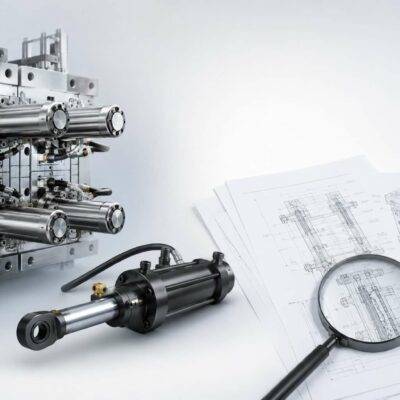

A Customer Case on force reduction, speed control and pneumatic seals
Hydraulic cylinders are designed around specific operating conditions, and the working fluid is one of the most important.
What happens when a Customer purchases a hydraulic cylinder but wants to operate it with compressed air instead of hydraulic oil?
This question was examined by the Vega Team in a technical Customer Case. The answer highlights three critical issues:
- the available thrust and traction force decrease significantly;
- the cylinder can move faster with air than with oil;
- the standard hydraulic seals are not intended for pneumatic operation and may cause leakage and pressure loss.
The case also shows that, when a cylinder is required to work with air, the solution may involve changing the sealing system rather than simply replacing the fluid.
1. The Customer’s Question
The original request was straightforward.
A Customer had ordered a hydraulic cylinder but intended to use air instead of oil and asked whether this could create problems for the cylinder.
At first sight, the cylinder would appear to perform the same basic function:
pressure → piston movement → rod movement
But the fluid inside the cylinder has a major influence on how the system behaves.
Hydraulic oil and compressed air cannot simply be considered interchangeable.
2. Oil and Air Behave Differently
The fundamental difference is that hydraulic oil is used as a hydraulic working fluid, while air is compressible.
This difference affects:
- force transmission;
- acceleration;
- speed;
- movement stability;
- sealing;
- pressure retention.
The Vega Team specifically warned that when hydraulic cylinders are operated with air, both thrust and traction forces decrease considerably.
Therefore, a cylinder that is adequate for an application with hydraulic oil cannot automatically be assumed to provide the same performance with compressed air.
3. The Available Force Is Significantly Reduced
The basic relationship for cylinder force is:
F = P × A
where:
- F = cylinder force;
- P = working pressure;
- A = effective piston area.
However, simply applying the same nominal pressure with air does not mean that the cylinder will behave identically to an oil-powered hydraulic system.
The Vega Team’s practical conclusion in this case was clear:
Thrust and traction performance decrease significantly when air is used.
This means that the first calculation before converting a cylinder should be the actual force required by the application.
4. Why This Matters in Mold Applications
Hydraulic cylinders are frequently used in injection molds to move:
- slides;
- pins;
- plugs;
- ejection plates;
- other mold components.
Vega’s product range is specifically designed for these applications. The official product overview lists cylinder families for cart and plug movement, ejection plate movement, unscrewing and mechanical locking.
In these applications, insufficient force can lead to incomplete movement or failure to reach the required mold position.
Consequently, if a hydraulic cylinder is converted to pneumatic operation, the required load must be checked again.
5. The Cylinder Can Also Become Faster
The second important difference concerns speed.
The Vega Team explains that air speed is higher than oil speed and therefore recommends checking and reducing the cylinder speed using a flow regulator.
This is particularly important when the cylinder was originally selected for a hydraulic circuit.
A change in fluid can significantly change the dynamic behaviour of the actuator.
6. Why Excessive Speed Can Be a Problem
A faster cylinder is not necessarily a better cylinder.
If the movement becomes too fast, the system can experience:
- impacts at the end of the stroke;
- higher dynamic loads;
- vibration;
- positioning problems;
- increased mechanical stress;
- premature wear.
For a mold, an uncontrolled movement can also affect cycle synchronization.
For this reason, the Vega Team explicitly recommends controlling the speed through a flow regulator when air is used.
7. Flow Regulation Becomes Essential
Vega currently offers hydraulic-cylinder accessories including flow regulators, controlled check valves and rod-end accessories.
These components are intended to help configure and control the cylinder according to the application.
In the specific Customer Case, however, the important technical point is that air can produce a higher movement speed and therefore requires appropriate flow control.
The regulator should therefore be considered part of the application design rather than an optional afterthought.
8. The Most Important Issue: The Seals
The reduction in force and increase in speed are not the only concerns.
The Vega Team identified another critical problem:
standard seals are designed specifically for hydraulic applications and not for pneumatic applications.
This means that simply draining the oil and connecting compressed air is not necessarily an adequate conversion procedure.
The sealing system must be evaluated.
9. Why Seal Selection Matters
A hydraulic-cylinder sealing system must maintain pressure while allowing the piston and rod to move repeatedly.
The seals are therefore exposed to:
- pressure;
- sliding movement;
- friction;
- temperature;
- the characteristics of the working fluid.
Vega explains that its standard sealing systems use combinations such as PTFE + bronze seals, FKM O-rings and Tufcot + graphite fabric guide bushes, while special sealing options are also available for particular applications.
The Customer Case makes the application-specific nature of the sealing system even clearer: standard hydraulic seals may not be appropriate for pneumatic service.
10. The Risk of Leakage and Pressure Loss
According to the Vega Team, using the standard hydraulic seals with air can result in:
- leakage;
- pressure loss.
This can create a chain reaction:
Unsuitable seal
↓
Air leakage
↓
Pressure loss
↓
Lower available force
↓
Unreliable cylinder movement
The problem can therefore become significantly more serious than simply having a small amount of leakage.
11. Pneumatic Seals Can Be Supplied
The Customer Case did not end with a simple recommendation not to use air.
The Vega Team proposed a practical solution:
special seals for pneumatic applications, interchangeable with the standard seals.
This means that, depending on the cylinder and application, a hydraulic cylinder can potentially be adapted to pneumatic service by using a suitable sealing configuration.
The important point is that the conversion must be engineered rather than improvised.
12. Vega Can Also Perform the Seal Replacement
The Vega Team offered a second option.
The Customer could send the cylinder back to Vega for seal replacement.
This can be particularly useful when the rod seal and scraper require more specialized assembly.
It also allows the conversion to be performed using the appropriate components and procedure.
13. The Piston Seal Is Easier to Replace
The subsequent exchange focused on maintenance.
The Customer asked whether replacing the seals was easy and whether the procedure was the same as for standard cylinders.
The Vega Team explained that:
- installing the piston seal is relatively easy;
- the rod seal and scraper are more difficult to install.
This distinction is useful when planning maintenance.
Not every seal inside a cylinder requires the same level of intervention.
14. A Pre-Assembled Cartridge Can Simplify Maintenance
To make the intervention easier, the Vega Team offered to supply a replacement cartridge with the rod seals already installed.
This approach can simplify maintenance because the technician does not need to install the most delicate seals individually.
The concept is:
Remove existing cartridge
↓
Install prepared replacement cartridge
rather than:
Disassemble
↓
Install individual rod seals
↓
Install scraper
↓
Reassemble and verify
15. Why the Rod Seal and Scraper Require More Attention
The rod sealing area is particularly important because the rod continuously moves through the sealing system.
The assembly has to:
- retain pressure;
- allow rod movement;
- limit leakage;
- protect the internal components.
The scraper also helps protect the internal sealing system from contamination entering from outside.
This explains why the Vega Team identified these components as more difficult to replace than the piston seal.
16. Can a Hydraulic Cylinder Be Converted to Pneumatic Operation?
The Customer Case supports a qualified answer:
A hydraulic cylinder may be adapted for pneumatic operation in specific applications, but the conversion must be evaluated technically.
The key factors identified by Vega are:
- reduced thrust and traction;
- increased speed;
- flow regulation;
- pneumatic-compatible seals;
- leakage and pressure retention.
The case therefore does not support the general assumption that every hydraulic cylinder can be converted to air simply by replacing the oil.
17. Conversion Is Not the Same as Designing a Pneumatic Cylinder
This distinction is important.
The Customer Case describes a specific situation in which Vega proposed special pneumatic seals for an existing hydraulic cylinder.
It does not establish that every hydraulic cylinder is suitable for every pneumatic application.
For a new application, the complete operating conditions should be checked, including:
- pressure;
- force;
- speed;
- stroke;
- cycle frequency;
- installation;
- sealing system.
If these conditions fall outside the suitable operating range, a dedicated pneumatic solution may be more appropriate.
18. What Happens to the Force Requirement?
Suppose a mold component requires a certain minimum force to move.
With hydraulic oil, the cylinder may have been correctly sized for that requirement.
After conversion to air, the available thrust and traction decrease significantly according to the Vega Team’s technical assessment.
Therefore:
Required force
must be compared against:
Available pneumatic force
before the conversion is approved.
If the available force is insufficient, changing the seals alone will not solve the application.
19. What Happens to the Cycle Time?
The opposite problem can occur with speed.
If the cylinder moves faster with air, the original hydraulic cycle timing may no longer be valid.
The designer should therefore verify:
- extension time;
- retraction time;
- end-of-stroke behaviour;
- synchronization with the mold;
- required flow restriction.
The Vega Team specifically recommends reducing the speed through flow regulation.
20. The Working Fluid Is Part of the Cylinder Design
This Customer Case illustrates a broader engineering principle:
The working fluid should be considered part of the cylinder specification.
Changing the fluid can change the:
- force;
- speed;
- pressure behaviour;
- sealing requirements;
- maintenance requirements.
Therefore, the working fluid should be defined when selecting the cylinder, not changed later without a technical review.
21. Vega’s Cylinder Range Is Designed Around Specific Applications
Vega manufactures hydraulic cylinders specifically for plastic injection molds and aluminum die-casting molds. Its official range is organized according to application, including cart and plug movement, ejection plate movement, unscrewing and mechanical locking.
Different series are designed for different combinations of:
- bore;
- stroke;
- pressure;
- speed;
- installation;
- application.
For example, the V450CM is a heavy-duty compact hydraulic cylinder for mold applications, with standard bores from 16 to 100 mm and strokes from 10 to 200 mm.
This reinforces the importance of selecting the cylinder according to its intended operating conditions.
22. The Sealing System Is a Core Technology
Vega’s technical documentation describes the sealing system as a key element for durability and efficiency.
The standard range includes PTFE + bronze seals, FKM O-rings and Tufcot + graphite fabric guide bushes, while special options are available for applications such as water-glycol or unusually high temperatures.
This is particularly relevant to the Customer Case.
The sealing system cannot be treated as a generic spare part.
It is an engineered component of the cylinder.
23. Maintenance Must Also Be Considered
If a cylinder is modified for a different working fluid, maintenance requirements should be considered at the same time.
Vega offers a dedicated support bag containing tools for removing, installing and calibrating hydraulic-cylinder seals.
The Customer Case also shows that Vega can provide a prepared cartridge with the rod seals already installed, reducing the complexity of the intervention.
This is particularly useful when the cylinder is already installed in a mold and downtime needs to be minimized.
24. What Should Be Checked Before Using Air?
Before replacing hydraulic oil with compressed air, the following questions should be answered.
Load
How much force does the application require?
Pressure
What pneumatic pressure will actually be available?
Speed
What extension and retraction speed is required?
Stroke
Is the existing cylinder suitable for the required movement?
Seals
Are the installed seals suitable for pneumatic operation?
Flow control
Can the speed be controlled safely?
Duty cycle
How frequently will the cylinder operate?
Installation
Are there lateral loads or alignment problems?
25. A Practical Engineering Decision Process
A useful approach is:
Step 1 — Define the application
Identify the load, stroke, speed and cycle.
Step 2 — Calculate the required force
Determine the minimum thrust and traction force.
Step 3 — Evaluate pneumatic performance
Confirm that the cylinder can provide the required force when operated with air.
Step 4 — Check speed
Determine whether the increased air speed requires flow restriction.
Step 5 — Check the seals
Confirm that the sealing system is suitable for pneumatic operation.
Step 6 — Define the conversion
Use suitable pneumatic seals or have the cylinder converted by Vega.
Step 7 — Test the complete system
Verify force, speed, leakage and end-of-stroke behaviour.
26. The Main Lesson from the Customer Case
The most important lesson is simple:
Replacing oil with air changes the operating characteristics of a hydraulic cylinder.
According to the Vega Team, the use of air results in a significant reduction in thrust and traction force, while the higher air speed requires flow regulation.
The standard hydraulic seals are also not intended for pneumatic applications and can result in leakage and pressure loss.
Vega’s proposed solution was to use special pneumatic seals, interchangeable with the standard seals, or to return the cylinder to Vega for seal replacement.
Conclusion
Can a hydraulic cylinder be used with compressed air instead of oil?
The Customer Case shows that the answer is application-dependent.
It cannot be treated as a simple fluid substitution.
The Vega Team identified three main consequences:
1. Lower force:
Thrust and traction performance decrease significantly when air is used.
2. Higher speed:
Air can produce faster movement than oil, making flow regulation necessary to control the cylinder speed.
3. Different sealing requirements:
Standard hydraulic seals are not intended for pneumatic operation and may cause leakage and pressure loss.
Vega can provide special seals for pneumatic applications, or the cylinder can be sent to Vega for the conversion.
The technical lesson is therefore:
A hydraulic cylinder should not be converted from oil to air without checking force, speed and sealing compatibility.
For demanding applications, the working fluid should be treated as a fundamental part of the cylinder specification from the beginning.
Useful and Verified URLs
I verified these links on the official vegacylinders.com domain. The descriptions are in English, matching the article.
- Materials and Components — Official Vega page explaining the materials and sealing components used in Vega hydraulic cylinders, including PTFE + bronze seals, FKM O-rings and guide bushes, as well as special sealing options for demanding applications.
Materials and Components - Hydraulic Cylinders for Molds — Official Vega overview of hydraulic cylinders for plastic injection and aluminum die-casting molds, organized by application such as cart and plug movement, ejection, unscrewing and mechanical locking.
Hydraulic Cylinders for Molds - Hydraulic Cylinders Accessories — Official Vega accessories page covering rod accessories, controlled check valves and flow regulators for hydraulic cylinders used in molds.
Hydraulic Cylinders Accessories - VR Hydraulic Cylinders Accessories — Official Vega page covering rod-end accessories, floating joints, check valves and unidirectional flow regulators, as well as accessories for testing cylinder sensors.
VR Hydraulic Cylinders Accessories - V450CM Heavy-Duty Short-Stroke Compact Hydraulic Cylinders — Official Vega product page for the V450CM heavy-duty compact hydraulic cylinder family, including its applications, construction, pressure capability and sealing system.
V450CM Heavy-Duty Short-Stroke Compact Hydraulic Cylinders