
Why Choosing the Right Seal Material Prevents Oil Leakage and Extends Hydraulic Cylinder Life
Hydraulic seals are among the smallest components inside a hydraulic cylinder, yet they play one of the most critical roles in determining its reliability.
A perfectly machined cylinder with high-quality steel components can still develop premature oil leakage if the sealing material is not suitable for the operating conditions.
Many engineers focus primarily on cylinder dimensions, operating pressure and stroke length while overlooking an equally important factor: seal material compatibility.
Temperature, hydraulic fluid, pressure, sliding speed and environmental conditions all influence seal performance.
This real engineering case demonstrates how the Vega Technical Department investigated an oil leakage problem and concluded that the most effective solution was not changing the cylinder design, but selecting a more suitable sealing material.
The Customer’s Problem
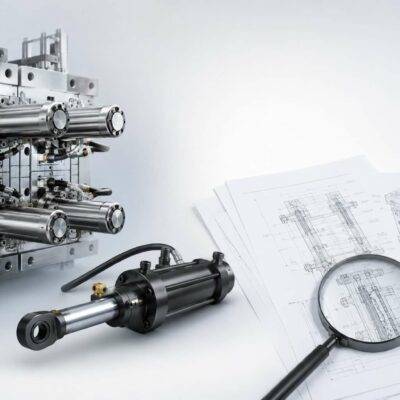
A customer reported oil leakage affecting several compact hydraulic cylinders installed on an injection mold.
The application included twelve identical cylinders.
The customer explained that all cylinders were leaking between the piston and the cartridge, despite using the same mounting arrangement previously adopted with another cylinder manufacturer.
After collecting additional information about the application, the Vega Technical Department verified that the operating temperature did not exceed 80 °C before proposing a solution based on special sealing materials.
Why Seal Material Is So Important
Hydraulic seals perform multiple functions simultaneously.
They must:
- prevent internal leakage;
- prevent external leakage;
- maintain pressure between hydraulic chambers;
- minimise friction;
- resist wear;
- withstand millions of operating cycles.
Even if the cylinder is mechanically perfect, an unsuitable sealing material can significantly reduce service life.
Seal selection should therefore always be considered part of the cylinder design process rather than a simple spare parts decision.
The Main Factors Affecting Seal Performance
Selecting the correct seal material requires evaluating several operating conditions.
Temperature
Temperature has a major influence on seal life.
High temperatures accelerate material ageing, increase hardness changes and may reduce sealing efficiency.
Low temperatures can make some elastomers stiff and less capable of maintaining proper contact pressure.
In the analysed application, confirming that the operating temperature remained below 80 °C was essential before selecting the appropriate sealing material.
Hydraulic Fluid Compatibility
Not every seal material is compatible with every hydraulic fluid.
Mineral oils, biodegradable fluids, water-glycol fluids and synthetic oils may require completely different elastomers.
Chemical incompatibility can cause:
- swelling;
- shrinkage;
- hardening;
- softening;
- cracking.
These changes often lead to premature oil leakage.
Operating Pressure
Higher pressure increases the mechanical load acting on the sealing lips.
If the seal material is too soft, extrusion may occur.
If it is too rigid, sealing efficiency may decrease.
For high-pressure applications, the seal profile is often as important as the seal material itself.
Sliding Speed
High rod speeds increase friction and heat generation.
Some sealing materials perform extremely well under slow movements but wear rapidly during high-speed operation.
Dynamic applications therefore require seal compounds specifically designed for continuous motion.
Surface Finish
Even the best seal material cannot compensate for poor machining.
Cylinder bore roughness and rod surface finish must remain within the specified tolerances.
Excessively rough surfaces accelerate seal wear.
Excessively smooth surfaces may reduce oil film formation, increasing friction.
The Most Common Hydraulic Seal Materials
NBR (Nitrile Rubber)
NBR is the most widely used hydraulic sealing material.
Advantages:
- excellent compatibility with mineral hydraulic oils;
- low cost;
- good wear resistance;
- suitable for general industrial applications.
Limitations:
- moderate temperature resistance;
- limited compatibility with aggressive chemicals.
Polyurethane (PU)
Polyurethane offers excellent mechanical strength.
Advantages:
- outstanding abrasion resistance;
- excellent extrusion resistance;
- long service life;
- ideal for high-pressure cylinders.
For this reason, polyurethane is commonly used in compact hydraulic cylinders subjected to demanding industrial cycles.
FKM (Viton®)
FKM is designed for high-temperature and chemically aggressive environments.
Advantages:
- excellent heat resistance;
- outstanding chemical compatibility;
- long ageing resistance.
Its higher cost makes it preferable only when operating conditions require these characteristics.
PTFE
PTFE provides extremely low friction.
Advantages:
- excellent chemical resistance;
- low wear;
- suitable for very high speeds.
Because PTFE is relatively rigid, it is often combined with elastomer energisers.
Why Special Seals Sometimes Solve the Problem
One of the most interesting aspects of this engineering case is that the solution was not replacing the cylinder itself.
Instead, the Vega Technical Department recommended using cylinders equipped with special seals after confirming the actual operating conditions.
Replacement spare parts were also prepared using the updated sealing configuration.
This demonstrates that selecting the correct seal material can often eliminate leakage without requiring major design modifications.
Engineering Lessons Learned
This case highlights several important engineering principles.
When analysing hydraulic oil leakage:
- never assume every seal material behaves the same;
- evaluate operating temperature;
- verify hydraulic fluid compatibility;
- consider pressure and speed;
- inspect cylinder surfaces;
- select sealing materials according to the real operating conditions.
Seal selection should always be treated as an engineering decision rather than a purchasing decision.
Conclusions
Hydraulic seals are not universal components.
Different operating conditions require different sealing materials.
This real engineering case demonstrates that carefully analysing temperature and application conditions allowed the Vega Technical Department to solve a leakage problem by selecting special seals instead of redesigning the hydraulic cylinder.
The key lesson is simple:
The reliability of a hydraulic cylinder depends not only on its mechanical design but also on choosing the right sealing material for the specific application.