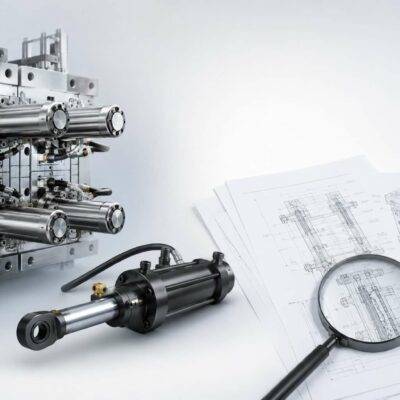

Why Matching Bore and Stroke Is Not Enough
Replacing a hydraulic cylinder with an equivalent model from another manufacturer often appears to be a straightforward task.
If the bore diameter, rod diameter and stroke are identical, many engineers assume that the new cylinder will fit perfectly into the existing machine.
In reality, hydraulic cylinder interchangeability is far more complex.
Even small dimensional differences can require modifications to the mold, machine frame or mounting system. Ignoring these differences may result in alignment problems, excessive side loads, premature seal wear or even complete installation failure.
This real engineering case demonstrates how the Vega Technical Department analysed the replacement of an existing competitor’s hydraulic cylinder and identified several critical dimensions that had to be verified before confirming interchangeability.
The Customer’s Challenge
A customer wanted to replace an existing hydraulic cylinder manufactured by another supplier with a Vega compact hydraulic cylinder.
At first glance, the replacement appeared simple because the cylinder size and operating function were very similar.
However, a detailed engineering review revealed several important dimensional differences that required careful evaluation before proceeding with the replacement.
This case clearly illustrates why selecting a replacement cylinder should never be based solely on bore diameter and stroke.
Why Hydraulic Cylinders Are Rarely Fully Interchangeable
Although many manufacturers follow similar dimensional standards, every company develops its own design philosophy.
As a result, cylinders having identical hydraulic performance may differ in:
- body dimensions;
- mounting arrangements;
- rod connection;
- keyway configuration;
- fixing holes;
- thread dimensions;
- accessories;
- overall installation envelope.
Ignoring any one of these details may require expensive modifications to the machine.
1. Overall Body Length
The first parameter analysed by the Vega Technical Department was the overall body length.
Although the stroke remained identical, the cylinder body differed by 16 mm compared with the original cylinder.
Part of this difference could be compensated by repositioning the cylinder, reducing the effective protrusion to approximately 11.5 mm.
Even relatively small dimensional differences should always be verified during the design stage.
2. Mounting System and Keyway
Mounting arrangements are frequently overlooked during cylinder replacement.
In this application, the original cylinder used only two mounting holes, while the Vega cylinder also allowed the use of a locating keyway.
The Vega Technical Department therefore recommended verifying whether the mold already incorporated a locating shoulder and suggested machining the keyway to improve positioning accuracy if required.
Correct positioning is essential for maintaining rod alignment and reducing side loads.
3. Body Height and Rod Centreline
Another important difference involved the cylinder body height.
The original cylinder body measured 100 mm, whereas the Vega cylinder measured 95 mm.
Although this difference appears small, it changes the rod centreline position by 2.5 mm.
To maintain perfect alignment, an adapter plate was required. If the locating keyway was used, the adapter plate also needed matching keyways on both sides.
Small dimensional variations like these often determine whether a replacement will operate reliably.
4. Mounting Hole Dimensions
Fixing holes represent another common source of installation problems.
In this case, the original cylinder used 17 mm mounting holes for M16 screws, while the Vega cylinder used 13 mm holes for the same screw size.
Because the Vega body was also narrower, the screw heads projected slightly beyond the cylinder body.
Although this did not prevent installation, it required verification of the available surrounding space.
5. Rod Thread Compatibility
The rod-end thread is another critical dimension.
The original cylinder used an M27 female thread, whereas the replacement cylinder used an M20 female thread.
Rather than assuming compatibility, the Vega Technical Department recommended verifying the actual push and pull forces before determining whether the smaller thread would provide sufficient safety margins.
Thread strength should always be evaluated according to the actual mechanical loads.
6. Accessories Are Not Always Interchangeable
Hydraulic cylinder replacement also involves external accessories.
In this case, a special hammer-head connection used on the original installation was not available as a standard component and therefore had to be manufactured by the customer.
Accessories are frequently responsible for the longest delays during retrofit projects.
A Practical Checklist Before Replacing Any Hydraulic Cylinder
Before replacing a hydraulic cylinder with another manufacturer’s model, engineers should always verify:
- bore diameter;
- rod diameter;
- stroke;
- overall body length;
- mounting dimensions;
- keyway position;
- body height;
- rod centreline;
- mounting hole dimensions;
- rod-end thread;
- available accessories;
- operating pressure;
- maximum push and pull forces;
- installation clearances.
A systematic review of these parameters greatly reduces installation risks.
Engineering Lessons Learned
This case demonstrates that hydraulic cylinder interchangeability is primarily a mechanical engineering challenge rather than a hydraulic one.
Two cylinders may deliver identical hydraulic performance while requiring completely different installation solutions.
Successful replacement therefore depends on analysing the complete mechanical interface rather than comparing only the catalogue specifications.
Conclusions
Replacing a hydraulic cylinder with an equivalent model from another manufacturer requires much more than matching bore diameter and stroke.
This engineering case shows how the Vega Technical Department evaluated body dimensions, mounting arrangements, keyways, thread sizes and accessories before confirming that the replacement could be successfully implemented.
The most important lesson is simple:
Hydraulic cylinders are interchangeable only after every critical mechanical dimension has been carefully verified. Even a few millimetres can determine whether a replacement succeeds or fails.
Further Technical Reading
To better understand hydraulic cylinder selection and installation, we recommend these technical resources from the Vega Technical Blog:
- Choosing the Right Cylinder – Pushing Force
- Choosing the Right Cylinder – Stroke
- Hydraulic Core Pulling Guide
https://www.icvega.com/hydraulic-core-pulling-guide - Hydraulic Cushioning in Injection Mold Cylinders
https://www.icvega.com/hydraulic-cushioning-in-injection-mold-cylinders - Block Cylinder Comparison—Vega V450 CM and AHP Merkle BZ 500
https://www.icvega.com/block-cylinder-comparison-vega-v450-cm-and-ahp-merkle-bz-500