
A Real Engineering Case on High-Speed Motion, Misalignment and Rod Failure
Hydraulic cylinder rods are designed to withstand extremely high axial loads while delivering precise and reliable linear motion.
However, even a correctly sized hydraulic cylinder can experience rod failure if the application generates forces that were not considered during the design stage.
When a cylinder rod breaks, the immediate reaction is often to suspect a manufacturing defect or inadequate material strength.
In reality, most rod failures originate from external mechanical conditions, such as misalignment, excessive side loads, impact forces or high dynamic stresses.
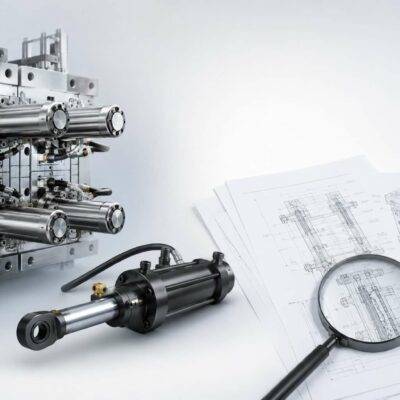
This real engineering case demonstrates how the Vega Technical Department, after examining photographs of two broken hydraulic cylinders, identified the most probable causes as excessive dynamic stresses generated by high-speed movement and misalignment between the slide and the cylinder rod. Before reaching a final conclusion, the engineering team requested the complete 2D and 3D mold drawings to analyse the entire application.
The Customer’s Problem
A customer reported that two compact hydraulic cylinders installed on the moving side of an injection mold had failed.
One cylinder had a broken piston rod, while the second suffered a failure of the rod coupler.
The customer requested an explanation of the failure mechanism together with recommendations for replacement parts and corrective actions.
Rather than immediately attributing the problem to the cylinder itself, the Vega Technical Department analysed the available evidence and investigated the application conditions.
Why Hydraulic Cylinder Rods Break
Hydraulic cylinder rods rarely fail because of hydraulic pressure alone.
In most industrial applications the rod is subjected to several different types of mechanical loading simultaneously.
These include:
- axial compression;
- axial tension;
- bending loads;
- impact loading;
- cyclic fatigue;
- torsional stresses generated by incorrect assembly.
When two or more of these loads occur together, the probability of failure increases significantly.
High-Speed Motion and Dynamic Loads
The first possible cause identified by the Vega Technical Department was the combination of high movement speed and the mass of the moving slide.
When a heavy slide accelerates or decelerates rapidly, inertia generates additional forces that are often much higher than the static force calculated from hydraulic pressure.
These dynamic loads may:
- increase rod stress;
- overload threaded connections;
- create impact forces;
- initiate fatigue cracks.
Repeated over thousands or millions of cycles, these stresses may eventually cause sudden rod failure.
Misalignment Between the Cylinder and the Slide
The second possible cause identified during the technical evaluation was misalignment between the slide and the cylinder rod.
Hydraulic cylinders are designed primarily to withstand axial forces.
When the rod operates under lateral loading caused by poor alignment, bending stresses develop along its length.
Even relatively small misalignments can generate:
- uneven bearing loads;
- accelerated seal wear;
- increased friction;
- rod deflection;
- fatigue failure.
Misalignment is one of the most common causes of premature hydraulic cylinder damage.
Why Photographs Are Not Enough
Although the photographs clearly showed the broken components, the Vega Technical Department did not issue a definitive diagnosis based only on visual evidence.
Instead, the customer was asked to provide the complete 2D and 3D drawings of the mold.
This reflects an important engineering principle.
The hydraulic cylinder cannot be analysed independently from the machine in which it operates.
Understanding guide systems, slide geometry, mounting arrangements and moving masses is essential for identifying the true root cause.
Common Causes of Rod Failure
Most hydraulic cylinder rod failures originate from one or more of the following conditions:
Excessive Side Loads
Side loading introduces bending stresses that hydraulic cylinders are not designed to withstand.
Proper guide systems should always absorb transverse forces rather than transmitting them to the cylinder.
High Impact Loads
Sudden mechanical impacts generate extremely high peak stresses.
Although these impacts may last only milliseconds, repeated shocks can initiate microscopic fatigue cracks.
Incorrect Cylinder Selection
An undersized cylinder may operate continuously near its mechanical limits.
Selecting a cylinder should consider not only hydraulic force but also dynamic operating conditions.
Poor Mechanical Alignment
Incorrect installation may create permanent bending forces even before the cylinder begins operating.
Accurate alignment significantly extends cylinder life.
Fatigue Failure
Many rods do not fail during the first overload event.
Instead, microscopic cracks gradually propagate until sudden fracture occurs after thousands of operating cycles.
How to Prevent Rod Failure
Several engineering practices help minimise the risk of rod failure:
- correctly size the hydraulic cylinder;
- minimise moving mass where possible;
- reduce unnecessary operating speed;
- avoid sudden deceleration;
- ensure perfect alignment;
- use adequate external guide systems;
- inspect rod threads regularly;
- perform preventive maintenance.
Most failures can be prevented during the design stage rather than after installation.
Engineering Lessons Learned
This engineering case highlights several important principles.
When a hydraulic cylinder rod breaks:
- never assume a manufacturing defect;
- investigate dynamic loads;
- verify slide alignment;
- analyse moving masses;
- inspect the mounting arrangement;
- review the complete machine design before replacing components.
Successful failure analysis always considers the entire mechanical system rather than the hydraulic cylinder alone.
Conclusions
Hydraulic cylinder rod failure is rarely caused by hydraulic pressure itself.
In this real engineering case, the Vega Technical Department identified excessive dynamic stresses generated by high-speed movement together with possible misalignment between the slide and the cylinder rod as the most probable causes of failure, requesting complete mold drawings before confirming the final diagnosis.
The key lesson is clear:
The reliability of a hydraulic cylinder depends not only on its strength but also on the mechanical design of the entire machine. Proper alignment and controlled dynamic loading are essential for long service life.