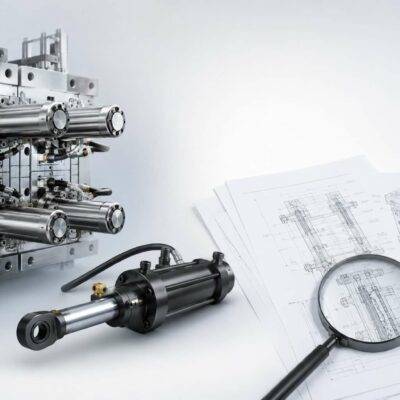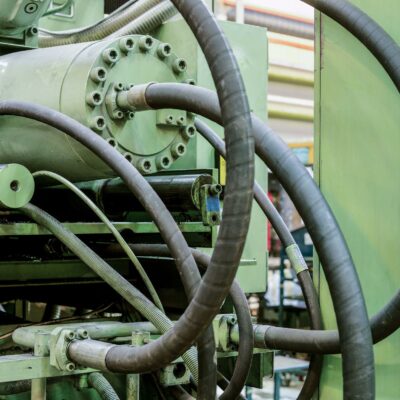

Increasing the oil inlet diameter of a hydraulic cylinder may seem like a simple machining operation. However, when the oil passages are positioned close to internal components, a modification must be carefully designed to avoid interfering with the cylinder’s internal geometry.
A real customer case involving compact hydraulic cylinders clearly demonstrates why simply drilling a larger hole is not always the correct solution.
The Customer’s Requirement
The Customer had several molds located in Turkey and requested a modification to the oil delivery holes of the hydraulic cylinders.
In particular, the Customer reported that the oil delivery hole on CM cylinders with an 80 mm bore was only 3 mm in diameter, while a 6 mm diameter was required.
The Customer initially considered having the modification carried out locally by disassembling the cylinders and drilling the existing holes.
However, the Vega Team explained that this operation could not be treated as a simple drilling process.
Why Simply Drilling the Hole Is Not Enough
The position of the internal components makes the modification considerably more complex.
On the rear side of the cylinder, the oil passage is located close to the piston guide ring. Therefore, simply disassembling the cylinder and drilling the hole to a larger diameter could interfere with the internal geometry.
The recommended solution was to modify the hole using CNC machining with a milling cutter, effectively ovalizing the passage where necessary.
This allows the required increase in oil passage area while respecting the position of the internal components.
The front oil port presents another specific issue.
Because the port is located close to the cartridge, the cartridge chamfer also needs to be modified. According to the technical information exchanged in the case, this modification is already incorporated as a standard feature on new cartridges.
V450CM Compact Short-Stroke Hydraulic Cylinders
The Importance of the Internal Geometry
This case highlights an important engineering principle: the diameter visible from the outside is not necessarily the only restriction affecting oil flow.
The hydraulic performance of a cylinder depends on the complete oil circuit, including:
- pump flow rate;
- oil viscosity;
- pressure losses;
- pipe diameter;
- manifold geometry;
- valve capacity;
- internal hydraulic passages;
- restrictions close to the cylinder ports.
Therefore, increasing the threaded oil port alone does not automatically guarantee a proportional increase in cylinder speed.
Why Does the Diameter of the Oil Ports Affect Hydraulic Cylinder Speed?
Why the Modification Is Not Easy
The Vega Team specifically explained that modifying these cylinders is not an easy operation because the oil passages are positioned close to important internal components.
For this reason, the recommended approach was not to provide a generic drilling instruction for local machining.
Instead, the Customer was asked to send the cylinders back to Vega in different batches so that the necessary modifications could be carried out correctly.
The estimated machining time was approximately two days per batch, depending on the number of cylinders included.
The Customer would only have to cover the transportation costs.
Why CNC Machining Is Important
CNC machining provides the necessary control over the modification.
In this type of operation, the objective is not simply to remove more material. The machining must take into account:
- the position of the oil passage;
- the proximity of the piston guide ring;
- the position of the cartridge;
- the required increase in oil passage area;
- the geometry of the internal components;
- the sealing and functional requirements of the cylinder.
This is particularly important when modifying an already manufactured hydraulic cylinder.
V450CM Hydraulic Cylinder – EGH Version
A Modification That Must Be Designed Around the Cylinder
The case demonstrates why modifications to hydraulic cylinders should not be approached as generic machining operations.
A request such as “increase the oil hole from 3 mm to 6 mm” sounds straightforward, but the correct solution depends on the internal construction of the cylinder.
In this case, the rear passage required CNC milling because of its proximity to the piston guide ring, while the front passage required a modification to the cartridge chamfer.
The safest approach was therefore to return the cylinders to the manufacturer rather than perform an improvised drilling operation locally.
Hydraulic Cylinders for Injection Molds
The Engineering Lesson
When a hydraulic cylinder needs a larger oil passage, do not assume that the solution is simply to drill a larger hole.
The complete internal geometry must be considered.
A correct modification should preserve the cylinder’s mechanical and hydraulic functions while providing the required oil-flow capacity. This is why machining operations close to guide rings, cartridges and other internal components require precise engineering and controlled manufacturing processes.
The case also shows the importance of distinguishing between increasing the port diameter and increasing the effective oil-flow capacity of the entire hydraulic circuit.