
A Customer Case on Reducer Pistons, End-Stroke Switches and Hydraulic Cylinder Retrofit
In injection-mold applications, a hydraulic cylinder can sometimes be perfectly suitable in terms of force, pressure and installation dimensions, while its standard stroke is not compatible with the mold’s position-detection system.
When this happens, replacing the complete cylinder is not necessarily the best solution.
A real Customer case handled by the Vega Team shows how a hydraulic-cylinder stroke was modified by replacing the standard piston with a special reducer piston, allowing the required shorter stroke to be achieved while restoring correct operation of the rear end-stroke switch.
The application involved two different cylinder configurations:
- a cylinder with a standard 120 mm stroke, which had to operate with an 80 mm stroke;
- a second cylinder with a standard 70 mm stroke, which had to operate with a 45 mm stroke.
The required modifications were therefore:
120 → 80 mm
and
70 → 45 mm.
The Vega Team proposed replacing the standard pistons with specially designed reducer pistons rather than replacing the complete cylinders.
This case illustrates an important principle for injection-mold maintenance:
When the cylinder itself is suitable but its stroke is incompatible with the mold’s position-detection system, a specifically engineered piston modification can sometimes provide an effective retrofit solution without replacing the complete hydraulic cylinder.
1. The Customer’s Problem
The Customer was using hydraulic cylinders whose standard configurations did not provide the stroke required by the application.
The first configuration had a standard stroke of:
120 mm
but the required stroke was:
80 mm.
The second configuration had:
70 mm
of standard stroke, while the application required:
45 mm.
The problem was not simply that the cylinders moved too far.
The stroke also affected the operation of the rear end-stroke switch.
The Customer reported that, with the existing configuration, the rear switch could not work correctly and asked whether an additional component could be installed to reduce the stroke.
2. Why End-Stroke Position Matters
In an injection mold, hydraulic cylinders frequently work together with position-detection systems.
The machine needs to know whether a cylinder has reached a defined position before allowing the next step of the molding cycle.
Position feedback can be used to confirm:
- cylinder retraction;
- cylinder extension;
- slide position;
- core position;
- ejector position;
- completion of a hydraulic movement.
If the mechanical position of the piston does not correspond to the expected sensor position, the machine may not receive the required signal.
The result can be:
- cycle interruption;
- machine alarms;
- incorrect sequencing;
- inability to start the next operation;
- potentially unsafe mold movement.
Vega’s current product range includes mechanical, magnetic and inductive sensing solutions for hydraulic cylinders.
3. The Initial Question: Can the Stroke Simply Be Reduced?
The Customer asked whether a component could be added to the piston to reduce the stroke.
This is a reasonable question.
If a cylinder has a stroke of 120 mm but the mold requires only 80 mm, it may seem sufficient to install a mechanical stop or an additional component.
However, a hydraulic cylinder is an engineered system.
Changing its effective stroke can affect:
- piston position;
- internal clearances;
- end-of-stroke position;
- sensor activation;
- sealing;
- mechanical loads;
- overall cylinder operation.
For this reason, the Vega Team did not recommend an improvised modification.
Instead, it proposed a purpose-designed solution.
4. The Solution: Special Reducer Pistons
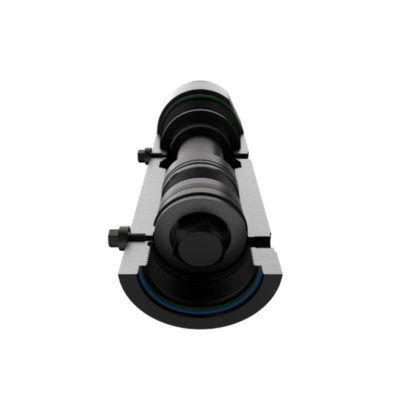
The Vega Team explained that the correct solution was to replace the standard piston with a reducer piston.
The reducer piston was specifically designed to provide the new required stroke.
The two configurations were:
First cylinder
120 mm → 80 mm
Second cylinder
70 mm → 45 mm
The Customer therefore did not need to replace the complete hydraulic-cylinder bodies.
Instead, the internal piston configuration could be changed according to the required stroke.
5. Why a Special Piston Was Necessary
A hydraulic piston is not simply a solid component that determines the stroke by its length.
Its geometry is related to the complete cylinder assembly.
The piston must work correctly with:
- the cylinder body;
- piston seals;
- rod;
- locking components;
- internal stops;
- end-of-stroke system;
- hydraulic pressure.
The Vega Team therefore supplied special pistons with a length different from the standard configuration, specifically according to the required stroke.
This is significantly different from simply placing an arbitrary spacer inside a hydraulic cylinder.
6. The Two Required Stroke Reductions
The Customer’s request involved two different modifications.
| Cylinder configuration | Standard stroke | Required stroke | Stroke reduction |
|---|---|---|---|
| RF071 | 120 mm | 80 mm | 40 mm |
| RF036 | 70 mm | 45 mm | 25 mm |
The documentation specifies the required reducer pistons for both applications.
This is an important detail because the solution was not a generic “short-stroke piston.”
Each cylinder configuration required a specific piston corresponding to the required final stroke.
7. The Spare Parts Required
The technical communication specifies:
- 2 RF071 reducer pistons, reducing the standard configuration from 120 mm to 80 mm;
- 8 RF036 reducer pistons, reducing the standard configuration from 70 mm to 45 mm.
This means that the retrofit was applied to multiple cylinders rather than to a single unit.
The use of dedicated spare parts also allowed the modification to be standardized across the cylinders in the application.
8. The Retrofit Procedure
The Vega Team explained that the modification required the cylinders to be disassembled.
The procedure involved:
- disassembling the cylinders;
- unscrewing the locking nuts;
- removing the existing pistons;
- installing the special reducer pistons.
This is a relatively targeted intervention compared with replacing the complete hydraulic cylinders.
However, because it involves opening a hydraulic cylinder, it must be treated as a proper maintenance operation rather than as an improvised modification.
9. Why the Sealing System Must Be Considered
Opening a hydraulic cylinder means that the sealing system must also be considered.
The Vega Team recommended purchasing the complete seal kit because there is a risk that a seal or O-ring could be damaged during maintenance.
This is a practical maintenance consideration.
Even if the original seals appear to be in good condition, opening and reassembling a hydraulic cylinder can create a risk of:
- seal damage;
- incorrect installation;
- deformation;
- contamination;
- subsequent leakage.
Planning the required seals at the same time as the piston replacement can therefore prevent an additional maintenance operation.
10. The Reducer Piston Was Supplied With Seals
The documentation also states that the reducer pistons were supplied with seals, including the piston seal and the O-ring to be installed inside.
Nevertheless, the Vega Team recommended the complete seal kit as an additional precaution.
This is a good example of preventive maintenance.
The objective is not simply to replace the component causing the original problem.
It is also to avoid creating a second problem during the intervention.
11. Restoring the Rear End-Stroke Switch
The ultimate objective of the modification was not merely to shorten the piston stroke.
It was to restore the correct relationship between:
piston position
and
end-stroke switch position.
The Vega Team confirmed that, after installing the new pistons, the rear switch would work correctly.
This is an important distinction.
The retrofit therefore addressed both:
- the mechanical stroke;
- the position-detection system.
12. Hydraulic Cylinders Are Part of a Larger Control System
A modern injection-mold hydraulic cylinder should not be considered as an isolated actuator.
It may be connected to:
- hydraulic valves;
- position sensors;
- PLC inputs;
- machine control systems;
- safety circuits;
- cycle-sequence logic.
Vega’s current documentation describes cylinders equipped with magnetic, mechanical and inductive sensors, with signals that can be transferred to the injection machine.
The Customer case demonstrates why these systems must be considered together.
A cylinder can operate hydraulically while still failing to provide the correct signal to the machine.
13. Sensor Compatibility and Stroke
The position sensor detects a specific physical condition.
If the piston does not reach the expected position, the sensor may not switch.
This can happen when:
- the stroke is changed;
- the piston geometry is changed;
- the sensor position is incorrect;
- the cylinder configuration is modified;
- the sensor is incompatible with the cylinder.
In this Customer case, the solution was specifically designed around the required stroke so that the rear switch could operate correctly.
14. Why Replacing the Complete Cylinder Was Not the Only Option
When a hydraulic cylinder does not work correctly in a mold, replacing the entire component is often the first solution considered.
But this can be unnecessary.
If:
- the cylinder bore is correct;
- the pressure rating is correct;
- the mounting is correct;
- the rod is suitable;
- the body is in good condition;
and the only problem is the relationship between stroke and position detection, a targeted retrofit may be possible.
The Customer case demonstrates exactly this type of approach.
15. The Advantages of a Targeted Retrofit
When technically feasible, modifying an existing cylinder can offer several potential advantages:
Lower replacement cost
Only the necessary components are replaced.
Reduced downtime
The complete cylinder does not have to be redesigned and replaced.
Existing installation retained
The mounting arrangement remains unchanged.
Reduced mold modification
The cylinder location does not necessarily need to change.
Simplified spare-parts management
Specific reducer pistons can be supplied for the required configurations.
Restoration of the existing control system
The objective can be achieved without redesigning the entire sensor system.
16. Retrofit Does Not Mean Improvisation
There is an important difference between:
engineering a retrofit
and:
modifying a cylinder without technical validation.
A hydraulic cylinder contains pressurized fluid and precision components.
An incorrectly installed spacer, stop or modified piston could affect:
- sealing;
- piston alignment;
- mechanical strength;
- stroke;
- sensor operation;
- hydraulic performance.
For this reason, a stroke modification should be designed and approved by the cylinder manufacturer for the specific model.
In this case, the Vega Team supplied dedicated reducer pistons rather than recommending an unspecified internal modification.
17. The Importance of the Correct Piston for Each Model
The case involved two different cylinder configurations:
RF071
and:
RF036.
The required reducer pistons were different because the original strokes and target strokes were different.
This demonstrates that a reducer piston is not a universal accessory.
Its dimensions and geometry must correspond to the specific cylinder.
18. Maintenance Planning Can Prevent a Second Intervention
The Vega Team’s recommendation to purchase the complete seal kits is particularly useful from a maintenance perspective.
Imagine opening the cylinder to replace the piston and then discovering that an O-ring has been damaged.
The cylinder would need to be opened again.
This creates:
- additional downtime;
- additional labor;
- additional shipping;
- additional production disruption.
Planning the necessary sealing components at the beginning can reduce this risk.
19. End-Stroke Sensors in Modern Injection Molds
Position sensors have become increasingly important as injection molds become more automated.
The machine can use cylinder-position feedback to determine whether:
- a core is fully retracted;
- a slide is in position;
- a locking mechanism has completed its movement;
- an ejector has returned;
- the mold can proceed to the next step.
Vega’s current product range includes dedicated sensor solutions and a SIM08 connection box designed to manage multiple cylinder switches.
The SIM08 provides individual switch monitoring and LED indication for each input, helping identify sensor malfunctions and preventing subsequent molding-cycle steps from proceeding when configured faults are detected.
20. The Relationship Between Mechanical and Electrical Problems
One interesting lesson from this case is that a problem that appears to be electrical may actually have a mechanical origin.
For example:
Sensor does not switch
could lead to the assumption:
Sensor is defective.
But the actual cause could be:
Piston does not reach the required position.
The Customer case demonstrates precisely this type of relationship.
The solution was not simply to replace the switch.
The stroke itself had to be adapted.
21. A Useful Troubleshooting Sequence
When a hydraulic-cylinder end-stroke signal does not work correctly, a systematic approach is useful.
Step 1 — Check the sensor
Verify wiring, connection and sensor condition.
Step 2 — Check the piston movement
Confirm that the cylinder actually reaches the expected position.
Step 3 — Check the actual stroke
Compare the installed stroke with the required stroke.
Step 4 — Check sensor position
Verify that the sensor is positioned correctly relative to the piston.
Step 5 — Check the cylinder configuration
Determine whether the piston and stroke correspond to the intended application.
Step 6 — Check mechanical stops
Make sure the mold mechanism does not prevent the cylinder from reaching the required position.
Step 7 — Contact the cylinder manufacturer
If a stroke modification is required, verify whether a dedicated piston or other approved retrofit is available.
22. The Customer Case in Numbers
| Parameter | Original configuration | Required configuration |
|---|---|---|
| RF071 | 120 mm | 80 mm |
| RF036 | 70 mm | 45 mm |
| RF071 reducer pistons | 2 units | — |
| RF036 reducer pistons | 8 units | — |
These values are taken directly from the technical correspondence contained in the Customer documentation.
23. The Complete Engineering Solution
The case can be summarized as follows:
Problem
The standard cylinder strokes were not compatible with the required mold positions.
↓
Additional problem
The rear end-stroke switch could not operate correctly.
↓
Analysis
The required stroke for each cylinder was identified.
↓
Solution
Replace the standard pistons with dedicated reducer pistons.
↓
Maintenance
Disassemble the cylinders and replace the pistons.
↓
Sealing
Consider the complete seal kits during the intervention.
↓
Result
Achieve the required shorter stroke and restore correct rear-switch operation.
24. What This Case Teaches Mold Designers
There are several practical lessons.
Do not immediately replace the complete cylinder
If the cylinder itself is suitable, investigate whether the problem can be solved through a dedicated retrofit.
Always check the actual stroke
The catalog stroke is not necessarily the stroke required by the mold.
Consider the sensor system
Cylinder stroke and position detection must work together.
Do not improvise internal modifications
A reducer piston must be engineered for the specific cylinder.
Plan the sealing components
Opening a hydraulic cylinder creates a risk of seal or O-ring damage.
Use the manufacturer’s technical support
The cylinder manufacturer can determine whether a particular stroke modification is technically possible.
25. Why This Type of Retrofit Is Particularly Valuable in Injection Molds
Injection molds often represent a significant investment.
Once the mold is completed, changing the position of a hydraulic cylinder can require:
- machining;
- modification of mounting plates;
- modification of hydraulic lines;
- changes to sensors;
- changes to the PLC program;
- new validation trials.
If the existing cylinder can be retained and only the internal configuration needs to be changed, the overall intervention can be considerably simpler.
The Customer case provides a concrete example of this philosophy.
26. The Broader Engineering Principle
The deeper lesson is that hydraulic-cylinder performance is determined by the complete system.
A cylinder is not simply:
pressure + bore + stroke.
It is part of a system involving:
hydraulics + mechanics + sensors + control + mold geometry.
A change to one parameter can affect the others.
Reducing stroke, for example, may appear to be a purely mechanical modification, but it can directly affect sensor activation and therefore the machine-control sequence.
Conclusion
This Customer case demonstrates how a seemingly simple end-stroke problem can be solved through a carefully engineered hydraulic-cylinder retrofit.
The application required two different stroke reductions:
120 mm → 80 mm
and:
70 mm → 45 mm.
The problem was related to the correct operation of the rear end-stroke switch.
Rather than replacing the complete hydraulic cylinders, the Vega Team proposed replacing the standard pistons with special reducer pistons, specifically designed for the required strokes.
The required spare parts included:
- 2 RF071 reducer pistons from 120 to 80 mm;
- 8 RF036 reducer pistons from 70 to 45 mm.
The maintenance procedure required disassembling the cylinders, removing the locking nuts and replacing the pistons.
The Vega Team also recommended considering complete seal kits because opening the cylinders could potentially damage a seal or O-ring.
Most importantly, the Vega Team confirmed that after installation of the new pistons, the rear switch would work correctly.
The main engineering lesson is therefore:
A hydraulic cylinder that has the correct force and installation characteristics does not necessarily need to be replaced when its stroke is no longer suitable. If the cylinder design permits it, a dedicated reducer piston can provide an engineered retrofit solution, allowing the required stroke and position-detection function to be restored.
The key is that such a modification must be designed for the specific cylinder configuration and carried out with appropriate attention to seals, piston geometry and sensor operation.
Useful and Verified URLs
1. Hydraulic Cylinders for Injection Molds
Official Vega page presenting the current range of hydraulic cylinders specifically designed for plastic injection molding and die-casting applications. It provides access to the different cylinder families and the online configuration system.
Hydraulic Cylinders for Injection Molds – Vega Cylinders
2. Hydraulic Cylinders with Mechanical Switches
Official Vega page describing mechanical end-stroke switches for hydraulic cylinders. It is particularly relevant when evaluating the relationship between cylinder stroke and mechanical position detection.
Mechanical Switches for Hydraulic Cylinders – Vega Cylinders
3. SIM08 Connection Box for Hydraulic Cylinder Switches
Official Vega page for the SIM08 connection box. It explains how multiple cylinder switches can be monitored individually and how the system can help prevent the molding cycle from proceeding when configured switch faults are detected.
SIM08 Connection Box – Vega Cylinders
4. V215CD Hydraulic Cylinders and Position Sensors
Official Vega product page describing long-stroke hydraulic cylinders and their compatibility with magnetic, mechanical, inductive and encoder-based position sensing solutions.
V215CD Hydraulic Cylinders and Sensors – Vega Cylinders
5. Hydraulic Cylinder Manufacturer and Supplier
Official Vega company page describing the company’s experience in designing and manufacturing hydraulic cylinders for plastic injection and aluminum die-casting molds, including technical support and customization.
Hydraulic Cylinder Manufacturer and Supplier – Vega Cylinders
6. When the Sensor Isn’t the Problem
A recent official Vega engineering article showing why a cylinder-position problem that initially appears to be a sensor failure may have a deeper mechanical or hydraulic cause. This is particularly relevant to the troubleshooting philosophy illustrated by the Customer case.
When the Sensor Isn’t the Problem – Vega Cylinders