
Low-Pressure Hydraulic Cylinders: Special Seals, Drainage and Compact Design
How to design a compact hydraulic cylinder when the application requires reliable sealing at low pressure
Hydraulic cylinders used in injection molds normally operate at relatively high pressures. However, some applications require the cylinder to operate correctly even at low hydraulic pressure.
This can occur during specific phases of the molding cycle, positioning operations, or when the hydraulic system of the machine operates at reduced pressure.
Under these conditions, the sealing system becomes an important part of the cylinder design.
A cylinder that performs well at high pressure cannot automatically be assumed to provide the same performance at very low pressure.
The challenge becomes even greater when the cylinder is extremely compact and increasing its external dimensions is not possible.
A technical case handled by the Vega Team illustrates this situation. The Client required special seals for low-pressure operation on compact cylinders, while also requiring the cylinder dimensions to remain unchanged.
1. Why Can Low Pressure Be More Challenging?
When hydraulic-cylinder sealing is considered, attention is usually focused on the maximum operating pressure.
However, the minimum operating pressure can also be an important design parameter.
A seal must maintain adequate sealing performance even when the hydraulic pressure is relatively low.
Depending on the design, inadequate sealing at low pressure can result in:
- oil leakage;
- seepage;
- irregular operation;
- difficulties initiating movement;
- inconsistent behavior during repeated cycles.
For this reason, when a hydraulic cylinder is required to operate at low pressure, the sealing configuration should be evaluated specifically for those operating conditions.
2. The Challenge Becomes Greater in Very Small Cylinders
In this case, the Vega Team contacted the seal supplier regarding the possibility of using special low-pressure seals on compact cylinders.
The supplier confirmed the feasibility of the solution, but also specified that the seals would need to be tested to evaluate their performance.
The reason was particularly important: the dimensions, especially the seal cross-section, were extremely small.
This is a fundamental consideration when designing compact hydraulic cylinders.
As the cylinder diameter decreases, the available space for:
- seals;
- grooves;
- support elements;
- contact surfaces;
- drainage systems;
also becomes more limited.
Miniaturization is therefore not simply a matter of scaling down a larger hydraulic cylinder.
3. Seals Must Be Designed Together with the Cylinder
In a compact hydraulic cylinder, the seal cannot be considered independently from the cylinder design.
Its geometry must be compatible with:
- rod diameter;
- bore diameter;
- groove dimensions;
- seal material;
- operating pressure;
- operating speed;
- temperature;
- hydraulic-fluid characteristics;
- manufacturing tolerances.
When the cylinder becomes very small, even a small change in seal cross-section can become significant.
In this case, the extremely reduced seal dimensions were one of the reasons why the special configuration required dedicated testing before its performance could be evaluated.
4. A High-Pressure Seal Is Not Automatically the Best Choice for Low Pressure
This is one of the most important principles to consider.
A sealing system designed for high-pressure operation is not automatically the ideal solution when the cylinder must also operate at very low pressure.
The complete operating range must therefore be considered.
The question should not simply be:
What is the maximum pressure of the cylinder?
It should also be:
What is the minimum pressure at which the cylinder must operate reliably?
In the documented case, the Client specifically asked whether the standard version could operate between 30 and 60 bar.
The subsequent Vega Team proposal moved toward a configuration using special low-pressure seals, with the qualification that the solution would need to be tested.
The available documentation does not provide a definitive statement that the standard configuration was validated for continuous operation throughout the 30–60 bar range. It is therefore important not to present that range as a general specification for the standard cylinder.
5. The Client Requirement: Low Pressure Without Increasing the Cylinder Size
The original request contained another important design constraint.
The Client requested cylinders equipped with a drainage flange and a set of seals suitable for low-pressure operation.
However, there was a specific limitation:
the external dimensions of the cylinder could not be increased because of the drainage flange.
This type of requirement is common in injection-mold design.
Available space can be extremely limited.
The cylinder must therefore fit into the mold without interfering with:
- mold plates;
- slides;
- cores;
- columns;
- hydraulic connections;
- sensors;
- other components.
A technically valid solution that increases the external envelope may therefore become unsuitable for the mold.
6. Why Can Drainage Be Required?
The Client’s original request included a drainage flange together with the low-pressure sealing set.
Depending on the cylinder design, drainage can be used to manage possible leakage or seepage through sealing elements and prevent oil from reaching unwanted areas.
However, incorporating a drainage system can require additional space.
This becomes particularly relevant in compact cylinders.
The Vega Team also considered drainage potentially useful on the compact cylinders, but noted that because of their very small dimensions, special bodies and additional external dimensions might be required.
This created a direct conflict between two requirements:
improved drainage
versus
maintaining the existing cylinder envelope.
7. The Compromise Between Sealing, Drainage and Dimensions
This case illustrates a classic engineering trade-off:
additional functions → additional components → potentially greater dimensions
A cylinder incorporating:
- special seals;
- drainage;
- additional sealing components;
may require more space than the standard configuration.
However, the mold may not provide that space.
The designer must therefore find the best balance between:
sealing performance
and
available installation space.
8. Vega’s Solution: Special Seals Without a Drainage Flange
The Vega Team proposed a practical solution.
The seal supplier confirmed the feasibility of special low-pressure seals for compact cylinders, while stating that testing would be required to evaluate their performance.
The updated quotation therefore included cylinders:
CM016EGDGX010S
with special seals.
The quotation also included:
3 complete replacement cartridges with special seals.
At the same time, the cylinders would be supplied:
without a drainage flange.
Most importantly, the Vega Team confirmed that the external dimensions would remain the same as those shown in the 3D drawing downloaded from the configurator.
This allowed the low-pressure sealing requirement to be addressed without changing the external cylinder envelope.
9. Why Is Maintaining the Same External Envelope So Important?
For mold designers, maintaining the same external dimensions can be extremely important.
The mold may already have been designed around the cylinder’s 3D model.
The designer may have already defined:
- mold plates;
- mounting holes;
- slides;
- fixing systems;
- clearances;
- hydraulic connections.
If the cylinder dimensions are subsequently increased, the mold design may have to be modified.
In this case, the special sealing configuration could be introduced while maintaining the same external dimensions as the 3D model supplied through the configurator.
This is a significant advantage when working in highly constrained mold layouts.
10. Miniaturization Makes the Sealing Design More Critical
As component dimensions decrease, the available space for the sealing system becomes increasingly limited.
A small dimensional variation can represent a significant proportion of the total seal cross-section.
Compact hydraulic cylinders therefore require particular attention to:
- seal-groove geometry;
- diameters;
- concentricity;
- surface finish;
- clearances;
- seal material;
- machining tolerances.
The seal supplier specifically highlighted the extremely small seal dimensions in this case, which is why dedicated testing was considered necessary.
11. Why Are Tests Necessary?
When a special seal is introduced into a compact hydraulic cylinder, it is not enough to confirm that the seal can physically be installed.
Its actual performance must be evaluated.
Depending on the application, testing can consider:
- sealing performance;
- behavior at low pressure;
- leakage;
- durability;
- repeated cycling;
- compatibility with the hydraulic fluid;
- operating temperature.
In this case, the supplier confirmed technical feasibility, but explicitly indicated that testing was necessary to evaluate the performance of the special seals.
This distinction is important:
technical feasibility is not the same as application validation.
12. Feasibility and Validation Are Not the Same Thing
The technical exchange provides a useful example of normal engineering development.
The supplier confirmed that the special seal could be implemented.
However, the supplier also indicated that it needed to be tested.
A component can therefore pass through several different stages:
- technical feasibility;
- manufacturability;
- installation;
- functional testing;
- application validation.
These stages should not be confused.
In this case, the special low-pressure seal was considered feasible, but its performance on the compact cylinder still required testing.
13. Why Supply Replacement Cartridges?
The quotation included three complete replacement cartridges with special seals.
This is useful from a maintenance perspective.
A complete replacement cartridge can simplify future servicing and reduce downtime.
Depending on the cylinder design, this approach can provide:
- faster maintenance;
- simpler replacement procedures;
- readily available spare parts;
- standardized maintenance;
- reduced downtime.
In this case, the replacement cartridges were specified with the same special seals required for the low-pressure configuration.
14. The 30–60 Bar Requirement
The Client asked whether the standard cylinder could operate between:
30 and 60 bar.
This is an important question because it concerns not only the maximum pressure but the minimum operating pressure.
The available documentation does not contain a definitive confirmation that the standard configuration was validated for operation throughout this pressure range.
Instead, the subsequent Vega Team communication focused on a special low-pressure sealing configuration and stated that the seals would require testing.
Therefore, when a customer asks whether a standard cylinder can operate at a specific low pressure, the correct approach is to verify the exact configuration and operating conditions rather than assuming that the maximum pressure rating also defines the minimum reliable operating pressure.
15. Minimum Pressure Should Be Considered During Cylinder Selection
When selecting a hydraulic cylinder, engineers usually focus on:
- maximum pressure;
- maximum force;
- stroke;
- speed.
For some applications, however, the minimum operating pressure is equally important.
If a cylinder must operate at low pressure, the designer should verify:
- sealing performance;
- starting behavior;
- possible leakage;
- repeatability;
- compatibility of the seal system with the application.
The Vega case demonstrates why this consideration becomes especially important in compact cylinders.
16. Compact Cylinders: The Challenge Is Not Only Force
When discussing compact hydraulic cylinders, attention is often focused primarily on:
- overall dimensions;
- available force;
- stroke.
This case demonstrates that miniaturization also affects the sealing system.
As the cylinder becomes smaller:
less space is available for the sealing system
↓
the seal cross-section becomes smaller
↓
the sealing design becomes more sensitive
↓
specific testing can become necessary
Compact-cylinder design is therefore not simply a matter of scaling down a larger cylinder.
17. The Relationship Between the Cylinder and the Mold
The hydraulic cylinder should be considered as part of the overall mold design.
In this case, the Client specifically required that the drainage flange must not increase the cylinder envelope.
This means that cylinder design must be evaluated together with:
- available installation space;
- mold plates;
- slides;
- cores;
- hydraulic piping;
- sensors;
- mounting systems;
- maintenance access.
A modification that appears minor when considering the cylinder alone can become significant when the cylinder is integrated into the mold.
18. Standardization Versus Customization
The case also highlights an important aspect of industrial engineering.
The Client required a configuration that was different from the standard cylinder.
The Vega Team therefore evaluated a customized solution involving:
special low-pressure seals
while maintaining:
the same external dimensions.
The proposed configuration also eliminated the drainage flange in order to maintain the required external envelope.
This is a typical example of how customization can solve a specific application problem while introducing the need for additional technical validation.
19. Practical Procedure for Low-Pressure Applications
When a Client requests a compact hydraulic cylinder for low-pressure operation, the following procedure is useful.
Step 1 – Define the minimum pressure
Do not consider only the maximum system pressure.
Step 2 – Define the operating range
In this case, the Client indicated 30–60 bar as the range to be evaluated.
Step 3 – Check the standard sealing configuration
Determine whether the standard seal system is suitable for the required minimum pressure.
Step 4 – Check the available space
Determine whether additional components can be accommodated.
Step 5 – Evaluate drainage
If drainage is required, verify whether it can be incorporated without increasing the cylinder envelope.
Step 6 – Evaluate special seals
If the standard configuration is not suitable, investigate a sealing system specifically intended for low-pressure operation.
Step 7 – Confirm technical feasibility
The seal geometry must be compatible with the compact cylinder.
Step 8 – Perform dedicated testing
This is particularly important when the seal cross-section is extremely small.
Step 9 – Define spare parts
In the documented case, three complete replacement cartridges were included.
Step 10 – Confirm the final external dimensions
Ensure that the customized configuration remains compatible with the mold’s existing 3D design.
20. What Information Should Be Requested from the Client?
For this type of application, it is useful to establish:
- What is the minimum pressure?
- What is the maximum pressure?
- What is the operating cycle?
- How many cycles are expected?
- What is the cylinder speed?
- What is the operating temperature?
- Which hydraulic fluid is being used?
- Is drainage required?
- How much installation space is available?
- Can the cylinder dimensions be increased?
- Is a special sealing configuration acceptable?
- Are spare cartridges required?
In the documented case, one of the most important constraints was that the drainage flange could not increase the cylinder dimensions.
21. An Important Lesson for Mold Designers
When designing an injection mold, it is not enough to ask:
“Does the cylinder fit into the available space?”
The more important question is:
“Can the cylinder provide the required performance within that available space?”
In this case, the solution had to balance:
- extremely compact dimensions;
- low-pressure operation;
- sealing performance;
- drainage requirements;
- maintenance;
- testing.
The proposed Vega solution used special seals, maintained the existing external dimensions and omitted the drainage flange.
22. Conclusion
Reliable operation at low hydraulic pressure should not be taken for granted, especially when dealing with extremely compact hydraulic cylinders.
The case analyzed demonstrates that the minimum operating pressure can be an important design parameter, just as maximum pressure is.
When a Client requires low-pressure operation, the sealing system must be evaluated specifically for that condition.
In this case, the seal supplier confirmed the feasibility of using special low-pressure seals on compact cylinders, but also emphasized that their very small cross-section required dedicated testing to evaluate performance.
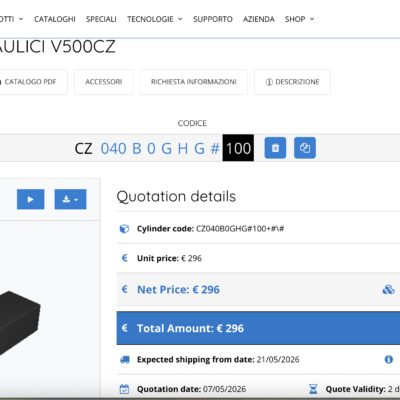
The proposed configuration consisted of CM016EGDGX010S cylinders with special seals and three complete replacement cartridges, while maintaining the same external dimensions as the 3D model downloaded from the Vega configurator. The cylinders were to be supplied without a drainage flange.
This is particularly important in injection-mold applications. When installation space is limited, adding a component such as a drainage flange can make an otherwise technically suitable cylinder impossible to install.
The main lesson is therefore:
When a compact hydraulic cylinder must operate at low pressure, it is not enough to consider only the available force or maximum pressure. The sealing performance at the required minimum pressure, the available space for drainage systems and the possibility of maintaining the cylinder’s external dimensions must also be evaluated. When the seal cross-section is extremely small, technical feasibility should be confirmed through dedicated testing.
This case also demonstrates an important principle of mold engineering:
The best solution is not necessarily the one with the greatest number of components or functions, but the one that achieves the required performance while maintaining the smallest practical envelope and providing a configuration that can be properly tested, maintained and integrated into the mold.
Useful and Verified URLs
I checked the current official Vega website and would use these links for the English version of the article:
- Vega Cylinders – Materials and Components — especially relevant for the section about seals. Vega explains its standard PTFE + bronze seals, FKM O-rings and guide bushes, and notes that special sealing options are available for particular operating conditions.
- Vega V250CE – Short-Stroke Compact Hydraulic Cylinders — useful for the discussion of compact cylinders for injection molds and their sealing system.
- Vega V250CE – BSP Oil Delivery Configuration — a specific V250CE configuration with BSP (Gas) threaded oil delivery, useful when discussing compact hydraulic connections.
- Vega V400CL – Short-Stroke Hydraulic Cylinders — particularly relevant because the V400CL is designed for applications where internal space is extremely limited.
- Vega Cylinders – Cart and Plug Movement — useful for connecting the article to compact cylinders used to move carts, pins and plugs in plastic injection molds.