Case Study: Over 1 Million Cycles on a Hydraulic Cylinder for Molds
In industrial molding applications, the reliability and lifespan of hydraulic cylinders are critical factors for ensuring productivity, operational safety, and long-term machine performance. This case study analyzes a real-world hydraulic cylinder failure that occurred after more than 1 million operating cycles inside an industrial mold application.
The case originated from a technical support request submitted by a sales representative identified as “C.H.”, who contacted Vega technical support to better understand the possible causes of a tie-rod failure and to request information about the expected service life of the cylinder .
The reported problem
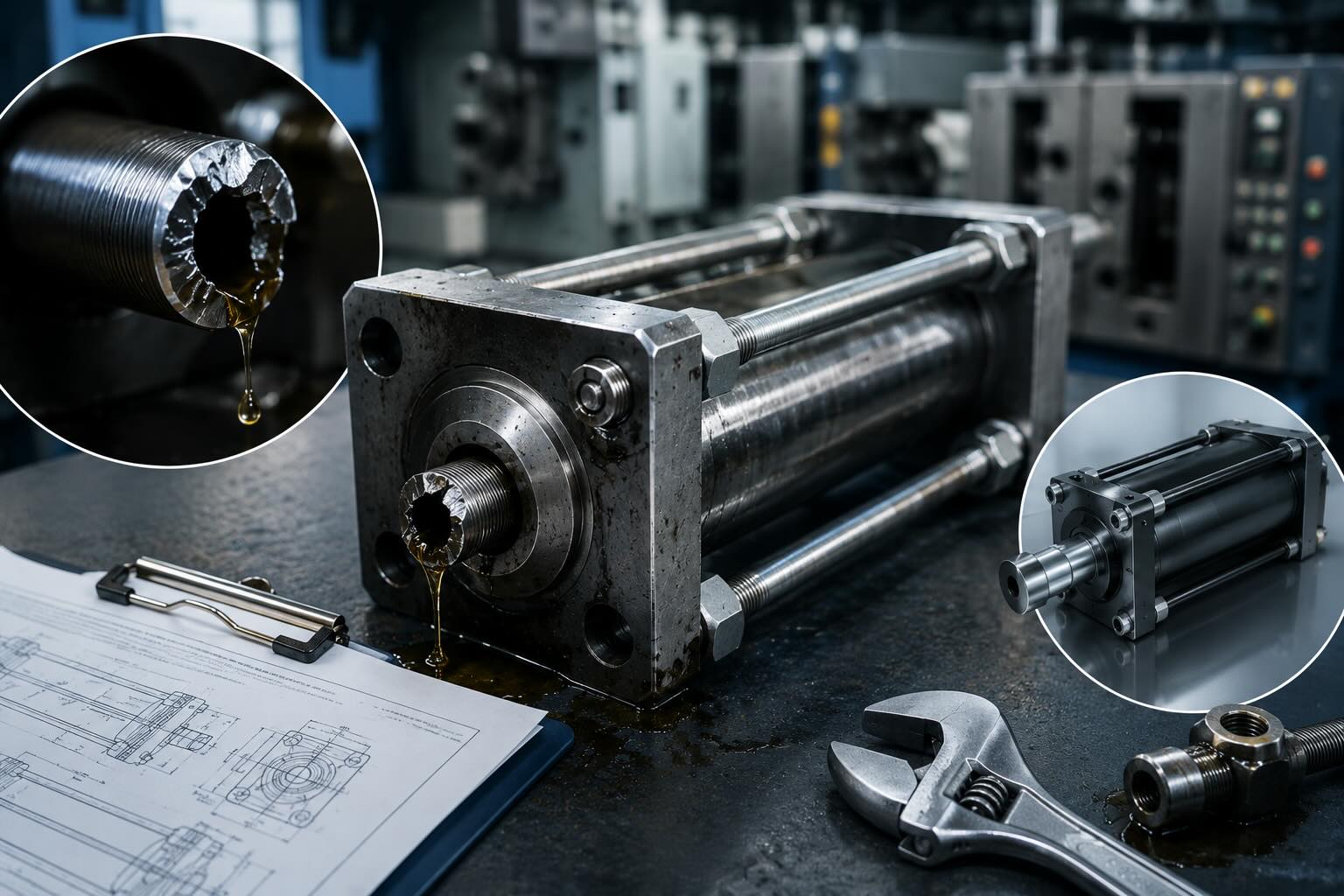
During normal mold operation, one of the cylinder tie rods failed, causing a sudden hydraulic oil leakage. According to the technical communication, the hydraulic cylinder had already exceeded more than 1 million production cycles before the failure occurred .
The installed unit was a CR series hydraulic cylinder operating in a demanding industrial environment with:
- maximum pressure 215 bar
- maximum temperature 140°C
- maximum speed 0.1 m/s
These operating values were shown directly on the cylinder identification label installed on the mold .
Vega Technical Support analysis
The initial analysis carried out by “Vega Technical Support” immediately highlighted an important point: there is no fixed theoretical lifespan for hydraulic cylinder tie rods. Service life strongly depends on the real operating conditions, installation quality, and mechanical stresses experienced during production cycles .
The technical report also pointed out that many Vega cylinders from the V215CR, V160C, and V230T series are still operating today after 20–25 years and millions of cycles without any tie-rod issues.
According to the technical evaluation, the possible causes of the failure included:
- extremely demanding operating conditions
- high speeds combined with heavy moving masses
- mechanical fatigue over time
- incorrect mold opening while the cylinder was still pressurized
- excessive tie-rod nut tightening
- collisions during mold handling
- additional operational factors requiring further investigation
Mechanical fatigue after more than 1 million cycles
One of the most interesting aspects of this case study is the possibility of accumulated mechanical fatigue.
The technical document explains that if the cylinder successfully operated for more than 1 million cycles before failure, it is highly plausible that the rupture was related to fatigue phenomena accumulated over time .
This type of wear becomes particularly important in applications involving:
- high cycle frequencies
- heavy moving masses
- high operating speeds
- constant direction changes
- pressure spikes
Over long periods, even heavy-duty industrial components can accumulate microscopic stresses that gradually reduce their structural resistance.
The risk of opening the mold while the cylinder is pressurized
Another extremely important technical aspect discussed in the report concerns incorrect mold opening while hydraulic pressure is still present inside the cylinder.
According to Vega Technical Support, this condition may generate a dangerous situation:
- the injection molding machine mechanically pushes the rod backward
- internal cylinder pressure suddenly increases
- tie rods experience severe overloads
- the cylinder tube may deform
Events of this type can significantly accelerate structural damage to hydraulic cylinders.
The importance of proper tie-rod tightening
The case study also highlights the importance of correct tie-rod nut tightening.
Excessive or uneven tightening may introduce additional stresses into both the cylinder tube and the tie rods themselves. For this reason, the report recommends:
- uniform tightening
- correct tightening torque
- proper alignment between head and end cap
These procedures are particularly important for tie-rod cylinders operating under high-pressure industrial conditions.
Lessons learned from this real-world case
This real-world case clearly demonstrates how hydraulic cylinders should not be considered simple mechanical components, but rather part of a complex dynamic industrial system.
Actual service life depends on many variables:
- operating conditions
- installation quality
- maintenance procedures
- pressure management
- moving masses
- operating speeds
- dynamic stress conditions
Exceeding more than 1 million cycles in a demanding industrial application already represents a significant operational achievement. However, this case study also demonstrates how preventive maintenance, monitoring, and correct operational procedures remain essential for maximizing both safety and service life.
Conclusions
This case study shows that structural failures in hydraulic cylinders rarely originate from a single cause. In most situations, failures result from a combination of:
- mechanical fatigue,
- demanding operating conditions,
- dynamic stresses,
- installation quality,
- long-term operational usage.
The approach adopted by Vega Technical Support focuses not only on the damaged component itself, but on the complete application context, identifying all factors that may influence long-term reliability and operational safety.
For mold makers, machine builders, and industrial users, this type of analysis provides valuable insights for improving maintenance strategies, cylinder design considerations, and overall operational management.