AHP Merkle vs Vega Cylinders Technical Manuals: Engineering Handbook or Practical Guide?
In the world of hydraulic cylinders, technical documentation is often just as important as the products themselves. A good technical manual does not simply describe a cylinder — it helps engineers, mold makers, maintenance technicians, and machine designers understand how to correctly select, install, calculate, and use hydraulic systems in real industrial applications.
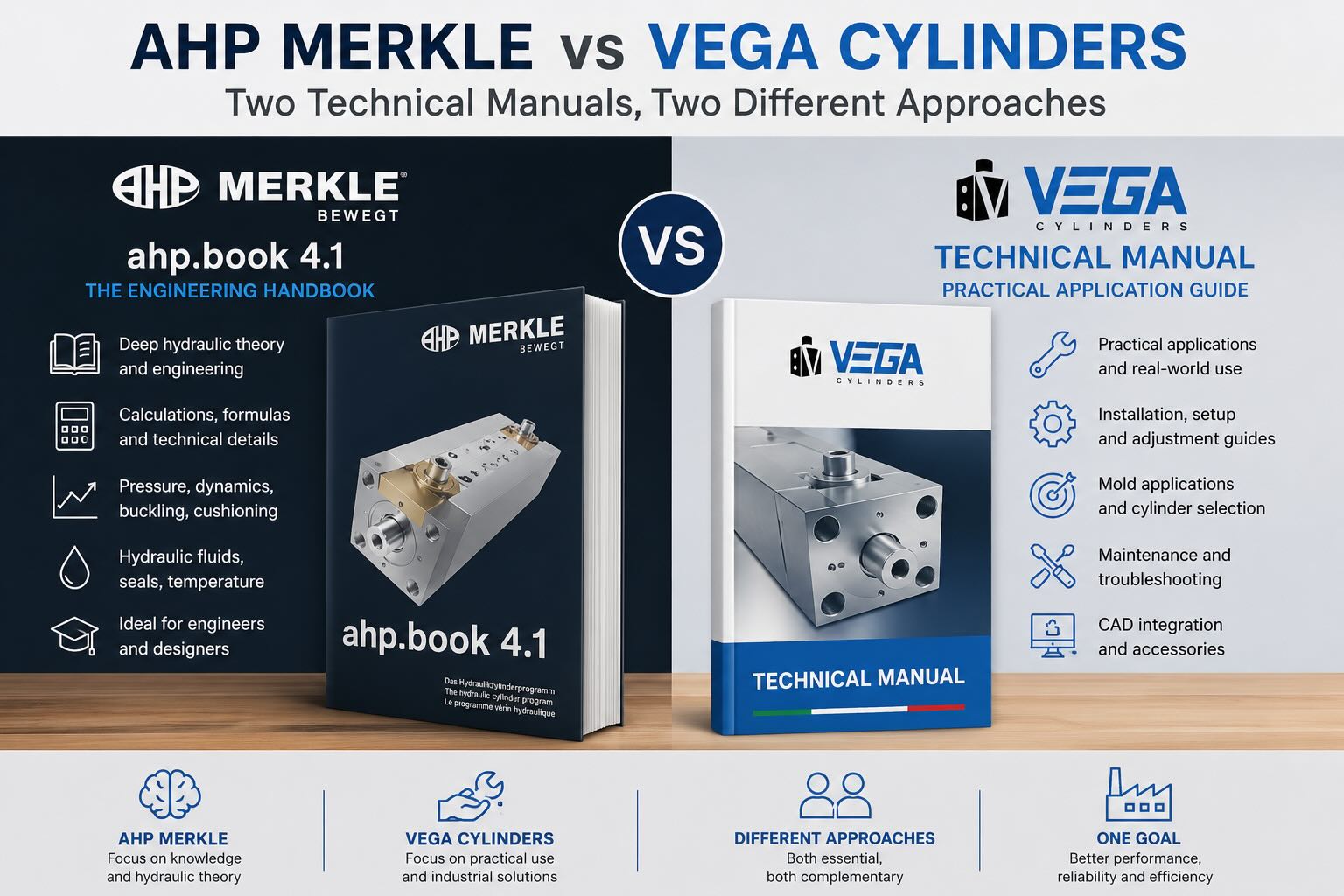
Two particularly interesting examples are the AHP Merkle hydraulic handbook and the Vega Cylinders Technical Manual . Although both documents discuss hydraulic cylinders, they approach the subject from very different perspectives.
Two manuals with two completely different philosophies
The first major difference between the two manuals is their philosophy.
The AHP Merkle book behaves like a true hydraulic engineering handbook. It is heavily focused on hydraulic theory, physical behavior, mathematical calculations, and detailed technical explanations. Reading it feels similar to studying an industrial engineering textbook dedicated to hydraulic cylinders.
The Vega Cylinders Technical Manual, on the other hand, is far more application-oriented. Its primary goal is not simply to explain hydraulic theory, but to help users successfully apply hydraulic cylinders in real industrial environments, especially in mold making and injection molding applications.
In simple terms:
- AHP explains how hydraulic cylinders work.
- Vega explains how to successfully use hydraulic cylinders.
The AHP manual: a deep hydraulic engineering handbook
The AHP Merkle “ahp.book 4.1” immediately presents itself as a comprehensive hydraulic engineering reference . Beyond the product catalogue pages, the manual contains extensive sections dedicated to:
- hydraulic principles
- Pascal’s law
- pressure dynamics
- oil compressibility
- cushioning theory
- seal systems
- hydraulic media
- stick-slip effects
- pressure spikes
- Euler buckling calculations
- ATEX considerations
- cylinder dynamics
One of the strongest aspects of the AHP document is the depth of its engineering explanations. The manual includes detailed sections about:
- differential cylinders
- synchronous cylinders
- damping physics
- side forces
- pressure amplification
- rod buckling calculations
- flow velocity recommendations
- hydraulic fluid classifications
The engineering approach is extremely methodical and reflects a classic German industrial design philosophy. The document is structured almost like a university-level technical handbook for hydraulic systems.
For design engineers and hydraulic specialists, this level of depth is very valuable because it explains not only what should be done, but also why.
The Vega manual: practical industrial usability
The Vega Cylinders Technical Manual takes a very different direction . While it still explains hydraulic fundamentals, the focus quickly moves toward practical industrial applications.
The Vega manual is heavily centered around:
- mold applications
- cylinder selection
- setup procedures
- cushioning adjustment
- sensor installation
- troubleshooting
- maintenance
- preload systems
- CAD integration
- practical installation advice
The structure of the document reflects real-world usage scenarios. Instead of focusing primarily on theory, it guides the reader through operational procedures and practical decision-making.
For example, the Vega manual includes:
- step-by-step cushioning setup procedures
- switch and sensor setup guides
- direct cylinder dimensioning calculations
- troubleshooting tables
- maintenance procedures
- real mold application examples
This makes the manual particularly useful for:
- mold makers
- tooling engineers
- machine builders
- industrial maintenance teams
- technical sales departments
- CAD designers
The language is also simpler and more operational. Instead of long theoretical explanations, the document often focuses on practical consequences and real application behavior.
Hydraulic theory vs practical application
Perhaps the clearest distinction between the two manuals is the balance between theory and application.
The AHP manual invests significant space explaining hydraulic physics and engineering calculations. Topics such as:
- oil compressibility
- dynamic pressure
- cushioning behavior
- thermal effects
- hydraulic fluid standards
- rod stability
are explored in considerable detail .
The Vega manual still addresses many of these topics, but usually from the perspective of practical usage:
- how air in oil affects molds
- how pressure spikes damage seals
- how side loads damage rods
- how to properly install cylinders
- how to adjust cushioning
- how to select the correct cylinder for a mold application
This creates two very different reading experiences:
- the AHP document teaches hydraulic engineering theory,
- the Vega document teaches hydraulic application engineering.
Structure and readability
The overall organization of the manuals also reveals their intended audience.
The AHP handbook is organized around:
- hydraulic fundamentals,
- cylinder theory,
- sensor systems,
- maintenance,
- cylinder finder tools,
- product catalogues.
The Vega manual is structured around:
- hydraulic basics,
- cylinder selection,
- product overview,
- sensors and accessories,
- mold applications,
- setup procedures,
- maintenance,
- troubleshooting.
This makes the Vega manual easier to navigate during real industrial work, while the AHP book is more suitable for engineering study and technical reference.
Which manual is better?
The interesting reality is that neither manual is “better” overall. They simply serve different purposes.
The AHP handbook is stronger when:
- deep hydraulic understanding is required,
- engineering calculations are important,
- advanced hydraulic theory must be understood,
- designers need detailed technical background.
The Vega manual is stronger when:
- cylinders must be selected quickly,
- mold applications are involved,
- maintenance and troubleshooting are needed,
- setup procedures must be followed,
- practical implementation is the priority.
In many industrial environments, the ideal situation would actually be to use both approaches together:
- the AHP handbook for hydraulic engineering depth,
- the Vega manual for practical industrial execution.
A reflection of two industrial philosophies
Ultimately, the difference between these manuals reflects two broader industrial philosophies.
The AHP document represents a classic engineering-centered approach:
- deep theory,
- detailed calculations,
- technical rigor,
- hydraulic science.
The Vega document represents an application-centered approach:
- operational usability,
- simplified implementation,
- practical troubleshooting,
- real industrial workflow integration.
Both approaches are valuable. Together, they demonstrate how technical documentation can evolve from simple product catalogues into powerful engineering and operational tools for modern industrial manufacturing.