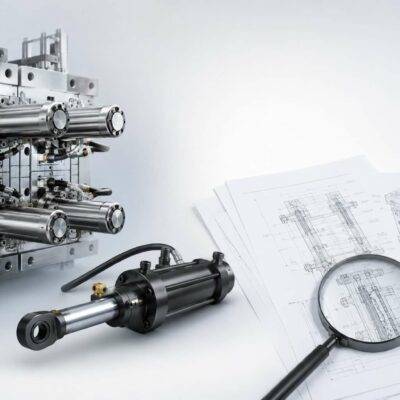

In hydraulic systems for injection molds, the connection between the cylinder rod and the moving component is just as important as the cylinder itself.
Even when the hydraulic cylinder is correctly sized and installed, the movement of the cylinder and the movement of the slide may not be perfectly aligned. A rigid connection can therefore create unwanted stresses at the rod connection.
A Vega technical case from 2016 addressed precisely this situation. A customer asked where the DFA rod accessory should be used. Vega recommended using the DFA accessory in cylinder applications because it provides a floating connection capable of eliminating or reducing possible misalignment between the cylinder and the moving part, such as a slide.
The Challenge: Connecting a Cylinder to a Moving Slide
Hydraulic cylinders are frequently used to move slides and other components in injection molds.
The cylinder generates a linear movement, while the component connected to the rod may have its own guiding system. If the two movement axes are not perfectly aligned, a rigid connection can make the connection between the cylinder rod and the moving component less tolerant of alignment errors.
This is the reason Vega’s technical team recommended the DFA accessory in the case.
The objective was not to change the cylinder itself, but to introduce an appropriate floating connection between the cylinder rod and the moving slide.
What Is the Vega DFA Accessory?
The DFA – Floating Joint with Female is a rod accessory designed to provide a floating connection.
Vega’s Technical Manual describes the DFA as a male-to-male joint adapter incorporating a complete floating joint, consisting of male and female elements. It allows a cylinder with a female rod end to be converted into a complete floating-joint connection.
This distinction is important.
The DFA is not simply a conventional threaded adapter. Its purpose is to introduce a floating connection between the cylinder and the component being moved.
How the Floating Connection Helps
The Vega case specifically states that the DFA allows a floating connection that can eliminate or reduce the possible misalignment between the cylinder and the moving part.
This makes the accessory particularly relevant when a hydraulic cylinder drives a slide or another guided component.
Instead of forcing the cylinder rod and the moving component to remain in a perfectly rigid geometric relationship, the floating joint provides a degree of mechanical compensation.
The practical objective is therefore:
Cylinder → DFA floating connection → Moving slide
rather than:
Cylinder → rigid connection → Moving slide
The first arrangement can be more tolerant of the type of misalignment described in the Vega case.
DFA, MFA and MTA: Different Rod Accessories
Vega’s Technical Manual places the DFA within a broader family of rod-end accessories.
The manual identifies:
- MTA – Metric Male Thread: an adapter used to transform a female rod into a male threaded connection.
- MFA – Floating Joint: an adapter that transforms a female rod into a floating-joint connection.
- DFA – Floating Joint with Female: an adapter incorporating a complete floating joint with male and female elements.
This makes the selection of the correct rod accessory an important part of cylinder installation.
The accessory should therefore be selected according to the cylinder rod configuration and the type of connection required by the moving component.
A Specific Advantage of the DFA
The main advantage documented in Case 221 is alignment compensation.
The Vega Team recommended the DFA because it can reduce or eliminate the effects of possible misalignment between:
- the hydraulic cylinder;
- the cylinder rod;
- the guided slide or moving component.
This is especially relevant in mold construction, where the cylinder and the moving slide may be mounted in different locations and connected through mechanical components.
The DFA Is Not Equivalent to an Integrated Floating Rod
There is an important qualification in the Vega Technical Manual.
Although the DFA can transform a cylinder with a female rod into a floating-joint configuration, Vega specifies that it cannot have the same performance as a cylinder rod with an integrated floating joint.
The same principle is stated for the MFA accessory: an adapter can provide a floating connection, but it is not equivalent to a rod designed with the floating joint directly integrated into it.
This distinction is important when selecting components for demanding applications.
The DFA should therefore be understood as a solution for adapting a suitable cylinder to a floating connection, rather than as a direct substitute for a purpose-designed integrated floating rod.
Protection Under Excessive Load
The Vega Technical Manual also makes an interesting observation concerning the material of the MTA and MFA adapters.
The manual explains that the adapter material is reasonably intended to break before the cylinder rod under excessive load, thereby helping to protect the cylinder. It also notes that some customers have requested higher-performance steel adapters, accepting the risk that a severe overload could instead damage the cylinder.
The Case 221 documentation does not specifically state that this principle applies to the DFA, so it should not be presented as a documented DFA safety feature.
The relevant lesson is broader: rod-end accessories must be selected with consideration for the loads that can occur in the application.
Floating Connections in Injection Mold Applications
Vega’s current product range confirms that rod accessories are specifically offered for hydraulic cylinders used in plastic injection molds and aluminium die-casting molds. The accessories category includes rod accessories, check valves and flow regulators.
The current Vega accessory range includes the DFA family in several configurations. For example, the DFA20X250 / DFA3/4-16 is specified as a floating joint with female connection for rod diameters Ø28 and Ø36.
DFA – Floating Joint with Female
The Italian Vega website also currently lists the DFA as a “Testa a martello con femmina”, with metric and UNF/UNEF versions and different sizes according to the rod-end configuration.
Accessori stelo DFA – Testa a martello con femmina
The Importance of Correct Cylinder Installation
Vega’s current accessories documentation emphasizes that proper cylinder mounting and setup are an important part of the overall hydraulic system.
The company provides rod-end accessories specifically to connect the cylinder to the moving component, together with hydraulic valves and connections for the oil circuit.
This supports an important engineering principle demonstrated by Case 221:
Selecting the hydraulic cylinder is only one part of the design. The connection between the cylinder and the moving component must also be considered.
Why Misalignment Should Be Considered During Mold Design
A hydraulic cylinder is designed primarily to generate linear force and movement.
If the connection to a guided slide is not properly aligned, the mechanical interface becomes an important part of the system design.
The DFA provides a floating connection specifically to accommodate the type of misalignment identified in the Vega case.
This can be particularly useful when designing:
- injection mold slides;
- core movements;
- guided moving components;
- compact mold mechanisms;
- hydraulic actuators connected to mechanically guided parts.
The exact suitability of a floating joint should always be evaluated according to the cylinder, rod diameter, loads and geometry of the specific application.
DFA as Part of the Complete Cylinder Solution
Vega’s current hydraulic-cylinder catalog groups cylinders according to their application, including cart and plug movement, ejection plate movement, unscrewing and mechanical locking. The company also states that standard fixing configurations can be customized according to customer requirements.
Rod accessories such as the DFA complement this approach by allowing the cylinder-to-machine connection to be adapted to the mechanical requirements of the application.
The Case 221 recommendation is therefore a good example of a broader engineering philosophy:
the cylinder, rod end and mechanical connection should be considered as one complete system.
Conclusion
Case 221 demonstrates a relatively small but important detail in hydraulic-cylinder installation.
A customer asked Vega where the DFA rod accessory should be used. Vega recommended it for cylinder applications because it provides a floating connection capable of eliminating or reducing possible misalignment between the cylinder and the moving slide.
Vega’s Technical Manual corroborates the function of the accessory, describing the DFA as a male-to-male adapter incorporating a complete floating joint and explaining that it converts a female cylinder rod into a floating-joint connection.
The current Vega catalog continues to list the DFA among its hydraulic-cylinder rod accessories for mold applications.
The key engineering lesson is simple:
When a hydraulic cylinder drives a guided moving component, the connection should not be overlooked. A correctly selected floating joint can help accommodate the misalignment between the cylinder and the moving slide.