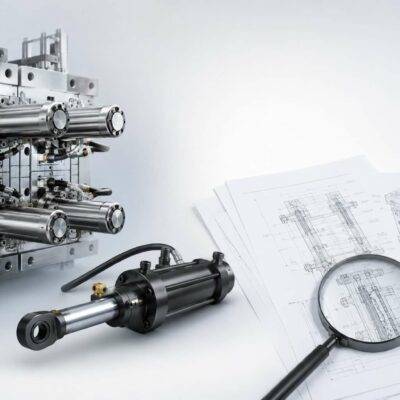

In today’s highly competitive industrial market, customers often expect suppliers to deliver customized hydraulic cylinders quickly, regardless of the technical complexity involved.
When a new project begins, it is common for customers to ask a simple question:
“Can you manufacture this hydraulic cylinder?”
Many companies feel pressured to answer “yes” immediately in order to secure the order.
However, responsible engineering follows a different approach.
Before promising a special hydraulic cylinder, engineers must verify technical feasibility, manufacturing capability, supplier availability and long-term reliability.
A real engineering case handled by the Vega Technical Department demonstrates why the most professional answer is sometimes “not yet”, rather than making promises that cannot immediately be fulfilled.
The Customer’s Request
A customer involved in the design of hydraulic press equipment requested several block hydraulic cylinders for different force requirements.
The application required cylinders capable of generating:
- 9 tons
- 22 tons
- 45 tons
- 68 tons
The hydraulic system would operate at 18 MPa (180 bar) with a two-second cycle time and mineral hydraulic oil ISO VG 68.
The customer was looking for a complete solution covering every required force level.
Engineering Begins with Feasibility
Instead of immediately confirming that every requested cylinder could be supplied, the Vega Technical Department first evaluated the actual manufacturing possibilities.
After reviewing the request, the engineering team confirmed that only the standard CM100CGHG#015 hydraulic cylinder, equipped with a stroke reducer, was immediately available for the 9-ton application.
For the larger cylinders requested by the customer, the answer was different.
The engineering team explained that the possibility of manufacturing special hydraulic cylinders with 160 mm, 200 mm and 250 mm bores was still under evaluation together with the supplier.
Rather than providing uncertain delivery dates or unrealistic commitments, the customer was informed that a final answer would be provided as soon as the technical evaluation had been completed.
The Difference Between Sales and Engineering
This case illustrates one of the fundamental differences between commercial negotiations and engineering decisions.
Sales departments naturally focus on satisfying customer requests.
Engineering departments have a different responsibility.
They must determine whether a product can actually be designed, manufactured and supported with the required level of quality and reliability.
Answering “yes” without verifying feasibility may create unrealistic expectations that eventually damage customer confidence.
Answering “we are evaluating the solution” demonstrates technical responsibility.
Engineering Honesty Creates Trust
Many companies believe that refusing a customer’s request may result in losing business.
In reality, customers often appreciate transparent technical communication.
In this case, the Vega Technical Department clearly distinguished between:
- products immediately available;
- products under technical evaluation;
- future development possibilities.
This honest approach allows customers to make informed engineering decisions rather than relying on assumptions.
Long-term business relationships are built on realistic technical information rather than optimistic promises.
Innovation Requires Technical Validation
Developing a new hydraulic cylinder is far more complex than increasing its dimensions.
Every new bore size requires engineers to evaluate:
- structural strength;
- sealing technology;
- machining feasibility;
- material selection;
- supplier capability;
- manufacturing processes;
- quality control requirements.
Only after these analyses can a manufacturer confirm whether a new hydraulic cylinder can be introduced into production.
The fact that a larger cylinder appears technically possible does not automatically mean it is ready for commercial supply.
Every Engineering Project Has a Development Process
One important lesson from this case is that engineering projects evolve through clearly defined stages.
These typically include:
- customer requirements;
- preliminary feasibility analysis;
- supplier consultation;
- design evaluation;
- prototype development;
- testing;
- production approval.
Skipping these steps simply to provide an immediate positive answer increases technical and commercial risks.
The Vega Technical Department followed the correct engineering methodology by informing the customer that supplier evaluation was still in progress before making any commitment.
Customer Support Is More Than Providing Products
Engineering support extends beyond supplying hydraulic cylinders.
Customers also expect reliable technical guidance.
In this case, the engineering team did not simply reject the request.
Instead, it immediately proposed the available solution for the 9-ton application while continuing to investigate the larger cylinders requested.
This approach keeps the project moving forward while maintaining complete technical transparency.
Engineering Integrity Protects Both Customer and Manufacturer
One of the greatest responsibilities of an engineering department is protecting both the customer and the manufacturer from unnecessary risks.
Delivering a product before its technical feasibility has been confirmed may lead to:
- unexpected performance problems;
- production delays;
- higher costs;
- customer dissatisfaction;
- reduced reliability.
By carefully evaluating each request before making commitments, engineering departments reduce these risks and build stronger professional relationships.
Conclusion
This real engineering case demonstrates that professional customer support is not based on promising every requested product.
Instead, it is based on providing accurate technical information supported by realistic engineering evaluations.
The Vega Technical Department immediately confirmed the availability of the standard hydraulic cylinder for the 9-ton application, while openly explaining that larger bore cylinders were still under technical evaluation with the supplier before any commitment could be made.
Rather than creating unrealistic expectations, the engineering team chose transparency, technical responsibility and continuous communication.
Ultimately, this case reinforces one of the most important principles of engineering:
The strongest customer relationships are built not by promising everything, but by providing honest technical evaluations, realistic expectations and reliable engineering solutions.
Related Articles (Verified on icvega.com)
- How to Find the Right Vega Cylinder or Accessory
https://www.icvega.com/choosing/find-right-vega-cylinder-accessory - Custom Hydraulic Cylinders
https://www.icvega.com/products - Alternative Classic
https://www.icvega.com/support/alternative-classic