
A Real Engineering Case on Seal Wear, Misalignment and Side Loads in Injection Molds
Hydraulic cylinder seal failures are often immediately attributed to excessive operating temperature.
When a seal shows premature wear, many engineers naturally assume that the material has exceeded its thermal limits and that a higher temperature-resistant seal is required.
Although temperature can certainly reduce seal life, it is far from being the most common cause of premature failure in hydraulic cylinders used in injection molds.
In many applications, the real problem is mechanical rather than thermal.
Cylinder misalignment, side loading, improper mounting or the absence of floating joints may generate radial forces that continuously overload the rod guide and sealing system. Under these conditions, even the highest-quality sealing materials cannot achieve their expected service life.
This real technical support case demonstrates how the Vega Technical Department helped identify the actual cause of premature seal wear, proving that the operating temperature was well within the limits of the sealing materials and directing the investigation toward a mechanical alignment problem instead.
The Customer’s Concern
A customer reported excessive seal wear on hydraulic cylinders installed in an injection mold operating at approximately 185°F (85°C).
The first assumption was straightforward:
The mold temperature was believed to be responsible for damaging the seals.
Before modifying the cylinder design or selecting different sealing materials, the customer requested confirmation of the maximum allowable operating temperatures for the sealing system.
This is a common engineering approach.
Before changing hardware, the operating conditions should always be verified against the material specifications.
Verifying the Seal Temperature Ratings
The Vega Technical Department reviewed every sealing component installed inside the hydraulic cylinder.
The analysis confirmed the following maximum operating temperatures:
| Component | Maximum Working Temperature |
|---|---|
| PTFE + Bronze seals | 250°C |
| FKM O-rings | 180–200°C (short periods) |
| Polyester resin wear rings with graphite | 150–160°C |
These values clearly demonstrated that an operating temperature of 85°C remained comfortably below the design limits of every sealing component.
Comparing Operating Temperature with Material Limits
An engineering comparison immediately shows the available safety margin.
| Component | Maximum Temperature | Operating Temperature | Safety Margin |
|---|---|---|---|
| PTFE + Bronze | 250°C | 85°C | 165°C |
| FKM O-Ring | 180°C | 85°C | 95°C |
| Wear Ring | 150°C | 85°C | 65°C |
Every sealing material was operating far below its allowable temperature.
Consequently, thermal degradation could not reasonably explain the premature wear.
This simple comparison immediately redirected the investigation toward mechanical causes.
Engineering Rule: Eliminate the Impossible First
One of the most effective troubleshooting methods in engineering consists of systematically eliminating impossible causes.
Rather than guessing, engineers compare measured operating conditions with component specifications.
If the actual temperature is significantly below the material limit, another failure mechanism must be responsible.
This logical approach prevents unnecessary replacement of perfectly suitable materials.
Looking Beyond Temperature
After excluding temperature as the primary cause, the Vega Technical Department proposed another hypothesis.
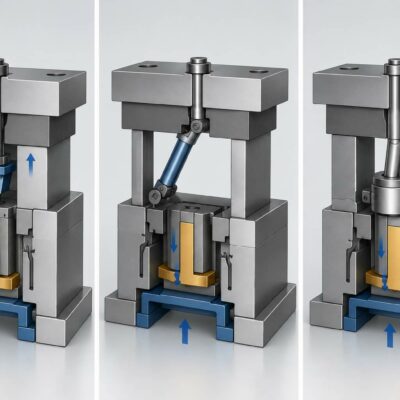
The cylinder might be suffering from misalignment between the cylinder and the slide.
This suggestion completely changed the direction of the investigation.
Instead of focusing on seal materials, attention shifted toward the mechanical installation of the cylinder inside the mold.
Why Misalignment Destroys Seals
Hydraulic cylinders are designed to transmit forces primarily along their longitudinal axis.
When the rod is perfectly aligned with the moving slide, the seals experience only the contact pressure necessary for hydraulic sealing.
However, even a slight angular or lateral misalignment generates continuous radial forces.
These forces produce:
- uneven seal loading;
- increased friction;
- accelerated wear of guide rings;
- rod surface stress;
- localized heating.
Over thousands or millions of cycles, this additional mechanical load dramatically shortens seal life.
The Importance of Floating Joints
While collecting additional information, the customer confirmed another important detail.
The application was not using a floating joint.
This observation strongly supported the misalignment hypothesis.
Floating joints are specifically designed to compensate for small assembly inaccuracies and unavoidable movements of mold components.
Without a floating joint, every small positioning error is transmitted directly to the cylinder rod.
Instead of allowing slight angular compensation, the rod must absorb bending forces that should never reach the sealing system.
Understanding Side Loads
Side loading is one of the most underestimated causes of hydraulic cylinder failures.
If a radial force acts on the rod, the guide bushings and wear rings must absorb that force before the seals can perform their sealing function.
The resulting contact pressure increases friction according to the basic friction equation:
where:
- Ff = friction force;
- μ = coefficient of friction;
- N = normal force.
Misalignment increases the normal force acting on the guides.
As the normal force increases, friction also increases.
Higher friction leads to:
- greater wear;
- higher operating temperature at the contact surfaces;
- shorter seal life.
Ironically, excessive temperature may become a consequence of misalignment rather than its original cause.
Heat Does Not Always Mean Thermal Failure
This case illustrates another important engineering concept.
Many failures associated with “high temperature” are actually caused by mechanical friction.
The heat measured on a worn seal may simply be generated by excessive contact pressure resulting from poor alignment.
Changing to a more temperature-resistant seal would therefore not solve the real problem.
Instead, correcting the installation geometry restores normal operating conditions.
A Systematic Engineering Investigation
The value of this technical support case lies not only in identifying a possible misalignment but also in demonstrating the correct engineering methodology.
The investigation followed a logical sequence:
- Verify operating temperature.
- Compare temperature with seal specifications.
- Exclude thermal overload.
- Investigate installation conditions.
- Evaluate alignment.
- Verify whether a floating joint is installed.
- Identify possible side loads.
Each step reduced the number of possible causes until the most probable root cause remained.
Lessons Learned from This Real Engineering Case
Premature seal wear should never automatically be attributed to temperature.
Before replacing sealing materials, engineers should verify:
- operating temperature;
- seal material limits;
- cylinder alignment;
- guide conditions;
- presence of floating joints;
- external side loads.
Only after eliminating mechanical causes should thermal upgrades be considered.
This approach reduces unnecessary maintenance costs while improving long-term reliability.
Engineering Conclusions
This real technical support case demonstrates the importance of distinguishing between symptoms and root causes.
Although the customer initially suspected that an operating temperature of 85°C was damaging the hydraulic cylinder seals, the Vega Technical Department confirmed that all sealing materials were operating well within their allowable temperature ranges, with limits between 150°C and 250°C depending on the component.
The engineering investigation therefore shifted toward mechanical installation, identifying possible cylinder-to-slide misalignment and the absence of a floating joint as much more likely contributors to premature seal wear.
The most important lesson is clear:
Hydraulic cylinder failures should always be investigated systematically. The apparent cause is not always the real one, and solving the wrong problem rarely produces a lasting solution.