Smart Manufacturing at Interpack 2026: How Digital Factories Are Transforming Packaging Production
The packaging industry is entering a new era where intelligent automation, connected machines and real-time data are reshaping manufacturing. What was once considered a vision of the future has become a practical reality for companies seeking higher productivity, greater flexibility and improved sustainability.
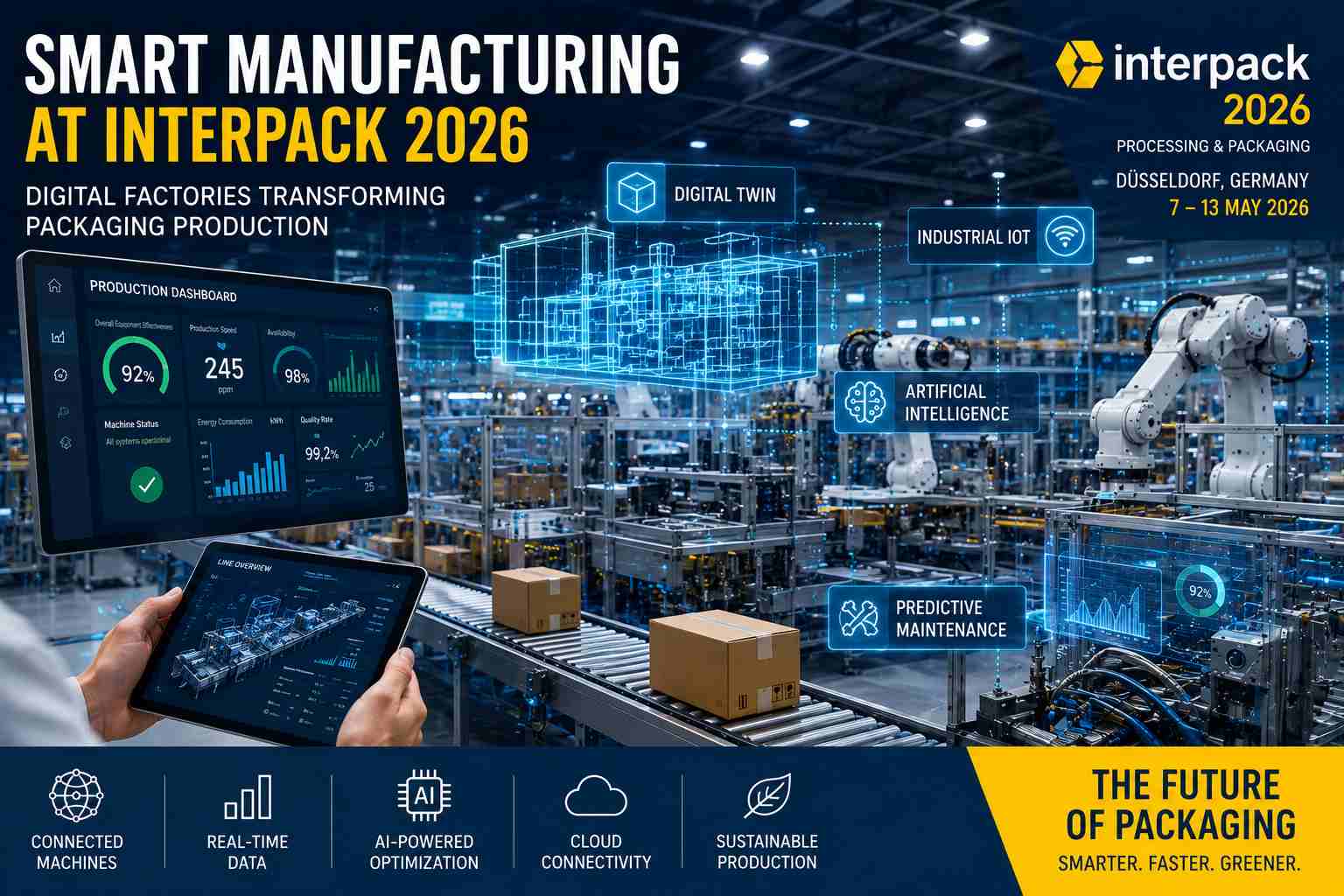
At Interpack 2026, Smart Manufacturing is expected to be one of the most influential themes, bringing together technologies such as Artificial Intelligence, Digital Twins, Industrial IoT, cloud connectivity and advanced automation.
Manufacturers are increasingly investing in digital factories capable of monitoring, optimizing and adapting production processes in real time.
What Is Smart Manufacturing?
Smart Manufacturing combines advanced automation with digital technologies to create highly connected production environments.
Unlike traditional manufacturing systems, smart factories continuously collect and analyze production data to improve operational performance.
Typical technologies include:
- Artificial Intelligence
- Industrial IoT
- Digital Twins
- Machine Learning
- Edge Computing
- Cloud Manufacturing
- Predictive Analytics
- Robotics
Together, these technologies enable packaging manufacturers to make faster and more informed decisions.
Why Smart Manufacturing Matters
Today’s manufacturers face increasing pressure to:
- improve productivity
- reduce downtime
- lower operating costs
- increase flexibility
- improve quality
- reduce waste
- achieve sustainability targets
Smart Manufacturing addresses these challenges through intelligent automation and real-time process optimization.
Industrial IoT Connects the Entire Factory
Industrial Internet of Things (IIoT) technologies connect machines, sensors and software into a single production ecosystem.
Connected equipment continuously monitors:
- machine status
- production speed
- hydraulic pressure
- temperature
- vibration
- energy consumption
- machine availability
Operators gain complete visibility into production performance.
Digital Twins Improve Machine Performance
Digital Twin technology creates a virtual model of a physical production line.
Manufacturers can use these digital models to:
- simulate production
- optimize machine layouts
- predict bottlenecks
- test new configurations
- improve maintenance planning
Digital Twins significantly reduce commissioning time while improving production efficiency.
Artificial Intelligence Optimizes Production
AI has become one of the most valuable tools within Smart Manufacturing.
Applications include:
- predictive maintenance
- automatic quality inspection
- production scheduling
- machine optimization
- defect detection
- process analytics
AI enables production systems to continuously improve based on operational data.
Robotics and Collaborative Automation
Smart factories integrate robotics with intelligent software.
Expected technologies include:
- collaborative robots
- autonomous mobile robots
- robotic palletizing
- machine vision
- flexible automation cells
These systems improve productivity while maintaining production flexibility.
Motion Control in Smart Factories
Advanced motion control remains fundamental.
Packaging machines require:
- precise positioning
- synchronized movements
- reliable linear motion
- servo control
- hydraulic actuation
- high-speed operation
Even highly digital factories depend on accurate mechanical movement.
Cloud Manufacturing
Cloud platforms allow manufacturers to monitor multiple factories simultaneously.
Benefits include:
- centralized monitoring
- production analytics
- remote diagnostics
- software updates
- global performance comparison
Cloud Manufacturing supports multinational production networks.
Predictive Maintenance
Instead of repairing equipment after failure, Smart Manufacturing predicts maintenance needs.
Systems analyze:
- vibration
- pressure
- temperature
- cycle counts
- motor performance
This reduces downtime and improves equipment reliability.
Cybersecurity in Connected Factories
As machines become increasingly connected, cybersecurity becomes essential.
Manufacturers are investing in:
- secure industrial networks
- encrypted communications
- user authentication
- access control
- secure cloud infrastructure
Cybersecurity protects both production systems and intellectual property.
Sustainability Through Digital Manufacturing
Smart Manufacturing also contributes to environmental performance.
Benefits include:
- lower energy consumption
- reduced material waste
- optimized production planning
- improved resource utilization
- lower carbon emissions
Digital technologies support more sustainable manufacturing practices.
Frequently Asked Questions
What is Smart Manufacturing?
Smart Manufacturing combines digital technologies, automation and real-time data analysis to optimize industrial production.
Will Smart Manufacturing be a major theme at Interpack 2026?
Yes. It is expected to be one of the exhibition’s key technology areas alongside AI, robotics and sustainable packaging.
What is the difference between Industry 4.0 and Smart Manufacturing?
Industry 4.0 refers to the broader industrial transformation, while Smart Manufacturing focuses specifically on connected, intelligent production systems.
How do Digital Twins improve production?
They allow manufacturers to simulate, monitor and optimize production processes before implementing changes on the factory floor.
Why should packaging companies invest in Smart Manufacturing?
It improves efficiency, quality, flexibility, sustainability and long-term competitiveness.
Looking Ahead
Packaging manufacturing is becoming increasingly digital.
Artificial Intelligence, Digital Twins, Industrial IoT and advanced automation are transforming factories into intelligent production environments capable of adapting continuously to changing market demands.
Interpack 2026 is expected to showcase many of these technologies, helping manufacturers prepare for the next generation of smart packaging production.