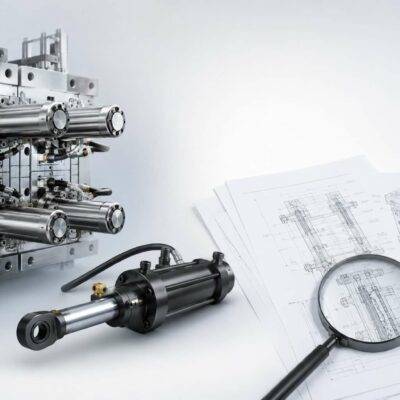

Exploring Hybrid Hydraulic Systems for Injection Molds
Hydraulic cylinders used in injection molds are normally connected to an external hydraulic power unit.
The hydraulic circuit controls oil flow, generates pressure and ensures that the cylinder extends and retracts in a predictable and repeatable manner.
But what happens if a mold designer wants to eliminate the hydraulic circuit altogether?
Can a hydraulic cylinder operate simply by using the movement of the injection machine itself?
Although this idea may initially seem unconventional, it was the subject of a real engineering discussion handled by the Vega Technical Department.
Rather than immediately accepting or rejecting the proposal, the engineers carefully analysed the concept, identified the technical challenges and explored whether a practical solution could be developed.
An Unusual Injection Mold Concept
The project involved a vertical injection molding machine equipped with a rotating table.
Unlike a conventional mold consisting of two halves, this design included:
- one injection side;
- two extraction sides;
- a rotary table that alternated the working positions of the two extraction stations.
While one side of the mold was producing plastic parts, the second station was simultaneously receiving inserts from a robot.
After the inserts had been positioned, the rotary table rotated, allowing the second station to become the next injection side.
This arrangement reduced idle time and increased production efficiency.
The Customer Wanted to Eliminate the Hydraulic Circuit
The most innovative aspect of the project was not the mold itself.
It was the customer’s proposal for operating the hydraulic cylinders.
Instead of connecting the cylinders to a conventional hydraulic power unit, the customer suggested:
- filling the cylinders with hydraulic oil;
- eliminating the external hydraulic circuit;
- controlling movement using only a one-way flow regulator;
- using the movements of the injection machine to move the piston.
The objective was to simplify the mold by removing hydraulic hoses and reducing the complexity of the installation.
A Good Engineer Does Not Reject New Ideas Too Quickly
One of the most interesting aspects of this engineering case is the response provided by the Vega Technical Department.
Rather than immediately stating that the idea could not work, Stefano Rogora first focused on understanding exactly how the proposed system was intended to operate.
He explained that the movement of the mold itself was understandable, but that the hydraulic connections required further clarification.
In particular, he questioned how the customer intended to manage the oil flow between the two hydraulic ports during the continuous movement of the cylinder.
This illustrates an important engineering principle.
Innovation begins with understanding the problem before evaluating the solution.
Previous Experience Matters
Another valuable aspect of this discussion is that the Vega Technical Department did not evaluate the proposal purely from theory.
Stefano explained that he had previously developed two or three hybrid single-action hydraulic applications, although he also pointed out that this new project was significantly different from those earlier designs.
This demonstrates the importance of engineering experience.
Past projects often provide valuable insights, but every new application must still be analysed on its own technical merits.
Hybrid Hydraulic Systems Can Be Technically Attractive
The customer’s proposal highlights a concept that occasionally appears in specialized mold design.
If the movement of the injection machine can provide the mechanical energy required to move the cylinder, eliminating an external hydraulic power unit may offer several potential advantages:
- fewer hydraulic hoses;
- simplified mold installation;
- reduced maintenance requirements;
- a cleaner mold layout;
- fewer external hydraulic connections.
However, these potential benefits can only be realised if the hydraulic behaviour of the cylinder is fully understood and properly controlled.
This is precisely why the Vega Technical Department concentrated first on analysing the hydraulic circuit rather than the mechanical layout.
Understanding the Hydraulic Circuit Comes Before Selecting Components
One of the strongest lessons from this engineering case is that hydraulic components should never be selected before understanding how the hydraulic system itself will function.
Before discussing cylinder sizes or configurations, the Vega Technical Department focused on a more fundamental question:
How will the hydraulic oil move during every stage of the molding cycle?
Without a clear answer to that question, no reliable engineering solution could be proposed.
Can Hydraulic Cylinders Operate Without External Hydraulic Connections?
Part 2 – Understanding the Hydraulic Challenges of Closed Hydraulic Systems
In Part 1, we explored an unconventional engineering concept proposed for a vertical injection mold: operating hydraulic cylinders without a traditional hydraulic power unit.
Instead of dismissing the idea, the Vega Technical Department carefully analysed how such a system could function and identified the technical issues that needed to be solved before the concept could become practical.
This engineering approach demonstrates an important principle:
Innovative ideas deserve careful technical analysis rather than immediate acceptance or rejection.
The Main Hydraulic Problem Was Not the Cylinder
After reviewing the customer’s drawings, the Vega Technical Department quickly identified the real engineering challenge.
The problem was not the hydraulic cylinder itself.
Instead, it concerned the hydraulic behaviour of the oil inside the cylinder.
Stefano Rogora explained that the proposed concept would probably not work correctly because the oil volume on the piston side is different from the oil volume on the rod side of the cylinder.
This observation highlights one of the most fundamental characteristics of a double-acting hydraulic cylinder.
Because the piston rod occupies part of one chamber, the two cylinder chambers never contain the same volume of oil.
As a result, a completely closed hydraulic circuit cannot simply transfer oil back and forth without compensating for this volume difference.
Oil Volume Balance Is Essential
In conventional hydraulic systems, this difference in oil volume is automatically managed by the hydraulic power unit and the oil reservoir.
The hydraulic circuit continuously supplies or receives the additional oil required during cylinder movement.
In the customer’s proposed system, however, the external hydraulic circuit would be eliminated.
Without an additional method of compensating for the different chamber volumes, pressure imbalances could develop, making smooth and reliable cylinder operation difficult.
This explains why understanding oil movement is often more important than selecting the hydraulic cylinder itself.
Engineering Is About Solving Problems
One of the most valuable aspects of this engineering case is that the Vega Technical Department did not simply explain why the proposed concept might fail.
Instead, the engineers immediately began searching for a practical solution.
Rather than rejecting the idea, Stefano Rogora suggested adding two small hydraulic reservoirs, similar in concept to the reservoirs used in automotive brake systems.
This proposal would allow the hydraulic circuit to compensate for the difference in oil volume between the two chambers during cylinder movement.
Although additional engineering analysis would still be required, the suggestion transformed the discussion from identifying a problem to developing a possible solution.
Hybrid Hydraulic Systems May Have Practical Advantages
Although unconventional, hybrid hydraulic systems can offer several potential benefits when correctly engineered.
Depending on the application, eliminating external hydraulic connections may provide advantages such as:
- fewer hydraulic hoses;
- simpler mold installation;
- reduced maintenance requirements;
- fewer potential leakage points;
- improved accessibility inside compact molds;
- cleaner mold layouts.
These advantages, however, can only be achieved if the hydraulic circuit is designed to manage oil flow and pressure correctly throughout the entire molding cycle.
Experience and Creativity Go Hand in Hand
Another important lesson from this case is the value of engineering experience.
The Vega Technical Department had previously worked on several hybrid hydraulic applications and used that practical knowledge to evaluate the customer’s proposal.
At the same time, the engineers recognised that every new application presents unique challenges.
Previous experience provides valuable guidance, but every design must still be validated according to its own operating conditions, geometry and hydraulic behaviour.
This balance between experience and technical analysis is one of the defining characteristics of good engineering.
Innovation Requires Understanding Fundamental Hydraulic Principles
This case demonstrates that successful innovation does not depend solely on creating new mechanical solutions.
It also requires understanding the physical principles governing hydraulic systems.
Before attempting to simplify a hydraulic circuit, engineers must evaluate:
- oil volume balance;
- pressure compensation;
- cylinder chamber geometry;
- flow control;
- repeatability;
- long-term reliability.
Ignoring these principles may result in a concept that appears mechanically attractive but cannot operate consistently in production.
Conclusion
This real engineering case demonstrates that eliminating an external hydraulic power unit is not simply a matter of disconnecting hydraulic hoses.
The Vega Technical Department identified that the main challenge lay in the different oil volumes contained in the two chambers of a double-acting hydraulic cylinder. Rather than rejecting the customer’s innovative proposal, the engineers analysed the hydraulic behaviour of the system and suggested using two small hydraulic reservoirs to compensate for the volume difference, illustrating how engineering combines creativity with a thorough understanding of hydraulic principles.
This case reinforces one of the most important principles of hydraulic engineering:
Successful hydraulic innovation is achieved not by eliminating components, but by understanding and controlling the physical behaviour of the hydraulic system. Every simplified solution must still satisfy the fundamental laws governing oil flow, pressure balance and volume compensation.
Related Articles (Verified URLs on icvega.com)
- Hydraulic Cylinders for Injection Molds
https://www.icvega.com/products - How to Find the Right Vega Cylinder or Accessory
https://www.icvega.com/choosing/find-right-vega-cylinder-accessory - Choosing the Right Cylinder: Stroke Selection
https://www.icvega.com/choosing/choosing-the-right-cylinder-for-your-mold-stroke - Choosing the Right Cylinder: Pushing Force
https://www.icvega.com/choosing/choosing-the-right-cylinder-for-your-mold-pushing-force - Hydraulic Cylinder Maintenance
https://www.icvega.com/maintenance/hydraulic-cylinder-maintenance