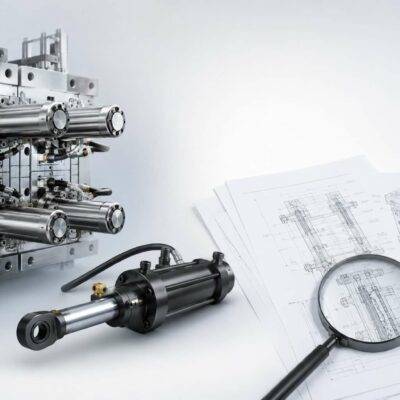

A Real Engineering Case on Pressure Peaks, Dynamic Loads and Hidden Oil Leakage
When a hydraulic cylinder begins leaking oil, the first assumption is often that the seals have worn out or that the cylinder has exceeded its maximum working pressure.
However, many failures occur even when the pressure gauge never indicates values above the cylinder’s rated operating pressure.
How is this possible?
The answer often lies in a phenomenon that conventional pressure gauges cannot detect: hydraulic pressure spikes.
Pressure spikes are extremely short pressure peaks generated by rapid movement, sudden deceleration, heavy moving masses or hydraulic shock. Although they may last only a few milliseconds, they can expose hydraulic cylinders to loads significantly higher than the normal line pressure.
This real engineering case demonstrates how the Vega Technical Department identified pressure spikes as the true cause of repeated hydraulic cylinder failures, even though the customer believed the system was operating under perfectly acceptable pressure conditions.
The Customer’s Problem
A customer reported repeated oil leakage from a hydraulic cylinder used in a production line.
According to the machine operator, the application was relatively light and the hydraulic pressure never exceeded 170–200 bar, well within the expected operating range.
Since the pressure appeared normal, the customer questioned why similar cylinders continued to fail.
Why the Pressure Gauge Can Be Misleading
One of the first observations made by the Vega Technical Department was that the machine pressure gauge measured only the line pressure.
A standard pressure gauge displays relatively slow pressure variations.
It cannot detect extremely fast pressure peaks lasting only a few milliseconds.
As a result, operators often believe the hydraulic system is operating safely while the cylinder is actually experiencing much higher transient loads.
Measuring Pressure Spikes
To investigate similar failures, the Vega Technical Department had previously used a digital pressure acquisition system connected directly to a pressure transducer installed in the hydraulic circuit.
This equipment recorded pressure values over very short time intervals.
In several applications, the measurements revealed pressure spikes between 60 and 80 bar higher than the normal line pressure within only 100 milliseconds.
For pressure events lasting less than 100 milliseconds, even faster equipment such as an oscilloscope was required to capture the complete pressure waveform.
This explains why conventional hydraulic instrumentation often fails to identify the real operating conditions.
Where Pressure Spikes Come From
Pressure spikes are usually generated by dynamic events rather than static hydraulic loads.
Typical causes include:
- rapid cylinder deceleration;
- high movement speed;
- heavy moving slides;
- sudden direction changes;
- hydraulic shock;
- insufficient cushioning;
- oversized flow rates.
Although each pressure peak is extremely short, repeated spikes gradually increase fatigue stresses inside the hydraulic cylinder.
How Pressure Spikes Cause Oil Leakage
The Vega Technical Department explained that high-speed cylinder movement combined with the mass of the moving slide can generate internal pressure spikes capable of producing microscopic cracks inside the cylinder.
Initially these cracks are invisible.
As production continues, the cracks propagate until they eventually cause oil leakage.
This explains why cylinders sometimes fail after hundreds of thousands of production cycles even though the recorded operating pressure has always appeared acceptable.
Dynamic Loads Matter More Than Static Pressure
Many hydraulic systems are designed by considering only the nominal working pressure.
However, hydraulic cylinders are subjected to dynamic loads throughout every production cycle.
When high operating speeds are combined with large moving masses, inertia generates additional forces that may significantly increase the internal hydraulic pressure.
The faster the movement, the greater the possibility of pressure spikes.
For this reason, evaluating only the nominal pressure is often insufficient for demanding industrial applications.
Selecting the Right Cylinder for Dynamic Applications
Following the technical investigation, the Vega Technical Department recommended replacing the existing cylinder with the V450 series, specifically designed for more demanding operating conditions and higher dynamic loads.
This recommendation illustrates an important engineering principle.
Hydraulic cylinders should not be selected solely according to nominal operating pressure.
Designers should also evaluate:
- movement speed;
- moving mass;
- acceleration;
- deceleration;
- expected pressure spikes;
- production cycle frequency.
These factors often determine cylinder life far more than the average hydraulic pressure.
Engineering Lessons Learned
This case highlights several important lessons for hydraulic system designers.
Never assume that line pressure represents the highest pressure acting inside a hydraulic cylinder.
Whenever unexplained failures occur:
- verify cycle time;
- evaluate moving masses;
- measure dynamic pressure using high-speed instrumentation;
- investigate hydraulic shock conditions;
- consider upgrading to a cylinder designed for higher dynamic loads.
Understanding pressure spikes often explains failures that cannot be justified by static pressure calculations alone.
Conclusions
Hydraulic pressure spikes are among the least understood causes of hydraulic cylinder failures.
Because they occur extremely quickly, they frequently remain invisible to conventional pressure gauges.
In this real engineering case, the Vega Technical Department demonstrated that apparently normal operating pressures concealed transient pressure peaks capable of generating microscopic cracks that eventually produced oil leakage.
The most important lesson is clear:
A hydraulic cylinder should always be designed for the real dynamic conditions of the application—not only for the pressure shown on the gauge.
Further Technical Reading
To better understand the engineering concepts discussed in this article, we recommend the following technical resources from the Vega Technical Blog:
- How to Calculate the Correct Hydraulic Cylinder Size for Injection Molds
https://www.icvega.com/support/how-to-calculate-the-correct-hydraulic-cylinder-size-for-injection-molds - Choosing the Right Cylinder for Mold Core: Pushing Force
https://www.icvega.com/choosing/choosing-the-right-cylinder-for-mold-core-pushing-force - How to Find the Right Cylinder or Accessory
https://www.icvega.com/choosing/find-right-vega-cylinder-accessory - Hydraulic Core Pulling Guide
https://www.icvega.com/promoting/hydraulic-core-pulling-guide