
A Real Engineering Case on 3-Wire Electronic Sensors, PLC Inputs and Switch Connection Solutions
Integrating hydraulic cylinders into a machine control system is often more challenging than installing the cylinders themselves.
Modern hydraulic cylinders are frequently equipped with electronic position sensors that provide accurate feedback to the PLC. However, problems arise when the machine controller has a limited number of available inputs or is not designed to interface directly with three-wire electronic sensors.
Many engineers initially assume the issue lies with the sensor.
In reality, the problem is usually related to the electrical architecture of the machine.
This engineering case demonstrates how the Vega Technical Department helped a customer connect four hydraulic cylinders equipped with electronic sensors by first verifying the PLC input configuration and then proposing the most suitable connection strategy.
The Customer’s Problem
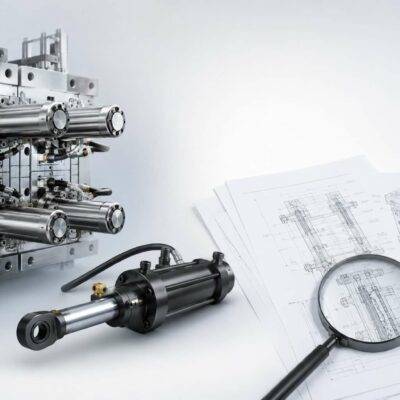
A customer operating an injection mold equipped with four V260CF hydraulic cylinders reported that the position sensors could not be connected correctly to the machine controller.
The cylinders were fitted with MSJ three-wire electronic switches, while the machine control system expected a much simpler wiring configuration.
Instead of replacing the hydraulic cylinders, the customer requested guidance on how to connect all four sensors to the PLC.
Understanding 3-Wire Electronic Sensors
Unlike simple mechanical contacts, three-wire electronic sensors require:
- +24 VDC power supply;
- 0 V reference;
- output signal.
This configuration provides reliable electronic switching and excellent immunity against electrical noise, making it suitable for industrial automation.
However, it also requires the PLC to provide compatible electronic inputs.
If the controller was originally designed for mechanical contacts, compatibility problems may occur.
The First Step: Check the PLC Terminal Box
Rather than immediately proposing new hardware, the Vega Technical Department first recommended verifying the machine terminal box.
The controller should provide:
- +24 VDC;
- 0 Volt;
- Cylinder Forward Signal;
- Cylinder Back Signal.
If these electrical connections are already available, the hydraulic cylinder sensors can often be connected without modifying the machine architecture.
This illustrates an important engineering principle:
Always verify the controller architecture before replacing components.
Series Connection of Multiple Hydraulic Cylinders
Once the PLC configuration has been confirmed, multiple hydraulic cylinders can often be connected using a series connection logic.
In this case, the Vega Technical Department explained that the same wiring principle used for two cylinders could also be applied when four cylinders are installed on the same mold.
This approach offers several advantages:
- reduced wiring complexity;
- fewer PLC inputs required;
- easier machine installation;
- simplified troubleshooting.
Proper wiring design becomes increasingly important as molds incorporate multiple hydraulic movements.
When a Switch Connection Box Is the Better Solution
Not every machine controller is capable of managing several electronic sensors directly.
For more complex installations, the Vega Technical Department recommended using the SIM08 Switch Connection Box.
The SIM08 simplifies electrical wiring by collecting multiple sensor signals into a dedicated connection interface between the hydraulic cylinders and the PLC.
Besides reducing installation time, this solution also improves maintenance by centralizing all electrical connections in a single location.
What If the PLC Cannot Handle 3-Wire Sensors?
Some older injection molding machines still use electrical systems designed only for mechanical switches.
In these situations, connecting electronic three-wire sensors may not be possible without modifying the electrical cabinet.
Instead of redesigning the machine, the Vega Technical Department recommended replacing the electronic MSJ sensors with the mechanical MSK version, fully compatible with simpler control systems.
This solution often represents the fastest and most economical way to restore compatibility.
Choosing the Right Sensor Is Only Part of the Solution
Position sensors should never be selected independently from the machine controller.
A successful installation requires compatibility between:
- hydraulic cylinder;
- sensor technology;
- PLC input type;
- electrical voltage;
- wiring architecture;
- automation logic.
Considering only the sensor specification without evaluating the PLC frequently leads to unnecessary installation problems.
Engineering Lessons Learned
This engineering case highlights several important principles:
- verify PLC compatibility before replacing sensors;
- identify the available input architecture;
- simplify wiring whenever possible;
- use dedicated connection modules for multiple cylinders;
- select sensor technology according to the machine controller—not only according to the hydraulic cylinder.
Good hydraulic automation is the result of both mechanical and electrical engineering working together.
Conclusions
Connecting multiple hydraulic cylinder position sensors is rarely just a wiring problem.
In this real engineering case, the Vega Technical Department solved the issue by first verifying the machine’s available electrical signals, then recommending the most appropriate solution based on the controller configuration: direct series wiring, the SIM08 Switch Connection Box, or replacement of the electronic sensors with mechanical versions when required.
The key lesson is simple:
Reliable hydraulic automation begins with compatibility between the hydraulic cylinder, the sensor and the PLC—not with additional wiring.
Further Technical Reading
To learn more about hydraulic cylinder integration and mold automation, we recommend these technical resources from the Vega Technical Blog:
- Switch Connection Box
https://www.icvega.com/switch-connection-box - New Low-Cost Magnetic Sensors
https://www.icvega.com/new-low-cost-magnetic-sensors - How to Calculate the Correct Hydraulic Cylinder Size for Injection Molds
https://www.icvega.com/support/how-to-calculate-the-correct-hydraulic-cylinder-size-for-injection-molds - Choosing the Right Cylinder for Mold Core: Pushing Force
https://www.icvega.com/choosing/choosing-the-right-cylinder-for-mold-core-pushing-force