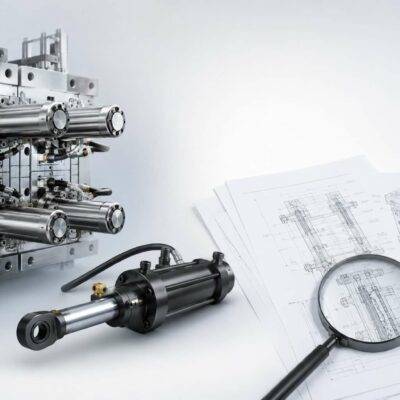

In industrial hydraulics, one of the most common assumptions is that if a hydraulic cylinder moves unexpectedly, the cylinder itself must be the source of the problem.
Reality, however, is often far more complex.
Recently, Vega Technical Dep. was asked to investigate a malfunction occurring on a zinc die casting mold equipped with two hydraulic compact cylinders. During the injection phase, both cylinders were retracting slightly, causing flash formation on the cast component and creating severe process instability. The customer was convinced that the hydraulic cylinders were incorrectly sized or defective.
The field investigation demonstrated exactly the opposite.
The real problem was not the hydraulic cylinders.
The real problem was a physical phenomenon that many engineers underestimate:
the compressibility of hydraulic fluids under dynamic pressure conditions.
The Initial Problem
The die casting mold was equipped with two hydraulic compact cylinders with a 60 mm stroke, responsible for holding a sliding section of the mold during the zinc injection phase. During production, the customer observed a flash thickness of approximately 0.03 mm on the cast part, indicating that the sliding component was moving under pressure.
The machine hydraulic unit could provide a maximum pressure of approximately:
Pmax = 120–125 bar
To improve the system performance, the customer had already installed:
- check valves;
- a replacement hydraulic valve;
- several machine adjustments.
Despite these modifications, the problem persisted.
Field Investigation
To understand the root cause of the problem, Vega Technical Dep. performed an on-site investigation.
The mold was mounted on the machine and operating at production temperature conditions.
The following procedure was implemented:
- installation of a pressure gauge directly on the upper cylinder supply line;
- positioning of the pressure gauge between the check valve and the cylinder;
- complete air bleeding procedure;
- gradual restart of production at reduced injection speed.
The purpose was straightforward:
verify whether the hydraulic cylinders were losing pressure or whether the hydraulic circuit itself was undergoing compression.
Static Pressure Versus Dynamic Pressure
One of the most misunderstood aspects of hydraulic systems is the difference between static and dynamic pressure.
According to Pascal’s principle, pressure in a hydraulic circuit is transmitted uniformly through the fluid:
P = F / A
where:
- P = pressure;
- F = applied force;
- A = effective area.
However, during high-speed die casting injection cycles, additional dynamic pressure peaks are generated.
The total pressure becomes:
Ptotal = Pstatic + Pdynamic
where:
- Pstatic is generated by the hydraulic unit;
- Pdynamic is generated by fluid acceleration, inertia effects, and cavity pressure during metal injection.
This distinction proved to be critical.
The Unexpected Pressure Increase
During the testing phase, the machine hydraulic system supplied approximately:
125 bar
However, during the actual zinc injection phase, Vega Technical Dep. measured pressure peaks reaching:
135 bar
inside the rear chamber of the hydraulic cylinder.
This measurement confirmed the theoretical calculations previously performed by the engineering department.
The hydraulic cylinders were not failing.
The hydraulic system itself was experiencing additional compression due to the pressure peaks generated during the injection process.
Hydraulic Fluids Are Not Perfectly Incompressible
Many engineers still assume that hydraulic oil behaves as a perfectly incompressible medium.
This assumption is incorrect.
According to hydraulic theory, all hydraulic fluids exhibit compressibility. Furthermore, any dissolved or entrapped air significantly increases this effect.
The total volumetric reduction can be approximated as:
ΔV ≈ 1% every 160 bar
under typical industrial conditions.
In die casting applications, where water-glycol mixtures are commonly used for safety reasons, this effect can become even more significant.
This means that a hydraulic circuit may behave similarly to a spring.
When subjected to rapid pressure peaks, the fluid volume compresses, allowing small but measurable displacements of the hydraulic cylinder.
Why 0.03 mm Matters
The customer observed a flash thickness of approximately:
0.03 mm
At first glance, this value appears negligible.
However, in die casting applications, even a few hundredths of a millimeter of mold separation can produce severe flash defects and compromise the entire process.
The measured flash value corresponded remarkably well with the displacement expected from:
- hydraulic fluid compression;
- dissolved air compression;
- elastic deformation of hydraulic components;
- local pressure peaks generated during zinc injection.
Mechanical Evidence
During the test campaign, another important observation emerged.
The leakage of molten zinc occurred only on one side of the sliding system.
This strongly suggested that the problem could not originate from the hydraulic cylinders alone.
Instead, it indicated the possible presence of:
- non-uniform load distribution;
- insufficient mechanical support;
- imperfect parallelism;
- lack of complete planarity between the slide and the fixed mold half.
In other words:
the hydraulic system was behaving exactly as physics predicted, while the mechanical structure required further investigation.
Sensor Resolution Limitations
During the investigation, Vega Technical Dep. identified a second issue.
The machine operators had adjusted the mechanical limit switches attempting to achieve a positioning repeatability of:
0.03 mm
This level of accuracy cannot realistically be achieved using traditional mechanical microswitches.
For applications requiring such precision, linear position transducers are generally required because they provide:
- higher repeatability;
- continuous position measurement;
- reduced sensitivity to vibration;
- improved process monitoring.
Possible Solutions
After completing the field analysis, Vega Technical Dep. proposed several possible solutions:
Solution 1
Replace the existing cylinders with larger hydraulic cylinders to reduce the influence of fluid compression.
Solution 2
Maintain the existing cylinders and install a hydraulic pressure intensifier.
Solution 3
Modify the mold design by introducing a positive mechanical locking system capable of absorbing the injection forces directly.
Engineering Is About Understanding Physics
This project demonstrates an important engineering principle.
The customer initially believed that the cylinders were undersized.
The field measurements demonstrated that:
- the cylinders were correctly sized;
- the hydraulic calculations were correct;
- the measured pressure increase matched the theoretical predictions.
The real challenge was understanding the interaction between:
- hydraulic fluid compressibility;
- air entrainment;
- dynamic pressure peaks;
- mold mechanical deformation;
- die casting process parameters.
Lessons Learned
1. Hydraulic fluids are never perfectly incompressible.
2. Dynamic pressure peaks must always be considered in die casting applications.
3. Entrapped air dramatically increases hydraulic system compliance.
4. Mechanical deformation and hydraulic compression often occur simultaneously.
5. Field measurements are often more valuable than assumptions.
6. The root cause of a problem is not always the component that appears to fail.
Conclusion
This case demonstrated that the hydraulic cylinders were not the source of the problem.
Instead, the apparent malfunction was caused by the combined effects of fluid compressibility, pressure spikes, mechanical tolerances, and process dynamics.
By combining theoretical calculations with real-world measurements, Vega Technical Dep. was able to identify the actual physical mechanisms responsible for the defect and propose several engineering solutions.
Because in engineering, solving a problem often means proving that the suspected component was never the problem in the first place.