
Why Bigger Hydraulic Ports Do Not Always Mean Better Performance
When designing a hydraulic circuit for an injection mold, engineers often focus on pressure, cylinder force and stroke.
However, one design parameter frequently generates debate between mold makers, OEMs and hydraulic component suppliers:
the diameter of the hydraulic oil ports.
At first glance, the answer appears obvious.
Larger ports should allow a greater oil flow, producing faster cylinder movement.
While this statement is partially true, it does not tell the whole story.
Hydraulic performance depends on much more than the diameter of a threaded connection.
Port geometry, internal oil passages, cylinder construction and the overall hydraulic circuit all influence how quickly a cylinder can be filled and how efficiently hydraulic power is transmitted.
A real engineering discussion between Faurecia and the Vega Technical Department illustrates why selecting the correct hydraulic port diameter is not simply a matter of making the holes larger.
Faurecia’s Requirement
The discussion began with a specific customer requirement.
Faurecia’s mold specification required 8 mm hydraulic circuits for the hydraulic connections used in the mold.
This created a challenge for the mold maker because the standard Vega hydraulic cylinders were normally supplied with 5 mm oil inlet ports.
As Bruno Barne explained, every new project required additional discussions with the customer because the mold specification requested larger hydraulic passages than those available on the standard cylinders.
From the customer’s perspective, the reason appeared straightforward.
Maintaining an 8 mm hydraulic circuit would ensure sufficient oil flow and therefore preserve the speed of the ejection plate.
At first sight, this assumption seems perfectly logical.
But hydraulic engineering is rarely that simple.
Does a Larger Port Always Increase Cylinder Speed?
Many engineers instinctively associate a larger hydraulic port with higher cylinder speed.
In practice, the relationship is far more complex.
Cylinder speed is influenced by the complete hydraulic system, including:
- hydraulic pump flow rate;
- oil viscosity;
- pressure losses;
- hose dimensions;
- manifold design;
- valve capacity;
- internal oil passages inside the cylinder.
The threaded port itself is only one restriction within the entire hydraulic circuit.
Increasing its diameter does not automatically eliminate every other flow limitation.
For this reason, experienced hydraulic designers evaluate the complete oil path before modifying connection sizes.
Vega Reviewed Previous Faurecia Projects
Rather than immediately proposing a new design, Stefano Rogora first reviewed previous Faurecia applications.
He confirmed that the hydraulic cylinders supplied in 2011 had been manufactured with 6.5 mm oil port holes, not with the standard 5 mm configuration.
This historical information proved extremely valuable.
Instead of starting from theory, Vega examined a solution that had already been successfully applied in production.
Engineering often progresses by analysing proven designs before introducing new modifications.
A Special Cylinder Had Already Been Developed
The investigation revealed another important detail.
For a previous project requiring interchangeability with HPS hydraulic cylinders, Vega had already manufactured a special cylinder body.
This design incorporated:
- 10 mm diameter oil port openings for the first 10 mm of depth;
- an internal reduction to 6.5 mm for the remainder of the oil passage.
This solution illustrates an important engineering principle.
The visible threaded connection is only part of the hydraulic flow path.
The internal geometry of the cylinder body is equally important.
Simply enlarging the external port does not necessarily improve the overall hydraulic performance if internal restrictions remain unchanged.
Oil Flow Is a Balance Between Speed and Pressure Loss
Every hydraulic circuit involves a compromise.
Increasing oil flow generally increases cylinder speed.
At the same time, oil moving through smaller passages produces higher flow velocity and larger pressure losses.
Engineers therefore seek the best balance between:
- cylinder speed;
- pressure drop;
- available pump capacity;
- compact cylinder dimensions;
- manufacturing cost.
Choosing the largest possible port diameter is not always the optimum solution.
Instead, the objective is to design a hydraulic circuit that provides the required performance without unnecessary complexity.
Vega’s Engineering Assessment
Rather than relying on assumptions, Stefano Rogora analysed the hydraulic behaviour of the proposed solution.
He explained that reducing the effective oil passage diameter would naturally reduce cylinder speed because the same quantity of oil would require more time to fill the cylinder chamber.
He also noted that pressure characteristics would change and that oil temperature might increase slightly, although he did not expect this to create significant operational problems.
This response demonstrates an important aspect of hydraulic engineering.
Engineers rarely describe components as simply “good” or “bad.”
Instead, they explain the consequences of each design decision and allow the customer to evaluate the most appropriate compromise.
Hydraulic Design Is More Than Choosing a Thread Size
One of the most valuable lessons from this engineering case is that hydraulic performance cannot be evaluated by looking at a single dimension.
The diameter of the hydraulic port is only one variable within a much larger system.
True hydraulic performance depends on how all the components interact:
- hydraulic power unit;
- directional valves;
- manifolds;
- hoses;
- fittings;
- cylinder design;
- oil properties.
Optimising one element while ignoring the others rarely produces the desired result.
Looking Beyond Port Diameter
The discussion between Faurecia and the Vega Technical Department ultimately demonstrated that selecting hydraulic cylinders requires much more than complying with a customer specification.
Meeting an 8 mm hydraulic connection requirement does not automatically guarantee faster cycle times.
Instead, engineers must understand how oil flows through the entire hydraulic circuit and how every restriction influences the overall performance of the system.
Why Choosing the Right Cylinder Is Often Better Than Enlarging the Hydraulic Ports
In Part 1, we examined the engineering discussion between Faurecia and the Vega Technical Department regarding the use of 8 mm hydraulic circuits instead of the standard oil port dimensions used on compact hydraulic cylinders.
Although the customer’s first concern focused on hydraulic port diameter, the engineering discussion gradually demonstrated that port size alone cannot determine hydraulic performance.
Cylinder speed, pressure losses and overall efficiency depend on the complete hydraulic system rather than on a single dimension.
Every Restriction Contributes to Pressure Loss
Oil flowing through a hydraulic cylinder encounters several restrictions before reaching the piston chamber.
Among them are:
- hydraulic hoses;
- fittings;
- manifolds;
- directional valves;
- threaded oil ports;
- internal oil passages inside the cylinder.
Enlarging only one of these restrictions rarely transforms the overall performance of the system.
If another section of the hydraulic circuit remains more restrictive, the expected improvement may be far smaller than anticipated.
For this reason, experienced hydraulic designers analyse the entire oil flow path, not just the inlet connection.
Bigger Hydraulic Ports Are Not Always the Best Solution
A larger oil port generally allows oil to enter the cylinder more easily.
However, increasing the port diameter may also introduce disadvantages.
Among the most common are:
- increased manufacturing costs;
- reduced interchangeability with standard cylinders;
- additional machining operations;
- special spare parts requirements;
- reduced standardization.
For companies producing hundreds or thousands of molds every year, maintaining standardized hydraulic components is often more valuable than optimizing a single dimensional feature.
Engineering therefore requires balancing hydraulic performance with manufacturing efficiency.
Vega Looked Beyond the Immediate Request
The original discussion focused on whether Vega should manufacture cylinders with larger hydraulic connections to satisfy Faurecia’s specifications.
Instead of simply enlarging the oil ports, the Vega Technical Department first evaluated previous projects, reviewed existing solutions and analysed the expected hydraulic behaviour before proposing any modification.
This systematic approach reflects an important engineering principle.
Before redesigning a product, engineers should determine whether an existing solution already satisfies the application’s requirements.
The Engineering Discussion Continued Beyond the Emails
The email correspondence represented only the first stage of the engineering process.
During a subsequent technical video meeting between the Vega Engineering Team and the customer, the discussion moved beyond hydraulic port dimensions.
After reviewing the application’s hydraulic requirements, the engineering team concluded that modifying the existing cylinder geometry was not necessarily the most effective long-term solution.
Instead, Vega recommended selecting hydraulic cylinders that had already been developed for applications requiring higher hydraulic performance.
The two recommended product families were:
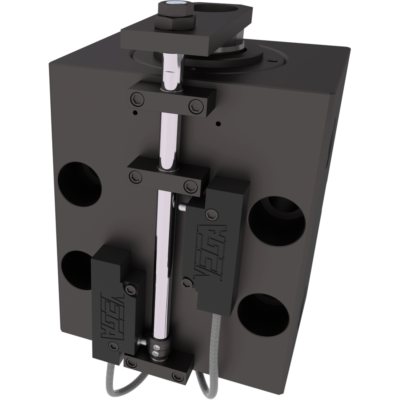
- V500CZ, designed for high-speed applications with optimized hydraulic flow and greater flexibility in stroke and configuration.
- V450CM-YES, a compact hydraulic cylinder designed to provide an excellent balance between performance, cost-effectiveness and standardization.
This recommendation originated from the engineering discussion held during the video meeting and complemented the technical analysis documented in the email exchange.
Why V500CZ Was Considered
The V500CZ was developed as the natural evolution of the V450CM family.
Besides offering compatibility with many industry-standard interfaces, it provides greater flexibility for long and intermediate strokes, optional cushioning and high-speed performance, making it particularly suitable for demanding automotive mold applications.
Rather than modifying an existing cylinder to satisfy a specific hydraulic requirement, selecting a cylinder already optimized for higher oil flow often provides a more robust engineering solution.
Why V450CM-YES Was Also Recommended
Not every application requires the maximum hydraulic performance available.
For projects where standardization, competitive cost and reliable performance are equally important, the V450CM-YES represents an excellent alternative.
It maintains the compact architecture of the V450 family while offering an economical solution for many injection mold applications.
This demonstrates another important engineering principle.
The best hydraulic cylinder is not always the most sophisticated one.
It is the one that best matches the technical and economic requirements of the project.
Engineering Is About Selecting the Right Product
One of the most valuable lessons from this case is that engineering does not always involve creating custom solutions.
In many situations, selecting a different product family provides greater benefits than modifying an existing design.
For Faurecia, choosing either the V500CZ or the V450CM-YES offered several advantages:
- optimized hydraulic performance;
- improved oil flow characteristics;
- faster cylinder response;
- standardized components;
- reduced manufacturing complexity;
- easier maintenance;
- shorter delivery times;
- lower total cost of ownership.
Instead of adapting the cylinder to fit the specification, Vega proposed selecting the cylinder that was already engineered for the application.
Hydraulic Performance Depends on the Entire Cylinder
This engineering case clearly demonstrates that hydraulic performance is determined by far more than the diameter of the oil ports.
Performance depends on the interaction between:
- hydraulic circuit design;
- pump capacity;
- manifold geometry;
- internal oil passages;
- cylinder construction;
- stroke length;
- moving mass;
- hydraulic cylinder architecture.
For this reason, experienced engineers evaluate the complete hydraulic system before recommending design modifications.
Conclusion
The discussion between Faurecia and the Vega Technical Department began with a simple question about 5 mm versus 8 mm hydraulic ports.
It ended with a much broader engineering conclusion.
Hydraulic performance cannot be optimized by considering port diameter alone.
Instead, the most effective solution often consists of selecting the hydraulic cylinder that has already been engineered for the required application.
Following the subsequent technical video meeting, the Vega Engineering Team recommended the adoption of either the V500CZ or the V450CM-YES, demonstrating that successful engineering is based on selecting the right technology rather than simply modifying individual dimensions.
Ultimately, this case reminds mold designers of an important principle:
The fastest hydraulic cylinder is not necessarily the one with the largest oil ports—it is the one whose entire hydraulic design has been optimized for the application.
Related Articles (icvega.com)
- https://www.icvega.com/products/v500-cz-block-cylinder-zylinder
- https://www.icvega.com/products/block-cylinders-compatibility
- https://www.icvega.com/support/mold-cycle-vs-cylinder-speed
- https://www.icvega.com/support/a-safer-approach-to-oil-pressure-in-compact-hydraulic-cylinders
- https://www.icvega.com/support/why-should-bigger-bore-sizes-have-lower-working-pressures
- https://www.icvega.com/support/which-fluids-are-best-for-a-hydraulic-cylinder
- https://www.icvega.com/support/choosing-the-right-cylinder-stroke
- https://www.icvega.com/support/how-to-find-the-right-cylinder-or-accessory